STV news strike takes election coverage off air

 BBC
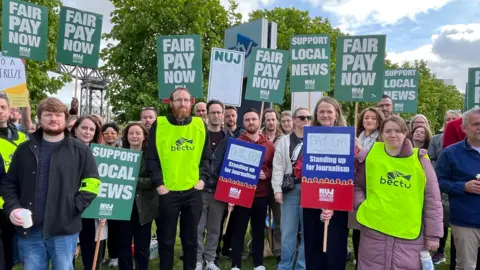
BBCSTV's election and news coverage has been taken off air after journalists and technical staff at STV walked out in a 24-hour strike over pay.
The action means there will be no Scottish news bulletins or television coverage of the Scottish election results.
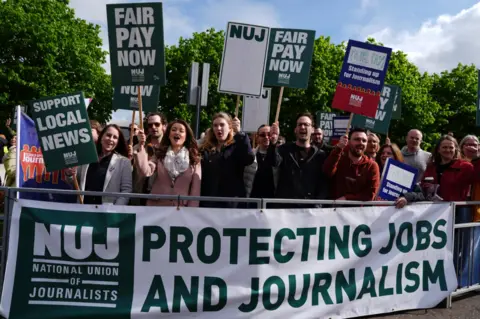
The National Union of Journalists (NUJ) and broadcast union BECTU are protesting about a pay freeze at the company.
STV says the freeze is needed to help the company's finances and protect jobs.
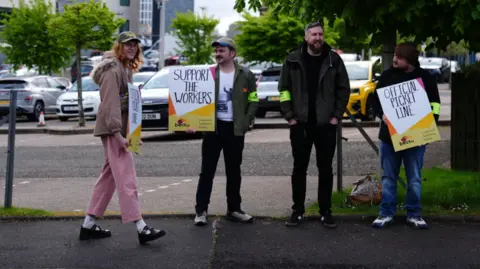
Several familiar faces joined a protest outside STV's Glasgow headquarters on Friday morning.
They included sports presenter Raman Bhardwaj and one of the station's main news reporters, Gordon Chree.
One prominent member of the news team told BBC Scotland they would rather be covering the election than striking, but they felt there was no alternative.
 PA Media
"The fact staff are willing to go ahead with the strike shows how angry we all are," they said.
"It is an awful situation. We're being asked to do more with fewer people and accept a pay cut with absolutely no sign of compassion from management."
A number of staff at STV have left recently as the company has reshaped its news operation.
It proposes to show less purely local news and end the separate news service for the north of Scotland, which is the legacy of the former Grampian TV service.
Regulator Ofcom is due to say whether it will allow the changes to the company's news commitments within the next few weeks.
In a memo to staff, chief executive Rufus Radcliffe defended the pay freeze but acknowledged that the decision to strike would not have been taken lightly.
He said a pay rise in 2026 would be "fiscally irresponsible".
"With the redundancy programme largely completed we are now prioritising job security and delivering financial sustainability," he said.
"We decided that to make a salary award in 2026 would be fiscally irresponsible and potentially give rise to the need to identify further cost savings later this year, a situation I am firmly committed to seeking to avoid as we stabilise the business and return to growth."
STV - like other commercial broadcasters - has been hit by declining advertising revenue.
Last year, the share price fell badly after a profit warning. Although STV is one of the biggest brand names in Scotland, the company itself is currently only worth around £50m on the stock market.
Today's Scottish news bulletins and election coverage are being replaced by standby material and programmes being shown across the rest of the ITV network
The vast bulk of the planned schedule - and all advertising - is being shown as planned.
 PA Media
Nick McGowan-Lowe, the NUJ's Scottish organiser, blamed the strike on the "stubborness of STV management".
He claimed management at the company had shown an "indifference" to how overworked and underpaid he alleged the staff were.
Paul McManus, BECTU negotiations officer for Scotland, said: "Staff at STV have been left with no choice but to take this action.
"They are being asked to take a real terms pay cut against the backdrop of rocketing prices and when they are already overworked.
"As usual it is workers being asked to take the financial hit while STV seems able to find money to invest in other areas of the business."
TV regulator Ofcom told BBC Scotland News that STV will not breach its broadcasting licence requirements because of the strike.
This is because there is no specific requirement to provide Scottish election results coverage or a TV news service each and every day.
Ofcom also allows licence commitments to be missed in exceptional circumstances such as industrial disputes.
