Osprey fledglings see forest approach milestone

 Visit Kielder
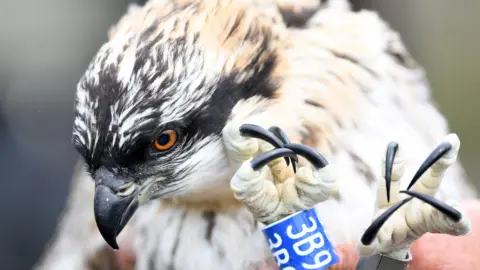
A forest is approaching a milestone of 150 fledged ospreys since their return.
In 2009, ospreys were born for the first time in Northumberland in centuries after conservationists built a nest in Kielder Forest.
Fast forward 17 years there are eight nests, with the forest celebrating a "record" year with eggs in each one.
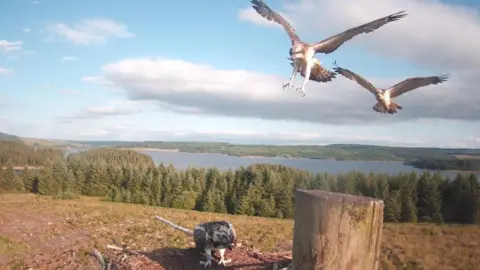
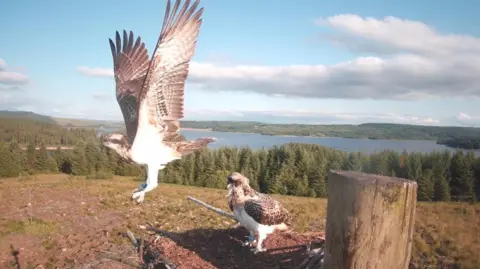
Kielder Water and Forest Park Development Trust director Liz Blair said three osprey chicks had fledged so far, with many more looking increasingly confident.
Last year only six chicks ultimately fledged, which was fewer than in previous years.
Factors including storms and predators can contribute towards a lower success rate.
 Visit Kielder
Ospreys are migratory birds and often spend winter in Africa, but were once found throughout the UK during the warmer months until they were driven to extinction as a breeding bird.
In the Victorian era, they then became a target for egg collectors and taxidermists.
They disappeared from England and Wales in 1847, then became extinct in Scotland in 1916.
 Visit Kielder
"We are looking at a milestone of 150 fledged ospreys in Kielder Forest since 2009," Blair said.
"We haven't introduced any new chicks from other areas, our little colony has all settled naturally."
The chicks this year have all been given names beginning with K, inspired by Northumberland forests, hills, hamlets and villages.
Among them are Kirknewton, Kirkharle and, of course, Kielder.
The recent calm weather in the forest has meant conditions have been trickier for the fledglings to navigate, Blair said.
"They like a little bit of wind under their wings to help them get off.
"So a lack of wind is hindering their confidence for lift off, so they do these little speculative jumps, but they often need a breeze to finally take the plunge."
Blair said "hopefully many more" of 2026's chicks were about to fly.
