Why is a replica Spanish galleon in the west of Scotland?

 BBC
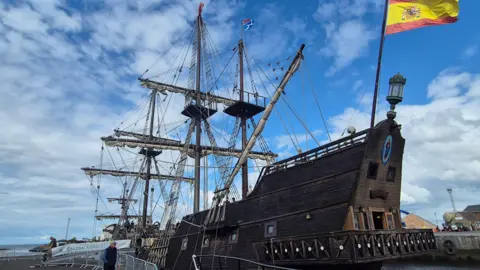
BBCThe waters at Ayr harbour commonly host commercial cargo ships and visits from the Waverley paddle steamer.
However for the past two weeks a very different sort of vessel has been berthed there - a replica of a 17th Century Spanish galleon, complete with national flag fluttering in the breeze.
The tall ship Galeón Andalucía, described as a floating museum by crew members, will depart Ayrshire on Monday, heading off to Tobermory on the Isle of Mull as its tour around Europe continues.
Not-for-profit organisation Nao Victoria Foundation are behind the 55m long boat, which was constructed in 2009 and is manned by cadets from the Spanish navy.
Vessels like the Andalucía were used to establish trade routes between Spain, the Philippines and America, and were therefore merchant ships - although the presence of cannons on board the replica offer a reminder they could defend themselves too.
Those cannons serve a different purpose on the Andalucía, as on a sunny morning various children are scampering over to get their pictures taken with them (and a few adults were doing the same).
For some of the crew, the purpose of the boat, which travels the world, is to help bring history to life.
"Not many people have been on a ship, especially one like this" says Eze Thomas, a 21-year-old marine engineer who has spent five months with the boat.
"Children love it, they're always keen to see the artillery deck. It's really important, especially in Spain - it's real history and real culture, and on here you can actually see how they [the sailors] lived."
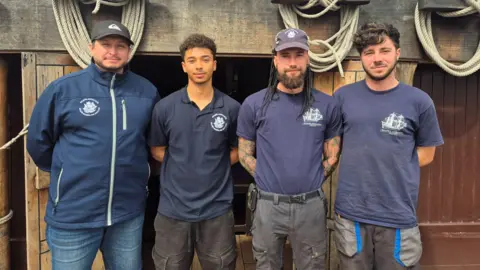
For Eze, the boat serves another, practical purpose - providing experience being at sea.
"You can see exactly how an old merchant ship used to be, but for us it's also experience. I'm a marine engineer and it works well for us to get days at sea. In Spain it's required to get at least nine months out at sea [when a cadet].
"It's hard work, but you meet wonderful people and I love it - I get to chat with people from different places and different cultures when showing the museum off too. It's both our life and our job."
The replica stops short of fully recreating life for a 17th Century sailor, though - the sleeping quarters have been modernised, meaning those on board do not have to clamber into hammocks, while the kitchen is up-to-date too.
Much of the ship, though, was constructed to similar specifications as those from hundreds of years ago.
"These ships travelled on spice routes, and the holds are huge - they could have spices, golds, silver down there," says Eze.
"As ships they would be smaller, and can manoeuvre better, than warships, so the cannons would only be used for self-defence."
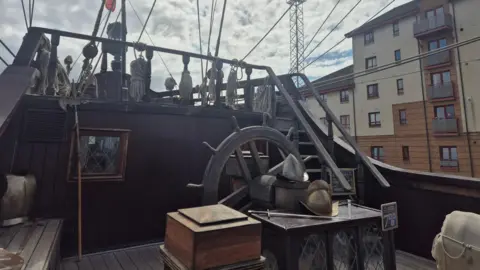
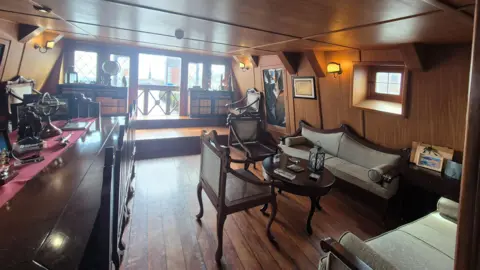
The ship includes recreations of the admiral's quarters, nautical instruments like the log - used to measure the speed of ships - and various plaques with historical information.
It took four years and 10 months to create, including a 16-month construction period.
Steady crowds have already visited the ship in Ayr, while it visited Oban earlier this year and will next arrive in Tobermory on 26 August.
However even a large galleon cannot get everything its own way.
The boat had to move out of its berth for one day while in Ayr, so that the Waverley - the world's last sea-going paddle steamer - could access the South Harbour at the port.
