The history and enduring appeal of the Major Oak

 Edwinstowe Historical Society
Sherwood Forest is perhaps most famous for being the haunt of legendary outlaws, but over the centuries it has also been an economic powerhouse, a military zone and a tourist attraction.
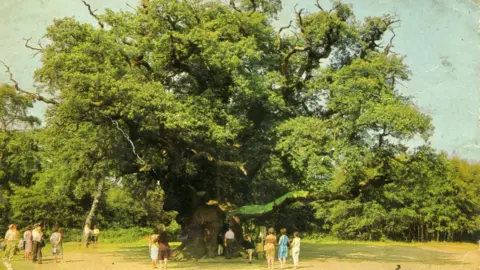
While it has seen many changes, one thing seemed constant - the Major Oak.
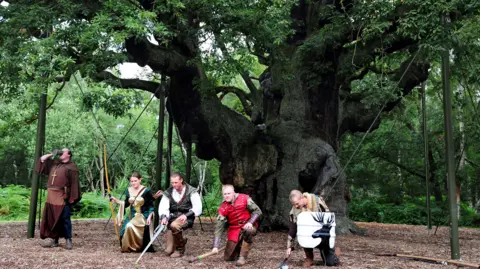
Estimated at between 800 and 1,200 years old, weighing about 23 tonnes, with a trunk circumference of 10m (33ft) and a canopy spread of 28m (92ft), it was the largest oak tree in the UK.
After experts said they believed the oak had died, a historian reflected on the role it played in the local and national story.
 Getty Images
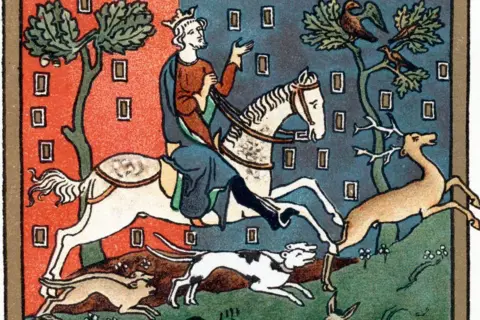
The first record of the forest is as "Sciryuda" in the 10th Century, which means "wood belonging to the Shire".
The earliest use of the name Sherwood Forest was in 1154, but the Major Oak was not individually noted until 1790.
Olwen Hawkes, chair of the Edwinstowe Historical Society, said: "It was surveyed by a Major Rooke, and it is from him it got the name, but was also often known as the Queen Oak or Cockpen Tree, as fighting cockerels were allegedly kept [in] its hollow trunk.
"Sherwood was first mentioned as a hunting forest for kings and nobles but it was also planted as a crop.
"Oak trees were very valuable.
"Sherwood timber was taken to repair Newark Castle during the English Civil War, it helped build St Paul's Cathedral, it repaired, and of course, it built the ships for the navy.
"Sherwood Forest was a big part of the story of the defeat of the Spanish Armada."
 Edwinstowe Historical Society
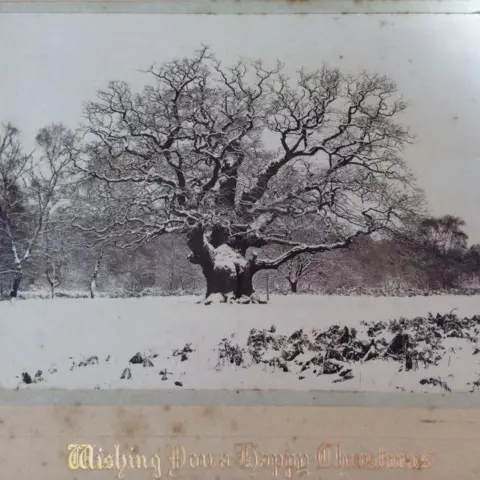
But the forest was also put to less constructive uses.
"We have records of hundreds of trees being sold for charcoal, which was used in forges and blacksmiths," Hawkes added.
"The money from this helped build the Dukeries, the grand stately homes like Thoresby, Welbeck and Rufford Abbey."
But this demand had an enormous impact on the forest.
In 1609, a survey listed 49,909 oaks in Sherwood, but by 1790, there were 10,117 remaining.
 Edwinstowe Historical Society
However, the attitude had started to change.
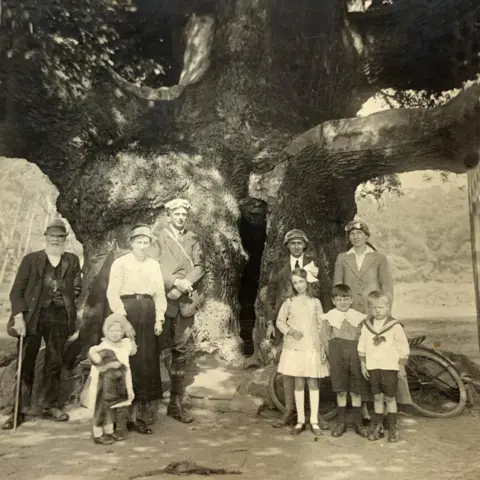
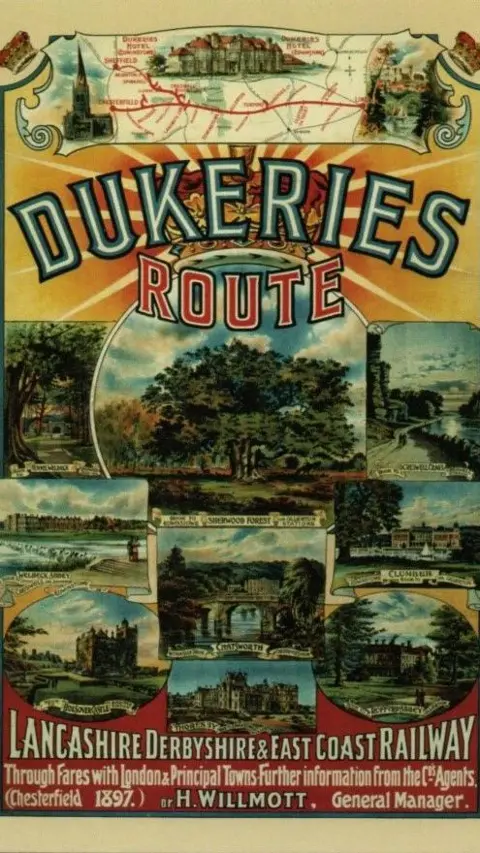
The Dukeries, which had done so much to exploit the area, started a new trend - tourism.
Hawkes said: "There would be carriages laid on for parties and guests.
"A railway station was built in Edwinstowe, with a quite palatial hotel opposite, mainly to bring hundreds of tourists to the area.
"When leisure travel became an option for more people, a parking area was built for the first buses, horse-drawn charabancs.
"The stories about Robin Hood are myth and legend but they gave the place a mystique and an appeal that has endured."
 Edwinstowe Historical Society
Edwinstowe railway station opened in December 1896 and between March and September the next year, it was used by 84,000 passengers, with the Major Oak featuring as the star attraction.
But just as tourism took off, the influence of war returned to Sherwood.
Hawkes said: "In both the first and second world wars, the forest was a site for training and ammunition storage.
"I remember tanks rolling across the roads and soldiers coming out of the trees if you went too far into the forest.
"It took a real effort by local people to get the military out and the forest was only fully handed back to the public in 1969."
 PA Media
The latest survey of the forest by current custodian, the RSPB, found there were only about 400 ancient oaks remaining, and now there is one fewer.
Experts believe the tree died following its first spring with no leaves this year.
The loss of the Major Oak is likely to be felt most keenly by those who lived close by.
Hawkes said: "I remember being taken to it by my teacher and climbing on it with all the other children.
"For countless families and many generations, a trip to the Major Oak was a cherished day out.
"The Major Oak was part of a Nottinghamshire childhood."
Listen to BBC Radio Nottingham on Sounds and follow BBC Nottingham on Facebook, on X, or on Instagram. Send your story ideas to eastmidsnews@bbc.co.uk or via WhatsApp on 0808 100 2210.
