Bonfire mosque replica treated as hate-motivated offence

 Pacemaker
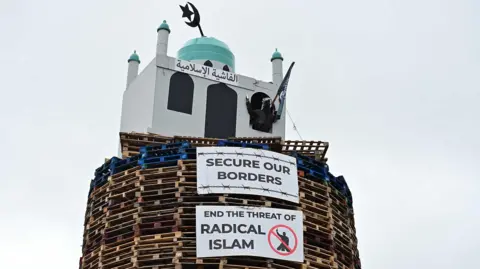
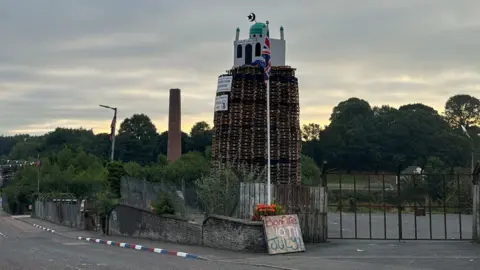
A replica of a mosque on top of a bonfire is being treated as a "hate-motivated criminal offence", police have said.
The bonfire, in Moygashel in County Tyrone, Northern Ireland, has featured other controversial displays in the past.
Police said a 56-year-old man had been arrested on suspicion of displaying threatening, abusive or insulting material which is intended to stir up hatred.
Kashif Akram from Belfast Islamic Centre said the display was distressing and insulting to people from his community.
In a statement, the Moygashel Bonfire Association said the bonfire combined cultural expression with political protest and that the display was not targeted at individuals but at "ideology and government policy".
'Abhorrent and unprecedented'
Analysis: BBC News NI crime and justice correspondent Julian O'Neill:
The police had anticipated something of this nature happening.
That said, the use of a replica of a mosque has been described as "abhorrent and unprecedented" and "a tipping point" in terms of a criminal offence and what has been seen on bonfires previously.
The police are considering next steps, while stating an investigation is continuing.
There had been an increased police presence in the area.
However, that did not stop the placement of the replica of a mosque on the bonfire.
It is suggested that this was done at a time when members of the community observed officers to be absent.
The PSNI are very mindful of how this looks – and by that they mean the burning, or potential burning, of a replica mosque, especially coming so soon after recent racially-motivated violence.
The counter-balance would likely be a consideration of whether any police action would escalate tensions in Moygashel or at other bonfire sites.
The senior police source said to me this would not be about the police being anti-loyalist culture.
This is squarely about what's on this bonfire.
'Deeply upsetting for Muslims across all of NI'
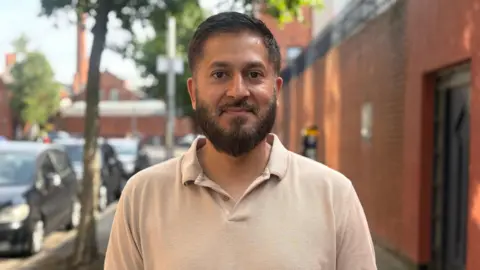
Akram told the BBC's Nolan Show that the replica of the mosque was deeply upsetting for Muslims in Northern Ireland.
He said he recognised that people had the right to celebrate culture and traditions but that this should not involve "another community or targeting their place of worship or identity".
Akram added that many Muslims were already "living with heightened anxiety" following racist attacks in Belfast and other parts of Northern Ireland.
These included riots in June after a man was injured in a knife attack in Belfast.
'Entirely wrong'
The chair of the Loyalist Communities Council David Campbell called the display "entirely wrong" and appealed to organisers to remove it.
He said the Twelfth of July festivities celebrates religious freedom.
Patrick Corrigan from Amnesty International called the display "a blatant attempt to stir up anti-Muslim hatred and intimidate local families".
The Archbishops of Armagh, Eamon Martin and John McDowell, said the effigy is "grossly offensive and raises tensions so soon after the unrest that destroyed property and severely impacted the lives of individuals and families".
In its statement, Moygashel Bonfire Association said the display might "shock, offend or outrage", but said those involved in making it were exercising their right to freedom of expression.
It said the replica of the mosque did not target any individual, adding: "Our opposition is not to people, but rather to ideology and government policy."
The group said the display focused on "an issue of significant public interest".
"If there was no uncontrolled illegal mass immigration, we would have no need to protest on this issue," the statement said.
Previous Moygashel controversies
It is not the first time Moygashel's annual bonfire has featured a contentious display.
In 2025, an effigy of refugees in a boat was placed on top of the bonfire and was set on fire when the bonfire was lit.
In 2024 a replica of a police car was burnt, while in 2023 a picture of the then Taoiseach (Irish prime minister) Leo Varadkar and an Irish flag were placed on the bonfire.
Bonfires are lit annually in some unionist areas across Northern Ireland in July to usher in the Twelfth of July, the main date in the parading season.
The majority are lit on 11 July, known as the Eleventh night.
The Twelfth commemorates the Battle of the Boyne in 1690 when the Protestant King William III defeated Catholic King James II.
'There is fear'
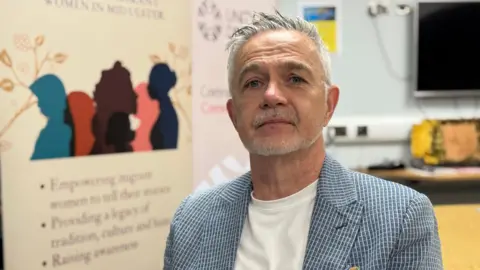
The CEO of First Steps Women's Centre in Dungannon, which is used by a number of women from migrant communities including Muslim women, said the bonfire display was appalling.
"My heart goes out to all the people who live in this area. Everybody I know is completely shocked and saddened and there is fear there as well," Michael McGoldrick said.
"What we've seen on this bonfire is a retrograde step."
What have politicians said?
The Justice Minister Naomi Long described the effigy as a "nauseating spectacle of hatred" and called on the people who built the bonfire to take it down.
Northern Ireland Secretary Hilary Benn said it was as a "sickening and cowardly act of intimidation".
Sinn Féin condemned it as "racist" and called on the PSNI to remove it.
The Democratic Unionist Party said the placing of flags, effigies or other items on bonfires is not part of the July tradition and "should not take place".
Social Democratic and Labour Party councillor for the area, Karol McQuade, said the mosque display was "vile, dangerous and deeply irresponsible".
Ulster Unionist Party leader, Jon Burrows, called for the "immediate removal of the offensive display".
Ron McDowell from the Traditional Unionist Voice said he did not condone the mosque effigy but he also would not call for it to be removed.
He said the mosque effigy was not aimed at all Muslims but was instead a protest against "radical Islam".
