Why huge housing plans are emerging across the West Midlands

 Getty Images
Plans for hundreds and even thousands of new homes have been emerging across the West Midlands in recent months.
Councils, developers and landowners have put forward proposals ranging from large extensions to existing communities, to entirely new settlements and major regeneration schemes.
Many have prompted fierce debate over where new housing should go and whether local infrastructure can cope.
Behind those proposals lie housing targets, local plans and difficult decisions about where future growth should take place.
Why are the numbers so big?
 LDRS
The scale of some recent proposals has attracted attention across the region.
In Walsall, plans have emerged for up to 900 homes at Yieldfields Farm, and up to 1,200 homes at Sandhills Farm.
A landowner has revived proposals for a new village of about 4,000 homes in Shropshire, while City of Wolverhampton Council has approved a city centre master plan that could accommodate 6,750 homes.
In Telford and Wrekin, an emerging Local Plan identifies land for more than 20,000 homes by 2041.
But councils are not simply deciding individual planning applications. Many are looking ahead 15 to 20 years, trying to identify enough land for future housing, jobs and infrastructure.
What is a local plan?
A local plan sets out where a council believes development should take place over a number of years.
It identifies land for housing, employment and infrastructure, and helps planners decide whether future applications should be approved.
Many of the major schemes currently being discussed across the West Midlands are linked to local plans or emerging local plans. Sites can be identified years before any planning application is submitted.
That means some of the biggest debates about future development happen long before construction begins.
 Getty Images
What happens without one?
Several councils argue that having an up-to-date Local Plan gives them greater control over where development takes place.
Shropshire Council is currently working on a replacement plan after withdrawing its previous version.
Earlier this year, councillors were told the authority was in a weaker position because it did not have an up-to-date plan in place and therefore had less control over some housing decisions.
The issue came into focus in Shawbury, where councillors were reminded they should favour sustainable development because the council did not yet have an updated Local Plan.
In Telford and Wrekin, planning chief Carolyn Healy argued the borough's proposed local plan would help organisations prepare for future growth.
"The plan gives certainty to partners like the NHS and utility providers so that they can plan knowing where growth will be," she said.
Why does green belt keep coming up?
Not every major housing proposal involves green belt land.
The plans for thousands of homes in Wolverhampton, for example, focus heavily on regeneration opportunities within the city.
But in other areas, particularly on the edges of towns and cities, green belt sites have become part of the debate because they can offer large areas of land capable of accommodating significant numbers of homes.
Two years ago, the then-Housing Secretary Angela Rayner said England was facing "the most acute housing crisis in living memory" as the government unveiled planning reforms designed to increase housebuilding and make it easier to develop some lower-quality green belt land.
Campaigners, however, argue brownfield sites - land previously developed or built on - should be prioritised before green belt land is considered.
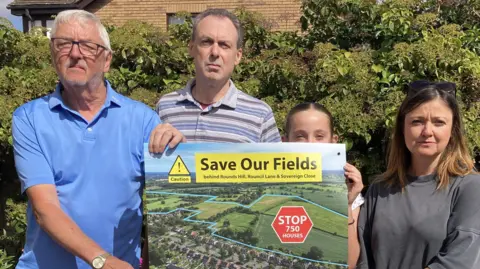
Why are people objecting?
While each proposal is different, the concerns are often remarkably similar.
Residents frequently raise questions about traffic, school places, GP appointments, pressure on local services and whether infrastructure will keep pace with housing growth.
At a protest against plans around Eccleshall, resident Martin Peet urged developers to "leave our countryside alone" and argued there were enough brownfield sites available for housing.
In Kingswinford, campaigner Steven Cutler warned proposed developments would create "massive problems" because "the infrastructure is just not there".
Others fear large developments could permanently alter the character of towns and villages or reduce the gap between neighbouring communities.
Supporters of development, meanwhile, argue more homes are needed, particularly for younger people struggling to get onto the housing ladder, with developers required, through what are called section 106 agreements, to pay towards offsetting the impact of a housing project.
Follow BBC Birmingham on BBC Sounds, Facebook, X and Instagram.
