I was accused of using AI in my dissertation but I wrote it all myself

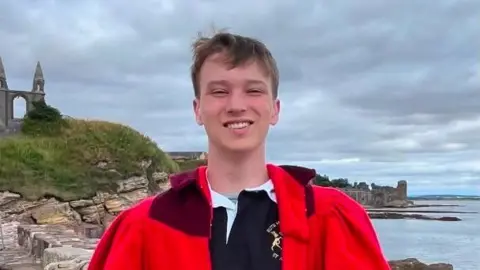 Harrison Sharples
In August last year, medical student Harrison Sharples was "shocked" to receive an academic misconduct alert saying the dissertation he had spent his summer writing had been flagged as being AI-generated.
The 20-year-old University of St Andrews student could not understand how the markers had thought the work wasn't his own.
He told the BBC he hadn't even considered using AI as he had plenty of time to complete the assignment and had enjoyed writing it.
"I tend to honestly just forget that it's an option for me to use," he said.
According to the university his dissertation on the impact of play therapy on reducing anxiety in hospitalised children was assessed by two human markers.
One of them raised concerns over the potential use of AI.
The marker's notes - seen by the BBC - raise concerns about the "polished/uniform tone" of the work, noting the "consistent flawless grammar and similar sentence structure with no variation in style".
The notes also mention a "formulaic paragraph structure that follows a typical AI pattern of 'general claim, the example/result, and conclusion'."
Other observations point to repetitive phrasing and a lack of "nuanced critique" as well as a high usage of "em" dashes, a type of punctuation thought to be favoured by AI models.
 Harrison Sharples
As a result of the marker's concerns, Harrison was given a date to attend a virtual hearing with a panel from the university's school of medicine to defend his case.
He says he prepared well to provide the evidence and defend his case but, on the day, the link to the virtual hearing did not arrive on time.
After emailing the university, he received the link five minutes after the start time for the hearing.
"At this point, I'm extremely nervous about it because I'm thinking this is my one chance to prove myself, to redeem myself - and they're going to think that I'm just not showing up," he said.
During the half-hour hearing the student was asked to define the medical terms he used in his dissertation, which Harrison says was a surprise.
"I was so shook up about my start to the hearing," he said.
"I don't think I represented myself completely well."
A week later, he received the decision that the allegations of AI usage had been upheld.
This meant his mark would be capped at seven, just enough to pass, and the matter may have to be declared when applying to the GMC for provisional registration.
 Harrison Sharples
"That was the thing which pushed me to appeal," Harrison said.
The university accepted the appeal, recognising that the late arrival of the link affected his ability to present his case. He was invited to attend another hearing in mid-November.
Harrison says that it was held in a similar way to the first one, except this time the panel's questions were on his approach to writing.
"It went a lot smoother," he said.
"I think I was a lot more clear in putting across my points."
This time the university decided not to uphold the allegations.
"I felt so relieved," Harrison said.
"It would just be really stressful to constantly have that strike on my record."
He eventually got his full mark for his dissertation and the case will not impact his professional record. But Harrison says he was consumed by worries throughout the whole of that semester and it affected his studies.
He says he had a support network of friends, girlfriend and family from back home in Manchester but the situation impacted him on "an inside level".
"There was so much time when I just didn't know what was happening and I think that is what caused me the most worry and stress about it," he said.
"It was so big in my mind it didn't allow me to think about anything else. That's why I neglected my studies because I just got pushed out of operating space in my brain."
Harrison had to defer his exams for a semester and sit them in the middle of the summer. As a result, his graduation has been delayed until December.
"I would be graduating if it wasn't for what happened to me," he said.
 Francesca Morrison
AI ethics advisor Sidrah Hassan told the BBC that AI large language models (LLMs) are progressing "at light speed" and it is difficult for institutions to keep up.
"There are tell-tale signs that AI systems tend to use in their outputs that can help you figure out if this is AI-generated or human-generated," she said.
But existing AI detection tools are not robust and have a high error rate, she said.
Human markers can flag them if they are unsure but Hassan says that catching students out may not be the future-proof solution.
"I think that's not the point," she said. "We should be changing the way we test them because as humans we'll always try to find the easy way to do something."
A statement from the University of St Andrews said : "We would not comment on the details of individual cases, but can confirm that, in this instance, the decision to uphold the student's appeal related solely to a procedural issue concerning the arrangements for the hearing.
"We are working both within the university and across the sector to support the responsible use of AI in academic work, including in medicine."
