Charity campaign to tackle veteran mental health

 BBC
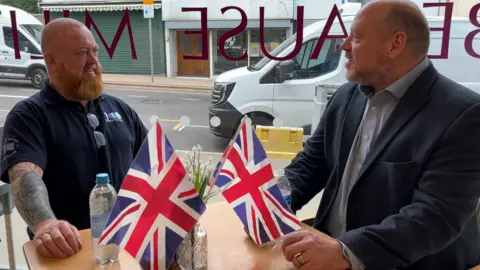
BBCA military mental health charity is raising money to help train more members to provide therapy to fellow veterans via a campaign called The 10.
Veterans at Ease, based across the North East, wants to enlist 10 of their regular users on a four-year psychotherapy course to give them the skills to help former armed forces personnel with their mental health.
The charity was founded in September 2010, by Garreth Murrell, following his own struggles with post-traumatic stress disorder (PTSD) after leaving the forces.
The organisation offers "free, open-ended, psychological therapy" to those who have left the armed forces, serving soldiers, blue-light services, and their families.
Murrell set up the charity after suffering undiagnosed PTSD for 14 years.
He found that a number of therapies did not work for him, but then he discovered neurolinguistic psychotherapy, which he has now become qualified to deliver to others.
When asked to describe how life changing the therapy was for him personally, he replied: "I'm still here."
At his lowest point, the former soldier recalled sitting in his living room and being faced with three options: to pick up the phone and make an appointment with a therapist; to pack a bag, leave home and sign into Durham Hospital because he felt he was "genuinely going insane"; or to end his life.
He picked up the phone.
Now he hopes others will do the same.
- If you have been affected by any of the issues raised in this story, information and support can be found at the BBC's Action Line.
Murrell said one of the charity's "unique selling points" is the fact their therapists come from the armed forces community.
He believes fellow veterans, who can understand and relate to the life experiences of other armed forces members, provide the most beneficial support.
"If you're a veteran who is suffering, knowing that person has also served means you don't have to change your language and explain things - and on top of that you've got the same lived experience, potentially."
Since 2010 the charity, which currently has four therapists - all from the armed forces community, has helped 475 men and women.
In order to train 10 new psychotherapists, the organisation needs to raise £200,000.
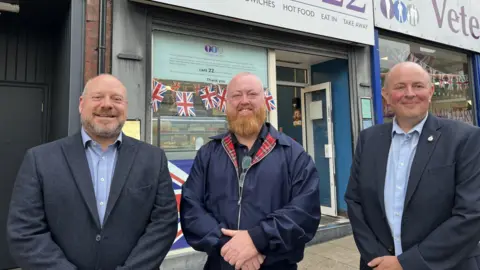
Murrell said the work also helps veterans transition back into the civilian world, by giving them a "stable state of mind".
He said many find the culture and language is different when returning back to the community, and pathways to things such as setting up a mortgage or bills are "completely different to how it is achieved in the military".
Mark Appleby, from County Durham, joined the military in 1990, and left in 2007, after serving for 17 years, but "unbeknownst" to him, he became depressed.
"I didn't have a clue what was going on. I didn't know what was happening with my life, why I was falling apart - and I was falling apart...completely".
He had already been on various mental health support courses, and found nothing had helped, when a friend mentioned Veterans at Ease.
In 2017 he got in touch and went to meet Murrell.
Appleby said he had struggled readjusting to civilian life when he left the military, and couldn't find anyone who could relate to his experience.
"I didn't have a clue I was depressed until it was nearly too late one night - then I thought, you've got to get some help".
He said speaking with another veteran made communication a lot easier, and the therapy worked.
He has since taken qualifications so he too can help other former military personnel.
Andrew Carr, from County Durham, served from 1992 to 2014, he was diagnosed with PTSD in 2024 and was signposted to Veterans at Ease.
He said reaching out and asking for help was one of the hardest things he had had to do, but receiving therapy was "a revelation" and it put everything into context for him.
He has described the charity as "invaluable" and has credited it with changing his life.
