Dry weather causing a host of problems for farmers

 Amanda White/BBC
A farmer has told of his fears about further crop fires, with fields so dry that a single spark could start a blaze.
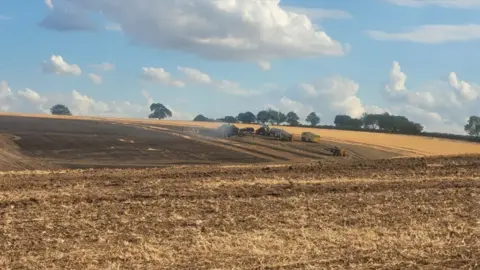
There have been numerous farmland blazes across the country in recent weeks, including a combine harvester fire in Burnham, North Lincolnshire, this week.
It is just one of the threats from the hot and dry weather, with yields falling and a large fall in crop moisture levels.
Richard Beachell, who farms in Bainton, near Driffield, East Yorkshire, said there was "always that nagging thought in the back of your mind that one spark or one bit of dust sets on fire and your machine's gone and then you're out of action".
Farmers are already seeing bills for damage running into millions of pounds.
Beachell said he was remaining vigilant in servicing his combine and having water bowsers and fire extinguishers on hand.
His farm has not had a fire, but he said he had seen "big black plumes of smoke" on neighbouring land.
"You think, 'Yeah, that's another one gone... a combine harvester, a baler, a tractor or just a stubble fire'."
During the incident in Burnham, smoke was seen from the A15 and the A180, and across the Humber Estuary in Hull. Six fire engines went to the scene and it took a couple of hours to put out. It destroyed 31 acres.
"The combine harvester was lost but fortunately nobody was injured," said Humberside Fire and Rescue Service station manager Jon Smyth, who added that the situation was putting pressure on firefighters.
"The period of dry weather without any rain has had a significant impact on the fire and rescue service," he said.
"We are out a lot, and our neighbouring fire and rescue services have ongoing incidents across the UK."
Henry Moreton, Lincolnshire chairman of the National Farmers Union, said the union's insurance assessor had looked at five combine and two baler fires in the past week.
"We've probably lost between 15 and 20 combines and probably six or seven balers in the last six weeks, so that's a lot of money's-worth of equipment just burnt out," he said.
"The machine can be anywhere between £500,000 and £1m. But it's the actual crop you're combining as well, and [a fire] could take 50, 60 acres out in less than 25 minutes. It could take out the neighbour's crop."
Moreton urged his fellow farmers to make sure there was nothing on their machinery that was smouldering – and to take care of themselves.
"I know it's your kit and it's your pride and joy out there, but please make sure you're safe. A combine can be replaced. A person cannot," he said.
The weather has also had an impact on the crops themselves.
Beachell said: "The harvest has been very early. We've never finished combining in July before, but [this year] we finished on the last day of July."
His yield was down 10%, "but further south, they've had yields of 50% less".
"There is a problem there... there's going to be a shortage of grain."
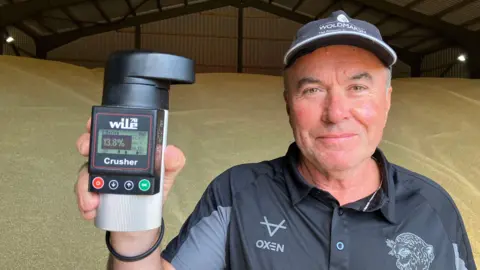
Moisture levels have fallen sharply and Beachell said his crop was very dry when it reached the grain store.
"Normally we're combining [with moisture levels] at 17% or 18%... we're coming in at 13.8%," he said.
The wider farming community shared their concerns about the impact on harvests generally, according to the NFU's Moreton.
"In my lifetime, I've never been actually harvesting this early. And it's a growing trend and we're getting less and less water," he said.
"We're looking to change our cropping plans now. We're going to try to grow different varieties of wheat that are a bit more drought resistant," he said.
Listen to highlights from Hull and East YorkshireorLincolnshireon BBC Sounds, and watch thelatest episode of Look North.
Download the BBC News app from the App Storefor iPhone and iPad orGoogle Play for Android devices
