Met chief visits mosque in alleged terror plot

 BBC
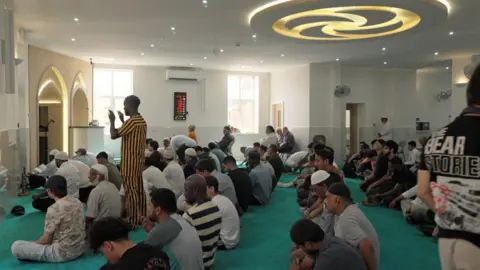
BBCMetropolitan Police Commissioner Sir Mark Rowley has said the force is "doubling down" on efforts to protect communities from hate crimes, as he visited a south London mosque at the centre of an alleged terror plot.
Earlier this week, a 14-year-old boy was charged with preparing acts of terrorism aimed at two mosques in Sutton.
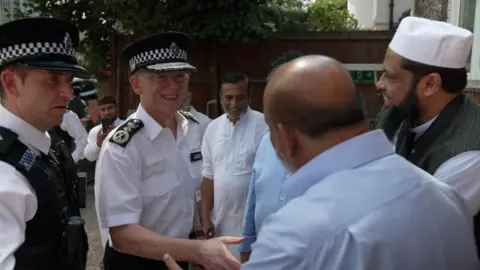
Sir Mark met representatives of the Sutton Central Mosque following Friday prayers to reassure worshippers and show "determination in fighting hate crime".
He told the BBC this was among a number of similar plots the Met Police had recently foiled and that the force had its "work cut out" amid current terror threats against "many different communities".
The boy accused of plotting an attack was allegedly planning to target the two mosques on 28 August.
The child, who cannot be named for legal reasons, is also charged with racially aggravated damage to property.
He denied the charges at Westminster Magistrates' court on Thursday and will appear at the Old Bailey in August.
During his visit to the mosque, Sir Mark said: "It's important for me to be here today in Sutton with the Muslim community, partly showing our determination in fighting hate crime and protecting them and partly to hear their reflections and look at what more we can do."
He said that since the alleged plot had been foiled, police patrols had been deployed to protect worshippers.
"They're seeing at the moment increased presence around mosques here and elsewhere, just like we've done recently for Jewish [people] in other communities.
"And we'll keep doubling down on this because it matters."
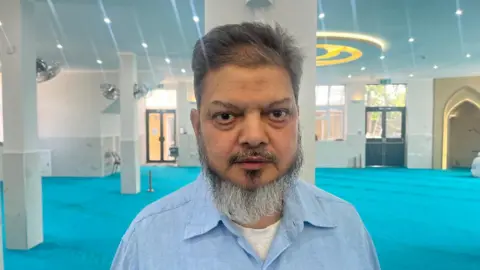
Moin Uddin, the mosque's treasurer, said he felt "very scared" when he found out about the alleged plot.
He told the BBC that since it had come to light, he believed local Muslims had been increasingly targeted with hatred.
One man, a doctor, recently described being followed by a cyclist and verbally abused, Uddin said.
"He had to rush to come into the mosque because he was scared, because this guy was on his bike with a dark cloth on his face following him and calling him and he was very scared."
Another worshipper who regularly cycles from Cheam was spat at and sworn at as he made his way to the mosque, Uddin said.
"People are worried, very worried."
The mosque's general secretary Mohammed Ali Sayestha agrees that worshippers have been shaken up.
"They are feeling very frightened. A lot of them are vulnerable and elderly, 60-year-olds, 70-year-olds, and young children.
"People are frightened to bring their children here for prayer."
He said he was glad more police officers were patrolling but said more education was needed to eradicate racial hatred.
According to Met Police data, 1,636 instances of anti-Muslim hate crime were recorded in London over the past 12 months - an increase of 31.4% on the previous year.
In Sutton, there were 35 instances of anti-Muslim hate crime in that period, up 119% annually.
According to the figures, the Met has had 145 positive outcomes for anti-Muslim hate crimes, up 76.8% compared with the previous year.
Sir Mark said: "We're living in difficult times where the threats against many different communities from different terrorist groups is deeply troubling.
"We're in times where there's high levels of hate crime that's driven by an online world that monetises hatred, the extremes of public debate which license hatred, and hostile states like Iran and Russia which encourage hatred on the street."
Listen to the best of BBC Radio London on Sounds and follow BBC London on Facebook, X and Instagram. Send your story ideas to hello.bbclondon@bbc.co.uk
