Baby was garroted and hidden under floor - coroner

 BBC
BBCA baby found beneath floorboards and wrapped in a 1910 newspaper was probably garroted shortly after birth, a coroner has said.
The skeleton of the full-term boy was discovered during the renovation of a building on Bishop Auckland's Fore Bondgate in July 2024.
A piece of twine wrapped around his neck raised suspicions for detectives, County Durham and Darlington Coroner Crispin Oliver heard.
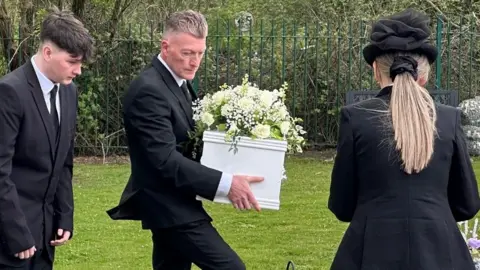
After concluding it was most likely a homicide, Oliver said it was a "very sad and singular case". The boy, named Baby Auckland by authorities, has been buried in Bishop Auckland Town Cemetery.
His date of death was listed as 29 July 2024, the day he was discovered.
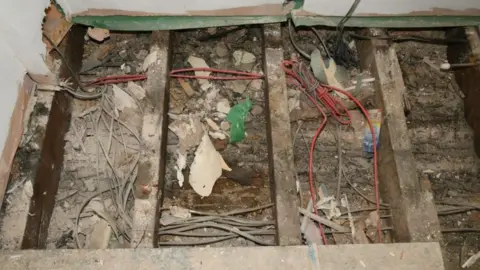
The inquest in Crook heard the building's owner, Peter Moody, was pulling up floorboards in the second floor living room when he saw an object wrapped in old brown paper.
He picked it up believing it to be a ball, but then "took a look and thought this is a baby," he said in a statement.
He could see a skull, bones and "the little feet", Moody said, adding he also noticed a piece of "garden twine" wrapped around the baby's neck.
 Durham Police
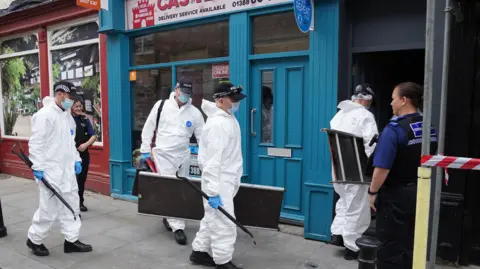
Durham Police immediately launched an investigation, the inquest heard.
Det Ch Insp Mel Sutherland said forensic anthropologist Dr Micol Zuppello worked for several days to "painstakingly extract the body", with all but the tip of a toe and some small eye socket bones recovered.
Zuppello concluded the child was a full-term baby of between 38 and 40 weeks development and had been placed face down.
Sutherland said his aim was to identify the baby, what happened to him and when he was placed under the floorboards.
"We had quite a lot to look at with not much to go on," he said.
Acid testing of the child's teeth, a technique developed by the universities of Durham and Bristol, coupled with DNA analysis concluded the child was most likely male, the inquest heard.
 Durham Police
Radio carbon dating found the boy dated from any time between 1655 and the start of the nuclear era 300 years later, the coroner heard.
Forensic pathologist Dr Louise Mulcahy said due to the limited remains, it was impossible to test if the child had any natural diseases or if he had been poisoned.
The skeleton showed no signs of traumatic injury, she said, and the cause of death was deemed to be "unascertained".
It was also not possible to determine if the child had been alive or was stillborn, the inquest heard.
Mulcahy could not say if the 3ft (1m)-long piece of twine, which had been wrapped three times round the child's neck, knotted and then looped round again, would have been tied tightly or loosely.
Sutherland said investigations continued to try and determine when the baby was placed beneath the floorboards.
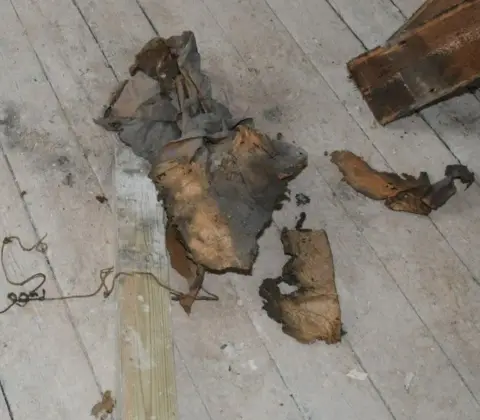
He said the building was built in about 1890 and the child was wrapped in an edition of The Umpire from Sunday 19 June 1910.
The detective said the "most likely scenario" was the baby came from about the date of the paper.
Investigators also looked to see if they could find living or deceased relatives through official DNA databases but none came up, the inquest heard.
Two sisters came forward to say they believed they might have been related to a servant working at the building at the time, but they were found not to be a DNA match to the boy, the inquest heard.
 PA Media
Sutherland said they also considered using genetic genealogy, databases of people who had voluntarily given DNA to trace relatives and family histories, but that was not usually allowed in the UK.
"It was assessed we wouldn't get to the identification of Baby Auckland even if we used that technique," Sutherland told the coroner, adding: "We would still be some generations off."
Officers also looked into getting a knot expert to examine the twine, but the nearest was in the Netherlands and the cost would be too expensive and the findings unlikely to be of much use, he said.
Sutherland told the coroner he was not aware of any religious practices or midwifery techniques from the time which would have involved the tying of string around a child's neck.
The detective said the twine was only around the boy's neck and appeared to have been deliberately placed there.
"I would ask why you would do that to a child who is already deceased?" he added.
 Durham Police
Oliver said it was unusual in the 21st Century to find it so difficult to answer all the coroner's key questions, namely who the deceased was, when and where they died and how they came by their death.
"This a very sad and singular case," he said, adding the police had "left no stone unturned".
The coroner said the "critical piece of evidence" was the twine and it "seemed unlikely" it would have been tied to a baby who was either stillborn or died of natural cases.
He said the "most likely explanation" was a "person in a position to care for him while he was most vulnerable... took the decision to end his life by means of strangulation using twine as a garrote".
"This was a homicide," the coroner said, with the baby never officially recorded as existing and "disposed of by means of concealment".
He also said it most likely happened in or around 1910.
"Clearly this was a terrible thing that happened to a defenceless infant," Oliver said, but he added it was "heart-warming" to see how people had "stepped up to do the right thing" after he was found.
