Finucane inquiry to consider 'extent killers were assisted by state'

 Pacemaker
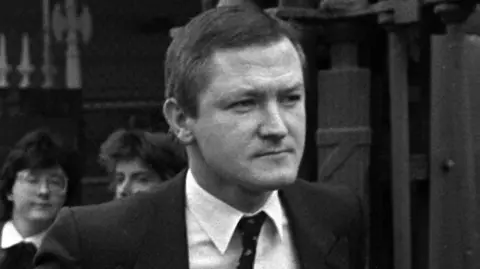
The Pat Finucane inquiry has heard that the "core concern at the heart of his murder" was the "extent to which his killers were encouraged, assisted, protected or directed by the state".
In his opening statement, counsel to the inquiry, Matthew Hill, said there was "no more serious question" in a society governed by the rule of law.
The 39-year-old solicitor was shot dead at his home in north Belfast by loyalist paramilitaries in front of his wife and children in February 1989.
Several examinations of the case have found evidence of state collusion.
On the second day of hearings, the inquiry heard an overview of "publicly available" material relating to what was one of the most controversial killings during the Troubles.
Hill set out what is currently known about the lawyer's murder and referred to previous reviews and investigations, including lawyer Sir Desmond De Silva's report from 2012.
"Sir Desmond's overall assessment was that there had been collusion in the murder of Patrick Finucane, a finding the government has accepted and is reflected in our terms of reference," he said.
Hill also outlined the involvement of Army and RUC agents in the murder and said Sir Desmond De Silva "recognised there was in his own words 'a broad spectrum of possible relationships between paramilitary figures and members of the security forces'".
Inquiry will examine role played Army agent
The inquiry, which formally opened in June, will consider relationships between those who carried out the killing and the security forces.
It will also examine the role played by Army agent Brian Nelson who was found by Sir Desmond to have "been knowingly involved and actively involved in targeting Patrick Finucane, despite his protestations to the contrary," the inquiry heard.
Hill also told the inquiry "the alleged direct culpability of a RUC officer or RUC officers in the decision to murder Patrick Finucane is a matter that this inquiry will examine and will examine thoroughly".
He said Sir Desmond found that "a police or police officers suggested to a loyalist paramilitary that he should murder Patrick Finucane".
Hill said the inquiry must also consider a "stark and disturbing explanation" that the interaction between the security forces and the UDA "were not nebulous, but the consequence of a deliberate and directed action to use the UDA as a proxy to murder a lawyer who had incurred the enmity of the state".
Hill said the inquiry would also examine the effect of Finucane's murder "on his family and friends, on his colleagues and those who continue to practice".
Finucane was described as a "ground breaking lawyer who developed law and the role of law, in a time of conflict".
Hill said Finucane's work was "not incidental" to his murder and added "on Sir Desmond's analysis, it was what led others to kill him".
What has happened so far?
The inquiry held its first public hearing in Belfast in June.
He said the inquiry would build on previous investigations into the murder, while remaining "independent and impartial".
A lawyer representing the government repeated a previous apology to the Finucane family for state collusion in the murder.
The Finucane family's lawyer, Danny Friedman KC, said it was essential to establish the "fullest possible account of the facts".
He said the identity of those who colluded and the precise nature of the help they provided before, during and after the murder had never been publicly disclosed.
Sir Gary has not set a timescale for completing the inquiry, but has said it will ultimately make findings of fact and recommendations.
Who was Pat Finucane?
 Pacemaker
He also represented loyalists.
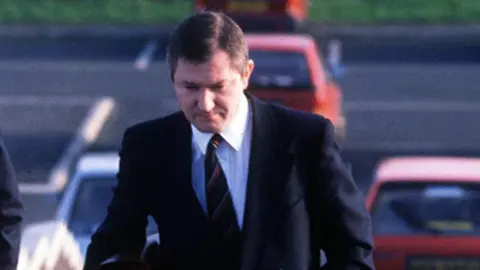
In February 1989, he was shot 14 times by two gunmen at his family home in north Belfast.
His wife Geraldine was also wounded.
One of his sons is the Sinn Féin MP for Belfast North, John Finucane.
At an inquest into his death, police rejected claims that Pat Finucane was a member of the IRA.
In 2012, Sir Desmond de Silva's report into the murder found there was state agent involvement and that police had failed to act on threat intelligence concerning Mr Finucane.
Why is there a public inquiry?
The UK government announced the independent public inquiry in September 2024 following a decades-long campaign by the Finucane family.
The then Northern Ireland Secretary Hilary Benn said previous UK government commitments to establish an inquiry remained unfulfilled.
He said it was for this "exceptional reason" that an independent inquiry would be established under the Inquiries Act 2005.
In 2019, the Supreme Court ruled that previous investigations into the murder had not met the procedural requirements of Article 2 of the European Convention on Human Rights.
The inquiry's terms of reference were published in March 2026, setting out its task of investigating the circumstances of Mr Finucane's death, particularly the role of the state.
