Recycling precious metals from discarded gadgets

 David Macmillan/BBC
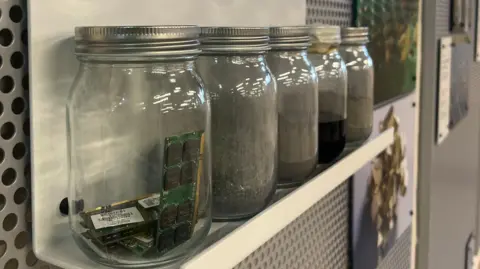
A Teesside business will use "urban mining" to recycle precious metals from discarded gadgets.
The DEScycle demonstration plant will recover gold, silver, copper and palladium from products like laptops and mobile phones.
The metals are crucial to the production of consumer electronics, cars and the hardware needed in AI data centres.
It comes after the government announced a £50m investment plan at The Wilton Centre, in Redcar, aimed at securing the UK's supply and becoming less reliant on imports.
DEScycle's co-founder and chief commercial officer Fred White said its mission was to "transform domestic waste streams into sovereign supply".
"We call this concept urban mining," he explained.
"The UK is geology poor but actually waste rich, we produce one of the highest amounts of electronic waste globally - phones, laptops, televisions, even things like fridges and toys.
"All of those devices contain valuable metals like copper, tin, silver and gold - these are critical resources and they mostly end up in landfill."
The government's Critical Minerals Strategy sets an ambition for recycling to meet 20% of annual UK critical mineral demand by 2035.
 David Macmillan/BBC
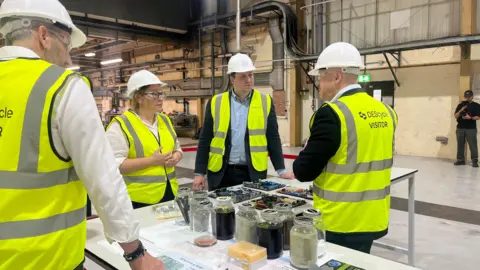
A liquid salt is used to dissolve the metals, before chemical and electrical processes are used to reform it again.
The technique, using solvent chemistry, was originally pioneered in an attempt to help archaeologists.
"It started with fossils," said co-founder and chief technology officer Rob Harris.
"They were looking at non-destructive ways to recover coatings of gold from their fossils.
"It worked very, very effectively and that's where it sat for a while, until some realised it had bigger use cases than just removing gold from fossils."
New Industrial Revolution
Another firm based at the Wilton Centre, Seloxium, extracts precious materials from waste water.
Projects to process lithium and recycle EV batteries are also being developed in the area.
Politicians have said it strengthens Teesside's claim to be at the heart of a new Industrial Revolution, involving clean energy, advanced manufacturing and digital technology.
"We have such an important background in chemical processing, that we are the best place to come for any of these new modern technologies," said Labour MP for Redcar Anna Turley.
"We have the expertise, we have the workforce, we have the skills."
Conservative Tees Valley Mayor Ben Houchen said Teesside was one of the rare places where great ideas and research can be turned into a real product.
"We need to make sure we are fit for the 21st Century," he said, adding: "It continues that conversation about Teesside being a place of innovation, industry and forward-thinking technology, of which DEScycle is a great example."
