Teens 'unsure what they'll do' amid social media ban

 BBC
BBCTeenagers have said they fear becoming disconnected from their friends and are "unsure what they'll do with their time" when the social media ban comes into force.
The government plans to stop under-16s using some platforms including Instagram, Snapchat, TikTok and YouTube, by next spring.
Pupils from John Cabot Academy in Kingswood, Bristol, said that the ban will change the way they interact with their friends online.
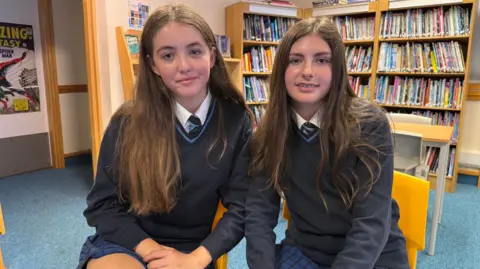
Year 8 pupil Giselle said: "I don't know what I'm going to do with my time - on TikTok I can scroll and it's helped me find interests and things I like."
She said: "Moving it all to WhatsApp will make me text people less or make me feel disconnected with people I don't see often."
Erin, who uses Snapchat and Instagram, echoed this view.
"I'll probably have to get everyone that's on my Snapchat over to WhatsApp," she said.
"But when you have Snapchat, you don't necessarily have everyone's actual numbers, so I'm going to have to get all of them and move it over."
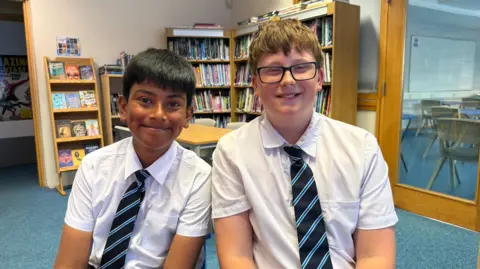
Year 7 pupil Arlo felt the ban would impact him.
"The messaging apps will [affect me], because people who are older will have messaging apps like Snapchat and I won't anymore," he said.
He conceded: "When other people aren't on these apps, I'll be able to go out more."
However, Ishrat, who only uses WhatsApp, said the ban is for the "greater good".
"I think it's safer to contact people that we actually know in real life," he said.
"In my year group, lots of people use these platforms and I think it will impact them, but for the greater good.
"Without being on these things, you won't get addicted, meaning you'll have a better education and attention span."
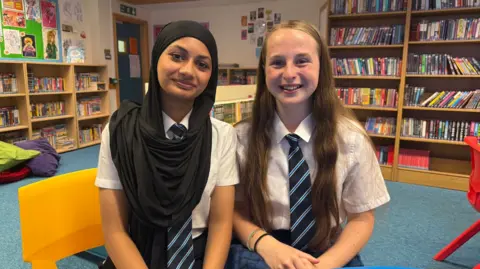
Year 9 pupil Ayera uses WhatsApp and Snapchat, and said the ban will help her to be more social.
"I think [the ban] is a good idea because a lot of children get impacted by [poor] mental health and it does lead to having a short attention span.
"We also get added by people we don't know, so I think that's a negative impact with Snapchat."
Classmate Poppy agreed, and hopes the ban will mean more people communicate in person.
"Some people see more negatives, but in the long run - even if it annoys them now - it'll be better for everyone in my year group."
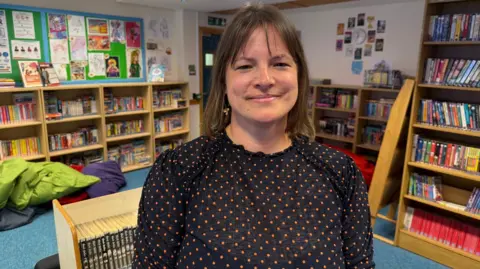
Gemma Read, head of school at John Cabot Academy, said the guidelines given to the school by the government had been "helpful" and "clear".
"It will require some logistical planning and working with our communities to understand some issues that are going to come up."
Read said the school will work with families and students to help them feel supported, while thinking of how they can develop more activities so young people don't feel like they are missing out.
Habit or addiction?
Sander van der Linden, professor of psychology at the University of Cambridge, said social media use is usually more of a habit than an addiction.
"In the DSM, the psychiatric manual, there is no such thing as a social media addiction diagnosis," he said.
"A small minority of people are physically addicted to social media. For most people, it's a bad habit that can escalate if we don't do something about it."
Prof van der Linden said he does not believe that a ban is not the most effective way to deal with the issue, adding that social media companies should be held accountable instead.
"Most scientists seem pretty aligned that a ban isn't a nuanced solution. You see that in Australia - it's not working. Most kids are getting around it anyway."
His advice to parents to help get their kids out of the habit: "Limit screen time, think about alternative activities, audit their social media every now and then and talk to them about what's going on in their feeds."
Technology minister Liz Kendall called the ban a "defining moment for our children", saying it will "give them the freedom to be children again" and "put power back into parents' hands".
Several youth organisations are calling for a wider conversation about what young people are being offered instead of social media.
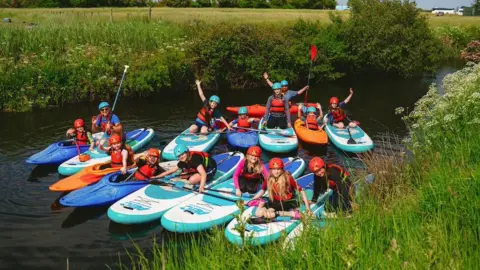
Mendip Adventure, a family-run outdoor activity provider based in Somerset said the debate should also focus on creating more opportunities for children and teenagers to build confidence, resilience, and social skills – away from the screen.
David Eddins, CEO of Mendip Adventure, said: "Reducing young people's exposure to harmful online spaces may be part of the answer, but it cannot be the whole answer.
"If we take something away, we need to offer something better in its place.
"Outdoor adventure gives young people the chance to go beyond their comfort zone, and experience achievement away from a screen. That's where the real opportunity is."
 Mendip Adventure
The Music Works, which offers mentoring to youngsters across Gloucestershire supports the ban, but said other activities must be available.
In a written statement, it said: "If the government removes something that occupies a significant part of young people's daily lives, it cannot simply assume that the void will fill itself.
"The organisations best placed to fill that space are the same ones that have faced years of underfunding and cuts.
"We would strongly urge government to pair this ban with meaningful, sustained funding for youth services and community provision."
Investing in services
The Department for Culture, Media and Sport said it would invest more than £3bn into programmes to help young people, following the response to its National Youth Strategy that was published in December.
The department created the strategy after it consulted 14,000 young people who said they wanted something to do, somewhere to go and someone who cared for them.
It said: "We have listened. We are investing over £3 billion into programmes that help ensure every young person has exactly that, including building or refurbishing up to 250 youth centres, funding for school sport opportunities, building new and upgraded grassroots sport facilities, and saving more than 1,000 arts venues, museums, libraries and heritage buildings from closure."
According to the department, local government spending on youth services fell by 73% between 2010/11 and 2022/23.
In that time, more than 1,000 youth centres closed and 4,500 youth worker roles were lost.
Follow BBC Bristol on Facebook, X and Instagram. Send your story ideas to us on email or via WhatsApp on 0800 313 4630.
