Demands for post-poll justice as Tanzania accused of weaponising counterterrorism laws

 BBC
Families affected by election-related violence in Tanzania that led to the deaths of at least 500 people a year ago have told the BBC they want justice for those killed in the protests and help with medical expenses for those injured.
"We can no longer afford to pay hospital bills," Meshack Sane, who was shot in the leg, told the BBC.
On the eve of the anniversary of the poll that saw President Samia Suluhu Hassan elected with 98% of the vote, rights group Amnesty International also accused her government of "weaponising counterterrorism laws to silence critics and instil fear".
The opposition dismissed the result as a "mockery" of democracy as Samia's two main challengers were excluded.
Tundu Lissu, the 58-year-old leader of the main opposition Chadema party, had been put on trial for treason ahead of the poll - preventing him from standing.
He had been demanding electoral reforms and a verdict in his case is due next week.
Earlier this week, Lissu went on a hunger strike as he was not being allowed access to his lawyers - an allegation the prison authorities denied.
His lawyer Dickson Matata told the BBC on Wednesday he had now been granted a meeting and would be eating again.
 Reuters
In its statement, Amnesty said it had documented how over the past year security agencies had committed human rights violations with impunity against government critics, opposition supporters, media organisations and dissenting members of the ruling Chama Cha Mapinduzi (CCM) party.
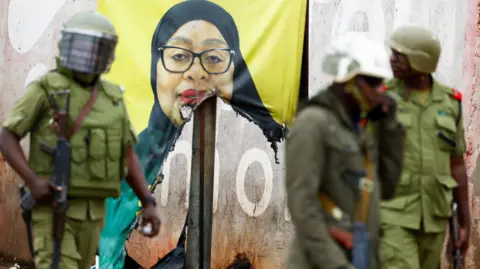
"Not a single official has been criminally investigated, let alone prosecuted and punished for the excessive force that Tanzanian security forces used against protesters," said Tigere Chagutah, the group's regional director for East and southern Africa
"In fact, the situation has only deteriorated since the crackdown began. In a classic tactic pulled out of the authoritarian playbook, the authorities are increasingly weaponising counterterrorism laws to silence critics and instil fear."
The authorities in the East African nation have repeatedly denied accusations of widespread abuses and say the government is committed to respecting human rights.
Samia, 66, has insisted the election was fair and transparent and blamed foreigners for the unrest, saying it was part of a plot to overthrow her.
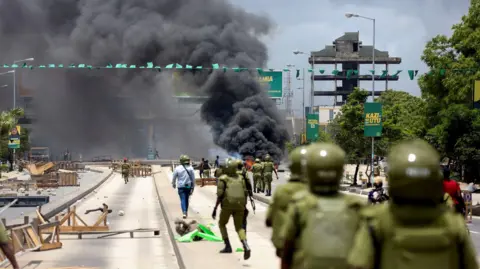
Last year, the BBC verified multiple videos of police shooting towards protesters. Footage posted online showed demonstrators being confronted by heavily armed units blocking their progress and firing tear gas to disperse crowds.

The BBC has since spoken to families of some of the victims of the electoral violence, who are still seeking answers.
Many, like Mwajuma Hamisi, have been left destitute. Her husband George Kisivani was shot in the northern city of Arusha on 29 October 2025, the day of the vote, and died two days later.
"I lost my husband, upon whom we, a family with five children, depended. We now have no other source of support. I am left to fight for the family on my own. We have no other assistance," the 32-year-old told the BBC.
She now sells vegetables at a nearby market to support the family - and would like help from the government.
Sane, who shot in the leg in Arusha, has been suffering physically and financially.
The father of three says he has undergone more than five major operations to deal with the gunshot wound. He still needs further surgery but says he can no longer afford treatment.
"We have done everything within our means, but we have reached our limit," the 33-year-old told the BBC.
"The government should look into the situation of those of us who have suffered these tragedies, so that we can receive medical treatment, as some of us are still very sick."
He explained how in the wake of the violence hospitals initially refused to treat injured people.
In the intervening months, his relatives have sought help from local officials and the district commissioner, but he says they were told the government had not allocated a budget for victims of the violence.
The BBC has not independently verified his account of those conversations.
A commission of inquiry's report into the violence was handed to President Samia in April, officially recording 518 deaths.
But Amnesty has criticised the fact that the full report has not yet been made public, saying it "entrenches a culture of secrecy".
The president has since set up another commission to inquiry to identify those behind the violence.
"It is imperative that this new commission comprehensively address the role of security forces in the election-related crackdown," Chagutah said.
 Reuters
The rights group says that between 3 and 17 September 2026, it interviewed 17 people who gave details of a continuing crackdown by the authorities.
Some of them were targeted after demonstrations were called for 7 July to demand democratic reforms and justice for those killed last year.
These marches were banned by the authorities. A 26-year-old man who had expressed support told Amnesty how he was arrested on 24 July in Dar es Salaam and held without charge for 47 days.
He said he was blindfolded by his interrogators who wanted to know who was funding the protests and threatened to kill him.
"On the first day, they didn't give me food. When I asked for water, they urinated on my blindfolded face and said, 'That is the price for those of you opening your mouths to make noise'," he said.
"On the second day, I was taken to Gogoni police station where they beat your legs until they get numb but then insist that you must stand."
The right groups also cites other "acts that may amount to torture... arbitrary arrests, enforced disappearances and abductions".
The authorities did not respond to the BBC's or Amnesty's request for comment.
Many of those who lost relatives a year ago want the government to acknowledge their suffering and address their questions about justice, like 40-year-old Neema Munuo.
She says her grief over the death of her 18-year-old daughter Maria Chami, who had gone out to buy phone credit in Arusha when she was shot, has often left her too distraught to leave the house.
"It is a date I will never forget for the rest of my life, because whenever I recall it, I feel as though I am burning inside," Munuo told the BBC.
This feeling resonates with farmer Juma Nasibu, who lives near the city of Mwanza on the shores of Lake Victoria.
He has not seen his 25-year-old nephew Juma Shabani since the unrest.
The young man had been at a cinema hall in the evening when his uncle later heard unconfirmed reports that he was amongst people rounded up and shot. His family have fruitlessly searched for him at hospitals, police stations and prisons.
"To date, what still pains me is that we were never able to recover the body," Nasibu told the BBC.
You may also be interested in:

Go to BBCAfrica.com for more news from the African continent.
Follow us on Twitter @BBCAfrica, on Facebook at BBC Africa or on Instagram at bbcafrica
