In search of 'mudlarking gold' on the River Thames

 Getty Images
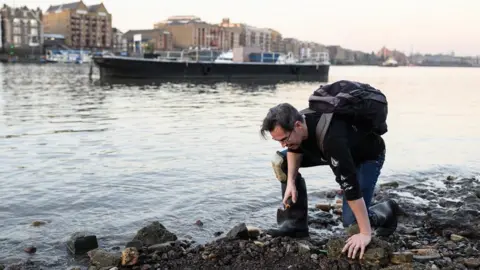
Mudlarks have been sifting through the banks of the River Thames for hundreds of years in search of relics of London's past. For some, including Jason Sandy, the holy grail of finds relates to a notorious dispute more than a century ago. He explains how his long search for jettisoned printing material has led to some surprising encounters.
On a warm September day, shortly after midnight, Sandy was where he can often be found - on his hands and knees, scouring London's muddy foreshore.
"I thought I was alone and then in the distance, I could hear sirens coming towards the bridge, and then they stopped above me.
"I didn't really take much notice of it just because I was so focused on collecting and then I heard voices coming towards me and it was first one police officer and then there were five others," says the 51-year-old.
Sandy is one of many licensed mudlarks based along the Thames.
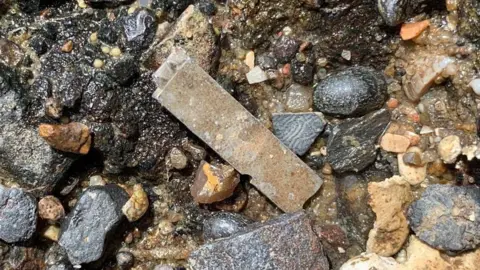
He's found everything from ornate Roman hairpins to medieval money, but for him and numerous others there are certain items lost in the depths of the river that Sandy calls "mudlarking gold".
 Jason Sandy
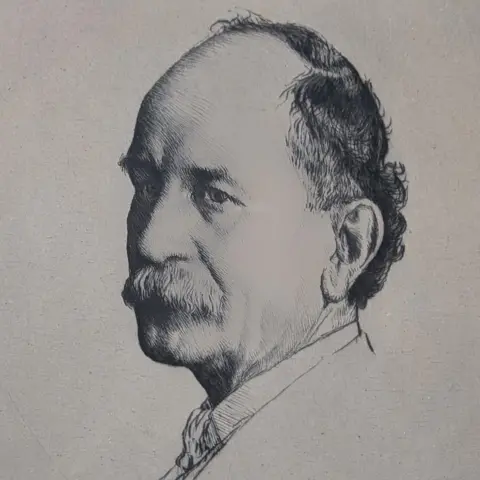
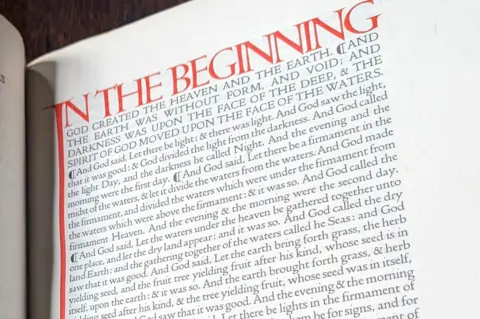
In 1900, an eccentric printer and bookbinder named TJ Cobden-Sanderson created the Doves Type, considered by many to be one of the best examples of font design of the Arts and Crafts movement.
Having set up the Doves Press printing business with printer and engraver Sir Emery Walker, the company produced beautiful hand-pressed books which were considered to be some of the finest created in Britain at the time.
However, a bitter feud broke out between the pair and the partnership ended in 1909, with Cobden-Sanderson accusing Walker of a lack of commitment to their art.
As part of a compromise, the younger Walker was meant to be given the type to use once 75-year-old Cobden-Sanderson had died.
 Lucinda MacPherson
Yet such an idea was considered abominable by the type's creator who instead came up with a secret plan to stop anyone ever getting their hands on his creation - chucking every piece of metal type into the river off Hammersmith Bridge under the cover of darkness.
"They estimate that he threw over a tonne of metal in the river - that's roughly 500,000 pieces - and he made around 170 trips between 1916 and 1917 to do it," explains Sandy.
"He then wrote an article in the local newspaper declaring that he had 'bequeathed' the type to the river, and that's how his business partner, Emery Walker, found out that the Doves Type didn't exist any more."
 Lucinda MacPherson
Sandy, an architect and property developer by trade, has been mudlarking for 14 years and says he became enthralled by the tale of the dispute after graphic designer Robert Green found the first pieces a decade ago.
"I live in the Hammersmith, Chiswick area, so very close to Hammersmith Bridge, and I've spent years hunting for it," he says.
In 2018 he announced online he had found hundreds of pieces of Doves Type, only for Green to get in touch to tell him it was probably not what he thought it was and offering to meet him.
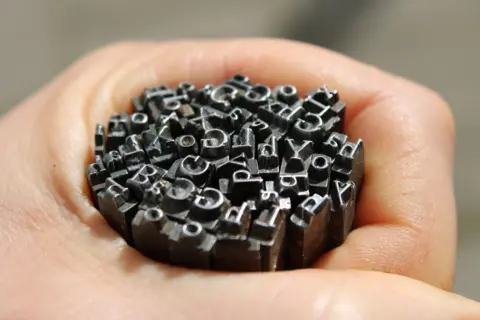
"He literally went through my case full of type and said: 'Sorry, Jason, you haven't found a single piece.'
"I had been searching on the wrong side of the bridge for five years," says Sandy.
 Jason Sandy
After some pointers from Green, Sandy kept returning beneath Hammersmith Bridge - and then came that September night last year.
"From July until September we have super low tides at night and low tide was after midnight.
"So I headed down, and because they had just recently removed Wet Wipe Island, the tide went much lower than in typical years so all of a sudden this rare patch appeared and I was able to collect 41 pieces in less than an hour."
Sandy finds the pieces of type by scooping mud into a sieve, which he then cleans in the water.
"I look like a gold miner panning for gold, but I'm actually panning for the lost Doves typeface."
As such, with his face towards the mud, he didn't notice when several police officers appeared.
"I think somebody thought I was doing something a bit devious under the bridge. If you remember, the IRA tried to bomb the bridge three times in the past century and it's not in great condition, it's not structurally sound."
Showing them his Port of London Authority mudlarking permit, Sandy says he explained to the officers the story of Doves Press and presented them with his latest stash.
"So they had a good laugh and said I was doing nothing wrong... They then let me go and escorted me off the foreshore," he says.
 Lucinda MacPherson
While that may have been the first time Sandy has had the police called on him, he says he has had to phone them himself while out mudlarking "because of dead bodies that we find in the river, and also even bones.
"I found a huge femur bone one time and had to call the police for them to collect it so I've had quite a few unique experiences."
In 2022 he even found the freshly shed skin of a 6ft (1.8m) long boa constrictor beside the water - probably from a pet abandoned along the river.
But such experiences haven't dissuaded him from carrying on his search for London's history and particularly the Doves Type.
"I was actually just there on Sunday again, and I found seven more pieces so I do check the spot occasionally," he says.
"It is kind of on everyone's bucket list, every mudlark wants to find some, and I'm just one of the lucky few that has found so many."
 Lucinda MacPherson
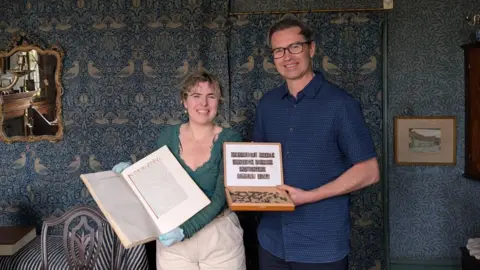
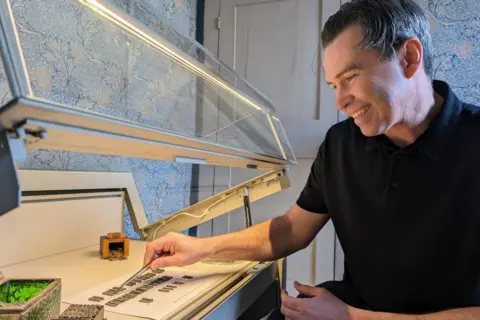
Sandy recently donated 50 of the Doves pieces he has collected to the nearby Emery Walker’s House.
Run by the Emery Walker Trust, the museum was where both Cobden-Sanderson and Walker lived and it has been kept in its original state, with William Morris wallpaper and tapestries covering the rooms.
Sandy sees his donation as returning the Doves Type to its rightful home.
"I just love the story and feel honoured that I'm able to make a humble contribution and give them back the lost type that was in the river for over 100 years."
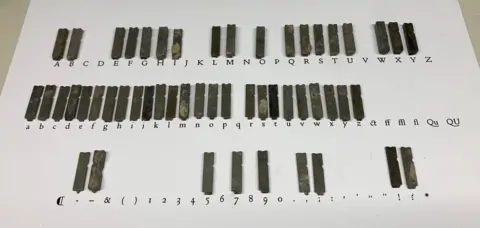
He's also now trying to convince other mudlarks who have found pieces of type to donate them, as "my goal in all of this is to return the full uppercase and lowercase set alphabet to the museum".
"It's a great bit of local history, and that's why I'm so passionate about the story and about finding the lost type," he adds.
"It's just because it is something that's very close to my heart and very close to home."
 Jason Sandy
Listen to the best of BBC Radio London on Sounds and follow BBC London on Facebook, X and Instagram. Send your story ideas to hello.bbclondon@bbc.co.uk
