Works on £10.6bn Lower Thames Crossing progress

 BBC
BBCThe first physical signs of the Lower Thames Crossing are beginning to appear across Kent and Essex, as work gets under way on the huge project.
The BBC has been given exclusive access to see some of the early preparation work, including the creation of a new wetland, new roads for construction traffic and preparations are for the tunnel beneath the River Thames.
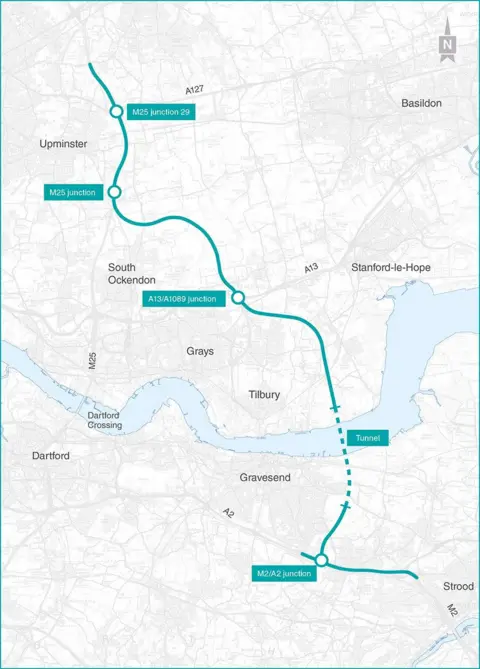
National Highways has said the Lower Thames crossing, a 14.5-mile (23km) road linking Essex and Kent via two tunnels underneath the river, will be the greenest large scale construction built in the UK.
But environmental campaigners have raised concerns about the loss of ancient woodland and traffic congestion.
The tunnel boring operation is due to begin in autumn 2028 with plans to open the road to the public in the mid 2030s, after plans were approved in 2025.
The project is expected to cost £10.6bn.
Andrea Griffiths, from the Campaign to Protect Rural England, said the project was "not the best use of public money" and argued "more consideration should have been given to moving freight by rail".
Griffiths added: "Yes the plans are to make the road green, but that doesn't replace the ancient woodlands being lost in Kent to the project."
'Punching through Thames banks'
At one site alongside the Thames, earth is being moved to create a new wetland area at Coalhouse Point.
It is part of a programme designed to provide new habitats as the landscape changes during construction.
Nick Clark, head of nature at the Lower Thames Crossing, told the BBC the wetland would be around the size of 50 football pitches.

"The team are punching through the Thames banks to allow for a twice daily flood of the wetlands," Clark said.
The new habitat will include wildlife scrapes, shallow areas designed to provide feeding and nesting opportunities for birds, including migratory ones over the winter, Clark added.
The wetland is one of a number of environmental measures being introduced as part of the project.
 Michael Keohan/BBC
Away from the wetlands, the construction operation is already changing the landscape, with new haul roads being built to carry the thousands of vehicles that will be needed during construction.
They are designed to allow materials and goods coming from the docks to reach the construction sites without having to use local roads wherever possible.
For communities along the route, it means construction activity is becoming visible well before the new crossing is completed.
The biggest engineering challenge will come when work moves underground.
Before that can happen extensive preparation is needed, including access roads, construction compounds and infrastructure to support the operation.
Shaun Piddock, programme director for the Lower Thames crossing, said careful planning was being used to try to control costs.
"We have planned this for a long time to make sure we don't get hit by unexpected costs," he said.
 National Highways
The project is intended to provide an additional crossing of the Thames and reduce pressure on the existing Dartford Crossing.
It has been welcomed by road freight companies, with Europa Worldwide transport manager Malcolm Castle saying extra capacity was "long overdue" and "congestion at Dartford can add significantly to drivers' journeys".
Follow BBC Kent on Facebook, on X, on Instagram and listen to BBC Radio Kent on Sounds. Send your story ideas to southeasttoday@bbc.co.uk or WhatsApp us on 08081 002250.
