Elephants came to say 'goodbye' to dying mum

 Margueriet Jones/Peter Haygarth
Ahead of the first UK exhibition dedicated to his wildlife photography, Peter Haygarth shares the story behind his passion and why you should never delay fulfilling your dreams.
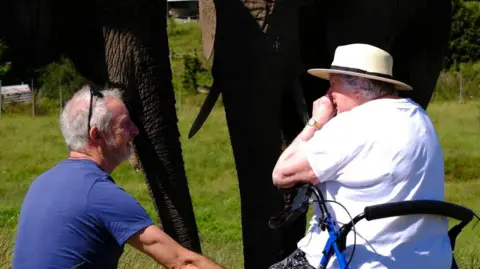
Shortly after 06:00, the elephants came.
It started as a rumbling among the distant trees, then one by one they strode into view from every direction, some 150 in total descending on the watering hole.
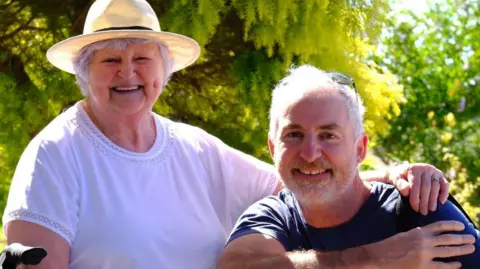
Peter turned to his 80-year-old mother Beryl, a retired shop worker from Bishop Auckland, County Durham, who had defied medical opinion to join her son on one last African adventure.
"They've come to say goodbye to you mum," he told her, noting the joy etched on her face.
It was the final day of their final trip together, and when reflecting on the moment several years later, Peter says he hopes his pictures will inspire others not to leave it too late to go and see the world.
 Margueriet Jones/Peter Haygarth
Peter had always been fascinated by African wildlife, a result of watching shows like Tarzan on TV.
While his brother collected football magazines, Peter bought animal publications.
He got his first camera with his first paycheck from the RAF, the teenager splurging £147 on a Pentax ME Super, paying £7 extra to get the black model.
Throughout his career, first with the RAF and then Durham Police, Peter was armed with his camera, taking courses along the way to improve his hobby skills.
As he approached 50 and retirement from public service, he set his sights on a second career - photography.
 Peter Haygarth
He started working for a sports agency, taking pictures at northern football matches, before moving into working with drones, which led to him filming Matt Le Blanc drive through a Moroccan desert for Top Gear.
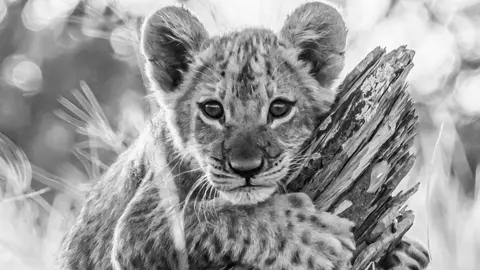
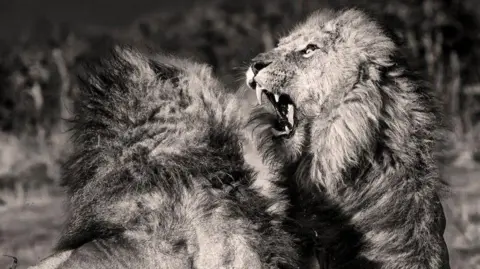
But animals were his main passion, in particular the big cats.
Peter first went to Africa in 2007 on a photography holiday and "absolutely loved it", returning six years later for a more extended stay volunteering on a game reserve.
He spent three months following and monitoring the cheetahs and wild dogs, observing their behaviour.
"That was when I really decided that I need to go back [to Africa] as often as I could," Peter says.
For the past 10 years he has spent two or three months a year in Africa, from Botswana to Zimbabwe, Kenya to Zambia, both as a wildlife photographer and instructor for others.
 Peter Haygarth
From watching the wildebeest migrations in Kenya's Maasai Mara reserve to intimate encounters with mountain gorillas in Rwanda, Peter has witnessed some of the world's most captivating animals in their most natural state.
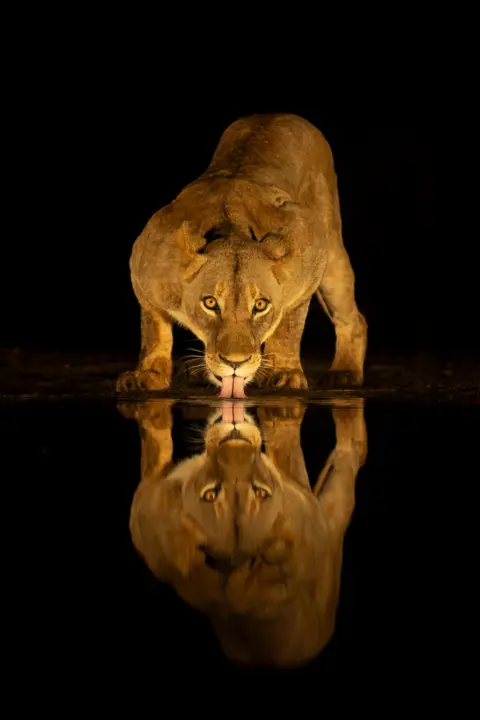
He spent 15 hours in a hide in South Africa to get a picture of a lioness lapping at a lake, the image one of half a dozen or so hanging around his Bishop Auckland living room.
"I instantly knew it was a good photograph," Peter says, adding the perfect reflection was almost immediately obliterated by the ripples caused by the cat's tongue.
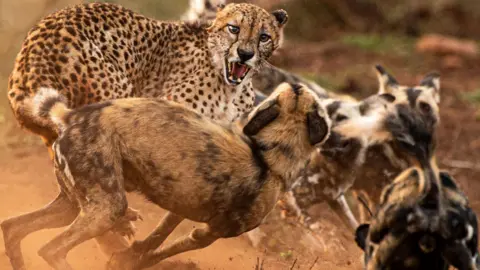
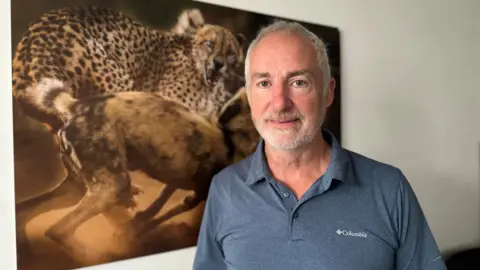
On the wall next to it is an encounter between a cheetah and pack of wild dogs, a picture that was highly commended in the Wildlife Photographer of the Year Awards and ended up on display at 10 Downing Street.
Peter is always conscious that this is the animal's world, he is merely a visitor, usually taking pictures in a vehicle from a discreet distance and ready to leave should he cause an unwanted disturbance.
 Peter Haygarth
"You pick it up pretty quickly," he says when asked about recognising when it is time to go.
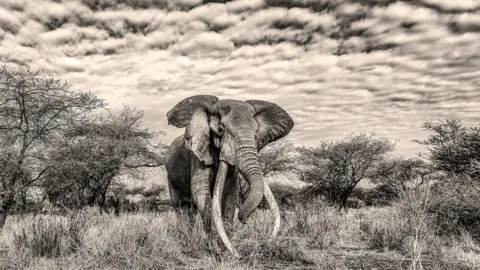
"Look at an animal like an elephant," Peter says.
"They'll put their ears out to try and make themselves look bigger, as if they need to.
"I wouldn't say they've been aggressive towards us, but they just kind of look at you, and they might move towards you quickly and then stop.
 Peter Haygarth
"It's them saying 'this is my territory' and the sensible thing is to completely accept that and back away.
"The last thing you want to do is to upset, disturb, or change the behaviour of wildlife."
Despite elephants brushing against his vehicle or finding the footprints of hippos outside his tent, Peter says he has never really felt scared.
"You put your faith in the fact that you are not in any way wanting to upset the animals, you hope there's a bit of karma there," he says.
Although capturing an incredible moment is a buzz, the real joy is in just being there, Peter says.
"When I'm sat in a vehicle in Africa by a waterhole, that's my favourite place to be.
"The picture is sort of incidental, it's the reason to get me there.
"Sometimes I'll just put the camera down and watch what's happening."
He still has ambitions, to see the polar bears at Svalbard and the jaguars in the Amazon, not to mention joining a David Attenborough documentary crew, but Africa is a constant lure.
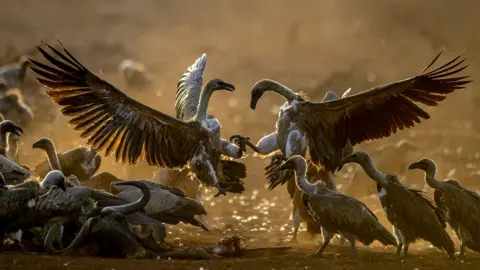
There is always more for his two Nikon Z9s and fleet of lenses to catch.
 Peter Haygarth
He hopes his exhibition in Darlington will help people appreciate wildlife more, much of which is in a perilous condition, but also inspire others to go and see the places for themselves.
That is what happened after he came back from his first African adventure in 2007 and showed his photos to his parents.
"My mum said to my dad 'I wish we had done that', because my mum loved elephants," Peter says.
"I said 'why don't you then', and they went the following year and loved it."
His mother joined him on several more trips after the death of his father, culminating in their final South African adventure together in February 2023.
 Peter Haygarth
Beryl had been unwell the previous year, telling her son: "If there's one thing I'd love to do before I go, it's to see the elephants in the wild again."
Peter promised her if she got herself fit he would take her which is what he did, defying criticism from those who said she was too old or unwell to travel.
"When we were out there, she said 'this is the best holiday I've ever had'," Peter recalls.
Beryl died a few months later, Peter having raced back early from another African trip to be by her bedside.
"I got a bit of criticism for taking her, but it turned out to be probably one of the best things I've done in my life," he says.
"You can't put things off."
Peter's exhibition Wild Africa will be at Gallerina in Darlington from 13 June to 25 July
