'Lucky' mum praises baby study after gene find

 Family handout/PA Wire
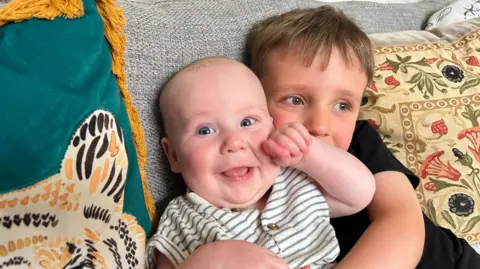
A Bradford mum has said she feels "ridiculously lucky" after a chance participation in a medical study found her two sons had a genetic change linked to a rare condition.
Jessica Barker-Roe said she had agreed for her youngest son to take part in the Generation Study - run by Genomics England and the NHS - when she was "bored" during a stay in hospital.
It found her boys Revan and Thorin had adrenoleukodystrophy, also known as ALD, which affects the adrenal glands and nerves of the spinal cord - but careful monitoring should mean they avoid life-limiting complications.
The Generation Study is screening 100,000 newborn babies in England for dozens of genetic conditions.
Jessica, 32, said she first heard about the study during a long stint in hospital while pregnant with Revan, who is now eight months old.
"The research midwives were just making their way around and chatting to patients, they asked me if I would be interested in signing up to the Generation Study," she said.
"Honestly I was just bored so I said, 'Yeah, whatever' and put it to the back of my mind."
 Family handout/PA Wire
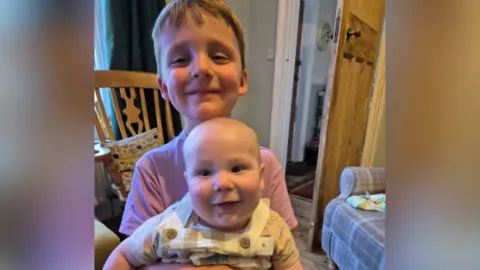
The test involved a heel prick on Revan and it revealed he had the genetic change associated with ALD – a progressive condition which causes problems with vision, movement and understanding.
Doctors also requested to test Revan's brother, Thorin, now aged four, who also tested positive for the change.
"That happened really quickly because symptoms start around four years old, and once symptoms start it is really hard to treat it," Jessica said.
"I feel so lucky, instead of feeling worried, I feel so ridiculously lucky that we timed having a baby when the Generation Study was out there as an option and I was in hospital at a time when it was being offered by the research midwives because I had not heard of it.
"If I hadn't had that bleeding I wouldn't have been in hospital, we probably wouldn't have signed up for it and the first we would have known about it was when one of the boys got ill."
'Best possible start'
The research project is available at more than 70 hospitals in England.
The study will help identify more than 200 rare conditions which cause a progressive loss of physical and mental skills.
Dr Catriona Firth, consultant neonatologist at Bradford Teaching Hospitals NHS Foundation Trust, said: "Early detection has given Revan and his family the best possible start.
"Identifying this genetic change meant we were able to refer to the specialists in this rare condition straight away.
"Signs and symptoms of ALD are non-specific, so the disorder usually takes time to diagnose even after concerns arise.
"The Generation Study test result means both boys can be monitored, so if there are signs of change, treatment can be started straight away."
Listen to highlights from West Yorkshire on BBC Sounds, catch up with the latest episode of Look North.
