What next for the Nottingham attacks NHS trust under criminal investigation?

 Supplied
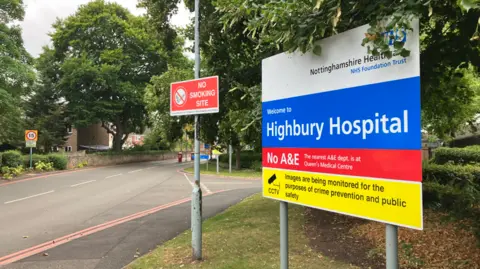
The NHS trust that was responsible for the care of the Nottingham attacks killer Valdo Calocane is now at the centre of a corporate manslaughter investigation.
Calocane, who was diagnosed with paranoid schizophrenia in 2020, was under the care of Nottinghamshire Healthcare NHS Foundation Trust for two years, but was discharged months before he killed three people in a spate of attacks in Nottingham in June 2023.
The trust has been heavily criticised since the attacks, and faced the scrutiny of a statutory public inquiry alongside other public bodies and individuals earlier this year.
Now, it is at the centre of a criminal investigation.
But what does corporate manslaughter mean, and what could it mean for the trust?
What happened during the Nottingham attacks?
 Nottinghamshire Police
On 13 June 2023, Calocane stabbed to death two 19-year-old students Barnaby Webber and Grace O'Malley-Kumar as they walked home from a night out in Nottingham.
He then walked across the city and fatally stabbed 65-year-old grandfather Ian Coates, before taking Ian's van and driving into Wayne Birkett, Sharon Miller and Marcin Gawronski, who were left with serious injuries.
Calocane later pleaded guilty to three counts of manslaughter on the grounds of diminished responsibility, and three counts of attempted murder.
He was sentenced to an indefinite hospital order in January 2024.
The killer's history of violence and mental health emerged following the attacks, leading to calls for the public statutory inquiry.
Nottinghamshire Healthcare NHS Foundation Trust was responsible for Calocane's care between 2020 and 2022. In that time, he was sectioned under the Mental Health Act four times.
He was discharged in September 2022, months before the attacks, due to a lack of engagement and because his care team could not find him.
Earlier this week, Northumbria Police said it was investigating "matters relating to the care and treatment of Valdo Calocane".
Why is a police force outside the area leading the investigation?
 Nottinghamshire Police
The investigation is being carried out by Northumbria Police.
Earlier this week, Northumbria Police said it was carrying out the investigation "on behalf of Nottinghamshire Police".
A spokesperson for Nottinghamshire Police told the BBC: "We received a complaint in relation to alleged failings within Nottinghamshire Healthcare NHS Foundation Trust which the complainant believes led to the city centre attacks on 13 June, 2023.
"We assessed this complaint as requiring investigation and requested that another force leads this so families and survivors are reassured this is handled impartially.
"We are grateful to our counterparts in Northumbria for leading this."
The Nottinghamshire force has faced its own criticism in relation to its investigation into the attacks and its interactions with Calocane before June 2023.
It is also at the centre of a number of ongoing investigations by the policing watchdog, the Independent Office for Police Conduct, over complaints made in relation to the attacks.
What is corporate manslaughter?
Corporate manslaughter is an offence under section one of the Corporate Manslaughter and Corporate Homicide Act 2007.
Dr Javier Eskauriatza, an assistant professor of criminal law at the University of Nottingham, said the statutory offence was "designed to plug a gap in the law".
He said: "There had been a number of large-scale disasters, where many people had died, and no company had been held criminally responsible for these deaths.
"It was really difficult to hold a company responsible for killing a person."
The offence is about companies being prosecuted, not individuals.
The organisations that can be prosecuted include corporations, government departments, police forces, trade unions (if they are an employer), and charities.
Before the 2007 Act, the common law of manslaughter only allowed a company to be liable if an individual at the company was identified as the controlling mind of the company, and it was their gross breach that led to the deaths.
However, it was sometimes difficult to identify an individual as the controlling mind, particularly at a large organisation, Eskauriatza said.
"It used to be the case before the Act that the prosecution had to identify an individual at the senior leadership level, who could be identified as the directing mind and will of the company, and it was their gross breach of duty that caused the deaths.
"Now you don't have to. Since 2007, that's changed," he added.
Corporate manslaughter focuses on how the activities of the company were managed or organised.
The prosecution must prove that there was a gross breach of a relevant duty of care, and that acts or omissions by senior management were a "substantial element" in that breach, according to the law.
Eskauriatza said: "These prosecutions are rare in terms of coming before the courts.
"They are complex offences and despite the obvious and understandable calls for justice, it is by no means a simple prosecution."
No NHS trust has ever been found guilty of corporate manslaughter.
What is the punishment for corporate manslaughter?
For an organisation that is guilty of corporate manslaughter, there is no custodial sentence.
Instead, if the trust was to be found guilty, the organisation could face an unlimited fine.
Under sentencing guidelines in England and Wales, a large organisation - with a turnover of more than £50m - could be fined up to £20m, depending on the severity of the offence as well as aggravating and mitigating factors.
For a very large company - which has a turnover or equivalent which greatly exceeds the threshold for large companies - courts should consider greater fine to achieve a proportionate sentence.
According to the trust's quality account report for 2025-2026, it has an annual budget of £747m, and provides care to more than two million people.
Can individuals be punished?
Individuals cannot be prosecuted for corporate manslaughter.
However, if evidence shows gross failings on the part of individuals within a company, as well as failings of the organisation, a person can be charged with gross negligence manslaughter in a separate prosecution.
What have the affected families said?
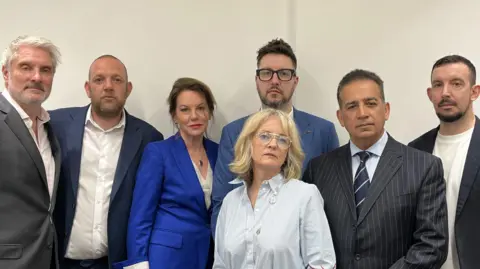
In a statement, Emma Webber, the mother of Barnaby Webber described the investigation as the "beginning of the reckoning".
She said it was the accountability the families had been calling for.
"This has to be the line in the sand - when those who fail, neglect and cover up, from the leaders at the top down, are fully held to account and made to recognise their failures," she said.
"This includes chief executives, chairmen of the board, non-executive and executive board members, as well as the negligent clinicians, practitioners and hospital managers who over a sustained period failed to manage and recognise the threat posed by Valdo Calocane."
Dr Sanjoy Kumar, Grace O'Malley-Kumar's father, said he was pleased the "very high threshold" for a corporate manslaughter investigation had been met.
He told the BBC: "I think what the inquiry showed us is that the failings weren't just at the senior management, they went all through this organisation, all the way from the people who work with the parents, all the way to the top.
"I think it [the investigation] will put every mental health trust across the country on notice so that these catastrophic failings don't happen again."
Lee Coates, one of Ian Coates' three sons, said: "We're really happy that they are looking into it. It kind of solidifies everything that we we've been fighting towards."
What has the trust said?
A spokesperson for the NHS trust said: "Northumbria Police, acting on behalf of Nottinghamshire Police, have begun an investigation into matters relating to the care and treatment of Valdo Calocane.
"We know how important the independent inquiry and police investigation are for the affected families, the survivors and our local communities.
"We will, of course, be co-operating fully with Northumbria Police, as we have with the statutory inquiry into these matters which is being chaired by Her Honour Deborah Taylor, and which will hear final submissions from all the parties involved later this year."
The Nottingham Inquiry, the public inquiry examining the attacks, heard evidence from the NHS trust earlier this year.
The inquiry is expecting to hear closing statements in September, with a report of findings to be published by May 2027.
Listen to BBC Radio Nottingham on Sounds and follow BBC Nottingham on Facebook, on X, or on Instagram. Send your story ideas to eastmidsnews@bbc.co.uk or via WhatsApp on 0808 100 2210.
