Israel building new land barriers in Gaza and displacing families

 BBC
BBC"We've been displaced from place to place, and now we have nowhere left to go," says Umm Mohammed al-Shawish.
She is desperately searching for somewhere to live after Israel moved yellow concrete blocks that mark out where it controls in the Gaza Strip.
Families living in al-Tuffah in northern Gaza woke on Monday to find the blocks had been moved westwards into the centre of Salah al-Din road, a key north-south route through Gaza.
Nearby, an Israeli flag was flying on top of an earth barrier around 3m (10ft) tall.
The al-Shawish family home was destroyed during the war. On Sunday, they had to flee again after the Israeli military called to warn of an attack on a nearby building. Their only shelter was a tent, which was torn apart by the strike.
"We are going to die here," Mohammed al-Shawish said. "Death is better than humiliation. No-one is standing with us."
Under the terms of the US-brokered ceasefire deal between Israel and Hamas last October, Israel agreed to withdraw its forces from across Gaza to a designated demarcation - the Yellow Line.
The deal was meant to leave Israel in temporary control of the area behind the Yellow Line - equating to 53% of Gaza's territory. However, the Israeli Prime Minister Benjamin Netanyahu recently said the Israel Defense Forces (IDF) controlled more than 60%. In May, he said publicly that his "directive" was to move to 70%.
Hamas accuses Israel of violating the October ceasefire agreement by moving the Yellow Line westwards. A senior Israeli government official said Israel rejected Hamas's claims outright. The BBC was told: "IDF deployments and security lines are operational measures taken to protect Israeli citizens and prevent Hamas from rebuilding its terror army. Israel will continue to act against any ceasefire violations."
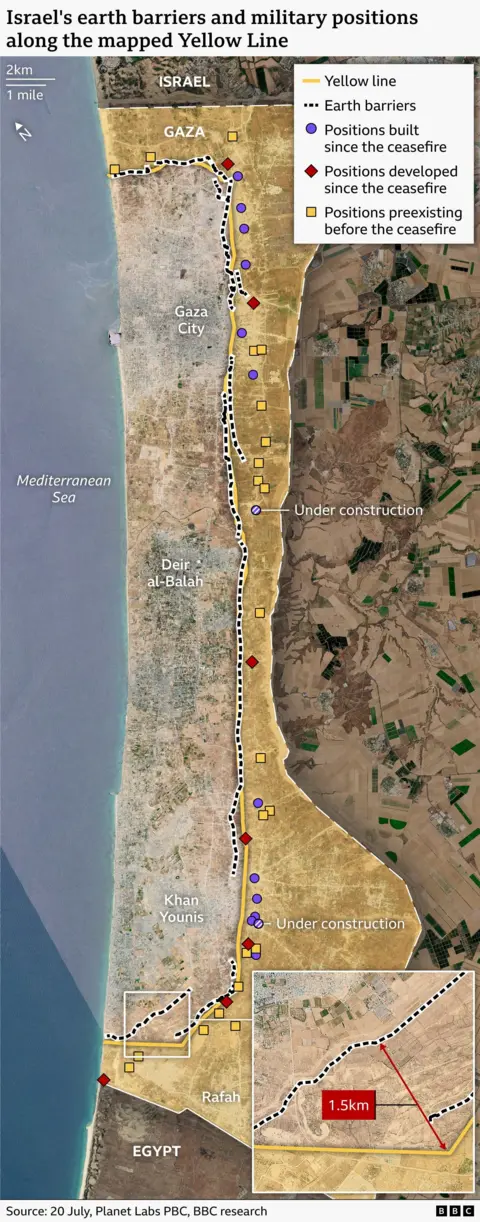
The Israeli military initially marked the Yellow Line with concrete blocks, before moving some markers further into Gaza. But Israel has now constructed a network of barriers, having started soon after the ceasefire. The barriers now stretch more than 42km (26 miles) and cover 85% of Israel's Yellow Line, with the longest section already 13.8km (8.5 miles).
Experts have told the BBC that the earthworks suggest Israel is planning for a long occupation of the strip. In some areas the earth barrier effectively moves the de facto "border" - the Yellow Line - deeper into Gaza, further increasing the deadly no-go zone for Gazans.
One section of the embankment near the al-Mawasi camp is more than 1.5km beyond where the Yellow Line was originally mapped. Another section in Khan Younis is positioned more than 500m over it.
The IDF says it is working to "clearly and visually mark the location of the Yellow Line on the ground" to "reduce friction". It has previously rejected "all claims that the Yellow Line has been moved or its crossing by IDF troops".
Other incidents of displacement have been reported in Gaza in recent months as the army has moved yellow blocks further into the territory into areas where Palestinians have been living during the ceasefire.
On 18 July, dozens of families hurriedly piled motorcycles with mattresses and any belongings they could manage as they fled the Zeitoun area, east of Gaza City. The IDF had issued an order to leave, and Gazans said they assumed this was a sign that the Yellow Line was being moved again. Some simply left empty-handed in their hurry to evacuate.
Locals described shooting from Israeli military vehicles, quadcopter drones and artillery shelling.
"The war is not over. That's a big lie. Every day there are strikes, displacement and evictions," declared Ismail Kashko. He said his family feared being hit by Israeli fire as troops approached: "We are living in tents, not in houses. There's no concrete to protect us."
According to the UN's humanitarian office, OCHA, some 30 families lost their tents in Zeitoun and had to be helped with basic supplies. Satellite imagery shows scores of temporary shelters disappearing from the area in July.
Residents of Zeitoun say that to the east, they have seen Israeli bulldozers and heavy machinery where the army has been building a new base and earth banks.
The Israeli military told the BBC their "defensive posture" includes "a security zone, a physical barrier, intelligence capabilities, technological means, and operational activity by IDF troops".
It said: "These measures are intended to prevent infiltrations and hostile activity, and to protect both the troops and surrounding communities. For operational security reasons, we will not provide further details regarding the components of the deployment, the route of the barrier, or its extent."
To the east of the central city of Deir al-Balah, families living on farmland told the BBC they were given two days' notice by the Israeli military before the area was razed. Satellite images show tank tracks and destroyed structures in the area, with an olive grove more than 500m beyond the Yellow Line apparently torn down. Verified video shows three yellow blocks recently placed there, the furthest of which is more than 300m from the Yellow Line mapped after the ceasefire.
Further to the south, near al-Mawasi, Palestinians say other blocks to mark the Yellow Line have moved closer to their camps. They describe daily movements of Israeli tanks, recurrent gunfire and the construction of tall sand embankments.
The founder of intelligence analysis firm MAIAR, Tony Reeves, analysed satellite images and estimated that one section of the embankments in Gaza was up to 7m tall.
Verified videos and satellite images show land and roads have been churned up and some buildings flattened to make way for the earth barriers, while Israel has continued its demolition campaign across Gaza since the ceasefire.
In June, days before beginning construction of the barrier near the southernmost city of Rafah, Israeli troops destroyed structures and rows of greenhouses in its path, satellite images show. In nearby Khan Younis, IDF drone footage showed a controlled demolition of a cluster of buildings beyond the Yellow Line. By July a barrier had been constructed nearby and many more buildings were destroyed.
In July alone, satellite imagery shows scores more buildings had been destroyed beyond the Yellow Line in Khan Younis, Deir al-Balah, Zeitoun, and in the northern towns of Jabalia and Beit Lahia.
The military has also built dozens of bases, outposts and staging areas behind the barrier along the Yellow Line. Fourteen new positions have been established since the October ceasefire, including two currently under construction, while a further seven set up before the ceasefire have been paved or extended.
The IDF did not directly respond when asked about demolition activity beyond the Yellow Line. "IDF troops under the Southern Command are deployed in the area of the Yellow Line in accordance with the ceasefire agreement," it said.
Retired Israeli brigadier general Assaf Orion, a senior researcher at Israel's Institute of National Security Studies (INSS), said the construction of barriers and bases suggests "the IDF is preparing for a long stay along the Yellow Line, as little (if any) progress has been made in disarming Hamas".
Dr Andreas Krieg, a security expert from King's College London, said the BBC's findings indicate that "Israel is turning the Yellow Line from a temporary withdrawal boundary into a de facto internal border".
People in Gaza say the Yellow Line is already having a devastating effect, squeezing the population of more than two million into an ever-smaller space amid dire humanitarian conditions. "The Yellow Line keeps moving day by day," said Abu Kamel Hamami who is displaced in Gaza City.
"We're constantly moving from one street to another. Everywhere is overcrowded with people, tents and displacement camps."

