Choking campers evacuate tents as wildfire experts call for more action

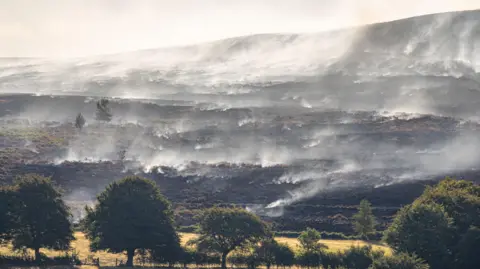 Stuart Baldwin SJB photography
Thick smoke from a wildfire forced choking campers from their tents and into a nearby house.
The blaze on Mynydd Garnclochdy near Blaenavon, Torfaen, was one of more than 200 wildfires across England and Wales in the past fortnight.
"It was awful. We were choking and coughing," said Ruth Bint from Oxfordshire who stayed at Willow Acres campsite with her family.
Three heatwaves during a prolonged dry period has contributed to a number of challenging wildfires, with experts calling for better land management to reduce the risk of fire and further investment in national wildfire resilience.
The Welsh government said there were plans for a multi-agency summit to discuss what more can be done.
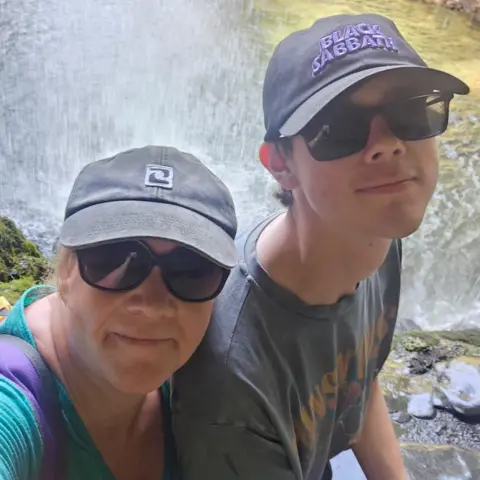 Ruth Bint
Simon Cockeram, co-owner of Willow Acres campsite, said he heard campers struggling to breathe as thick, black smoke descended across the site during the evening.
"They were coughing and spluttering, so we sent them to our house," he said.
"We waited to see if the smoke would dissipate, but it didn't, so we said you're all staying in the house tonight and we'll make a decision in the morning."
South Wales Fire Service has worked with local farmers in Torfaen during the past week and a half to contain the fire.
Bint said the campsite owners were very kind to allow holidaymakers to spend a night in their home.
"The advice usually is to shut doors and windows, but you can't really do that in a tent," she said.
"I tried sleeping in a jumper on the second night in case we needed to make a run for it.
"In the morning, our tent was covered in ash and the smell inside the tent was awful."
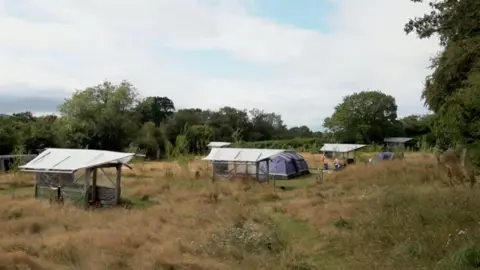
The worsening conditions cut their camping holiday short and the Bint family and others decided to find hotels instead.
Cockeram said the conditions forced them to close the campsite for a few days, which has cost the business £1,200.
Fire and rescue services in England and Wales have responded to 208 wildfires between the 16 and 28 of July, with 706 incidents recorded so far in 2026.
However, the number remains lower than during the same period in 2025.
Almost all UK wildfires are started either deliberately or accidentally by humans.
The National Fire Chiefs Council said the long-term effects of climate change were increasing the likelihood of larger, more complex and more resource-intensive wildfire incidents.
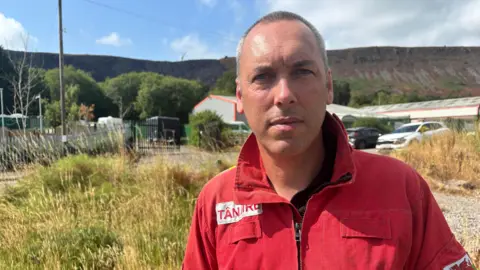
Wildfire science expert Stefan Doerr of Swansea University described the increasing incidents of wildfires as "disastrous".
"We haven't had any [wildfire] fatalities in the UK and fingers crossed it won't happen. But this is usually when people wake up, at least in terms of policy-making, to make a change, but I hope we can make a change before that happens."
"Our landscape is too flammable," Doerr warned.
"Apart from trying to reduce ignitions through education, we must manage our land better year round to reduce the accumulation of flammable vegetation in the landscape."
South Wales Fire and Rescue Service said work was already taking place across Wales through education, prevention campaigns, partnership working and land management initiatives.
Wildfires during the summer months have increased during the past 10 years, according to firefighter of more than 30 years, Craig Hope from Rhondda.
As a result, they become more difficult to extinguish and prevent from reigniting due to the land being much drier than during the spring, he said.
"We need to be careful as to how we manage our resources. We can't keep throwing fire engines and fire crews at these fires because it limits their everyday business in the community.
"This is why we need to move more towards wildfire tactical advisers, people who can make plans for these fires to limit their impact," said Hope, who is currently the UK Government's National Wildfire Resilience Capability Adviser.
"Obviously our response to wildfires is very important, but we need to look ahead more at the risks."
Hope said approaches like better land management and preparing the mountains and moorlands for the risk of wildfire can help deal with the risks.
"If we're going to be doing more re-wilding then we need to be doing more firebreaks as well," he added.
The Welsh government said: "Wildfire has long been a serious risk in many parts of Wales, and climate change is increasing that risk further, particularly during summer heatwave conditions.
"This is a matter we take very seriously as a government as we look to ensure we are resilient to the impacts in the longer term."
Natural Resources Wales said it was working with government and partner organisations to improve prevention, preparedness and response to wildfires.
