Can party politics ever be taken out of the grooming gangs debate?

 BBC
BBCBradford Council leader Stephen Place has warned of "difficult conversations down the line" after the district was named as one of the first areas to be examined by the national grooming gangs inquiry.
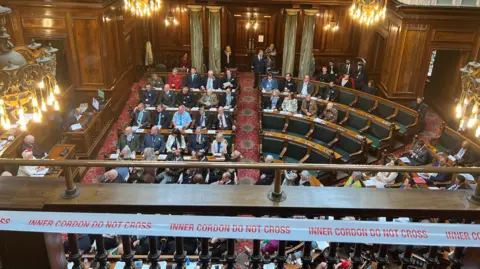
He told fellow councillors the independent review, led by Baroness Longfield, must not become "a political football" as every political group welcomed confirmation that Bradford and Keighley would be among the inquiry's first local investigations, alongside Oldham and London.
A special meeting had been called by Bradford's Conservative group on Wednesday for one purpose: to urge the government to ensure Bradford was included in the inquiry.
But, six hours before councillors gathered, it was announced Bradford and Keighley had already been selected.
 Aisha Iqbal/BBC
Bradford and Keighley's inclusion in the national grooming gangs inquiry marks the culmination of years of campaigning by survivors and victims.
But, at Bradford City Hall, as elsewhere, the inquiry has become about much more than historical child sexual exploitation.
It sits at the intersection of child protection, politics, institutional accountability and community trust, exposing the difficult questions Bradford, and increasingly the country, must wrestle with.
The meeting had, in effect, achieved its goal before it had even begun. That councillors chose to press ahead regardless was, in itself, politically revealing.
Rather than deciding whether Bradford should be included, councillors instead found themselves debating how their response would be recorded publicly.
In local government, the wording of a motion matters beyond pure semantics. Once passed, it becomes the council's formal position and helps shape the public and historic record of how events are understood.
At this meeting, a Conservative motion, a Reform amendment to it and a Labour amendment all welcomed the inquiry and pledged support for victims and survivors. Where they differed was in how they explained the road that had brought Bradford to this point, and where political accountability lay.
The votes themselves were revealing.
Before councillors even reached the main vote, Labour proposed adjourning the meeting so party leaders could agree a single, unified motion reflecting the fact that Bradford had already secured the inquiry. That proposal was defeated by 42 votes to 40, with the Conservatives and Reform voting against, and the other parties voting for.
Ultimately, councillors approved the Reform amendment to the motion, incorporating additional wording from the Conservatives. Only Labour abstained on the final vote, maintaining it could not support wording which criticised previous Labour administrations - despite the party supporting the inquiry itself.
'Political point scoring'
Conservative group leader Rebecca Poulsen had suggested that "not everyone in the district has stood up and shown the same leadership" as campaigners and survivors outside the chamber had.
She criticised the previous Labour administration for not urging the inquiry chair Baroness Longfield to prioritise a local Bradford focus in her inquiry.
Labour group leader Imran Khan welcomed the inquiry, but accused the Conservatives of bringing "a partisan, party political motion on this of all issues", arguing Labour had already backed participation in the inquiry almost exactly a year ago.
"Despite the narrative that some people want to peddle, we were in there from the start," he said, adding that listening to victims should come above "cheap political point scoring".
Again and again, councillors across the parties insisted victims and survivors should remain at the heart of the inquiry. Yet politics and "politicking" continually found its way back into the discussion.
The narrow procedural votes reflected something else too: the fragility of Bradford's new political landscape, where Reform are running the authority, but with a minority administration.
The Bradford element of the inquiry will unfold against that politically delicate backdrop.
The inquiry also begins at a time when this issue has become a touchstone in national arguments about identity, integration and political trust.
That wider tension was evident during the debate, and surfaced most powerfully during Conservative councillor Falak Ahmed's emotional speech.
She recalled that after speaking about grooming gangs during a previous debate on violence against women and girls she had been "shouted down". Had people listened, she said, they would have heard that she was not attacking a particular community, but confronting crimes committed by individuals against children.
That is a distinction many people working across Bradford's community and voluntary sector, including those supporting survivors and those at risk of exploitation, have also been trying to navigate for years, often against the backdrop of shrinking public funding.
Place closed the debate by stressing a collective need to acknowledge "consistent failings" within Bradford and Bradford Council.
"No 'I said this, I did that', it has to stop," he said. "We must now listen, and we're going to learn. We have to support the victims and survivors."
One question now hangs over Bradford's politics: can party politics ever truly be separated from this profound and painful issue?
Because while some political parties may continue to contest ownership of the past, survivors ask for something much simpler, accountability, justice, healing and the chance to reclaim their future.
Listen to highlights from West Yorkshire on BBC Sounds, catch up with the latest episode of Look North.
