US Supreme Court to rule on birthright citizenship and trans athletes

 Getty Images
The US Supreme Court will release two of its most anticipated rulings of Donald Trump's presidency on Tuesday.
Perhaps the most closely watched decision will be on Trump's effort to limit birthright citizenship, the rule that grants those born on US soil automatic citizenship.
The ruling could uphold or upend 150 years of precedent enshrined in the US Constitution.
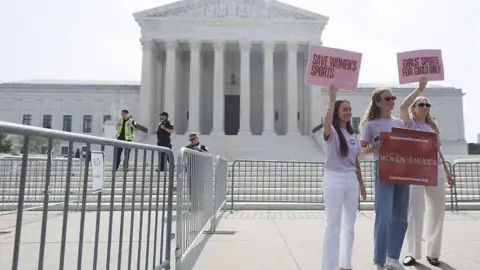
For its final day in this session, the high court is also due to rule on transgender athletes in women's and girls' sports.
Birthright citizenship
The principle of birthright citizenship - also known by the legal term "jus soli" or "right of the soil" - stems from the first sentence of the 14th Amendment to the US Constitution.
"All persons born or naturalized in the United States, and subject to the jurisdiction thereof, are citizens of the United States and of the state wherein they reside," that sentence reads.
Added to the charter in 1868, the law was originally intended to grant citizenship to American-born, formerly enslaved people in the wake of the American Civil War.
In one of his first moves in office, Trump signed an executive order directing federal agencies to limit birthright citizenship by denying it to children whose parents were in the country illegally or were in the country on temporary visas.
The move was a core part of Trump's immigration agenda, which has included crackdowns on illegal border crossings and the revocation of Temporary Protected Status for many migrants. The Supreme Court recently allowed the administration to withdraw protected status from hundreds of thousands of Haitian and Syrian migrants.
The American Civil Liberties Union (ACLU) and its partners immediately filed a class action lawsuit, Barbara v Trump, challenging the "unconstitutional" order.
The core issue of contention centres on the meaning of the phrase "subject to the jurisdiction thereof" in the 14th Amendment.
The administration has argued that the clause means the amendment excludes children of people who are not in the country permanently or lawfully.
On the other side, the ACLU has argued that the clause refers to the physical presence of people born on US soil, not their parents' legal status.
Trump has argued birthright citizenship is a scam that allows both wealthy foreigners and undocumented immigrants to exploit the system.
But the ACLU says ending the practice would create "a permanent subclass of people born in the United States".
During oral arguments on the case in April, the Supreme Court justices appeared sceptical of Trump's efforts to end birthright citizenship.
Justice Elena Kagan said at the time the administration was seeking to undo a legal tradition that dates back to English common law.
"What the 14th Amendment did was accept that tradition and not attempt to put any limitations on it. That was the clear rationale," the liberal justice said.
Whether the court will ultimately issue a broad or narrow opinion is not yet clear.
The difference between a sweeping ruling on constitutional grounds versus a more tailored opinion on statutory grounds is a critical one, legal experts have said.
Transgender athletes
The other major case being released on Tuesday has to do with whether states can restrict transgender athletes from competing in women's and girls' school and college sports.
During oral arguments in January, the court considered cases from students in Idaho and West Virginia who were challenging bans on participation.
The two states enacted laws that require public school and college sports teams to compete in accordance to their sex recorded at birth.
One of the two challenges says the ban violates equal rights protections in the US Constitution. The other says it contradicts civil rights laws.
Over two dozen states currently have similar bans.
During more than three hours of arguments, at least five of the justices appeared to favour upholding the bans.
The court has a 6-3 conservative majority.
Requiring transgender athletes to compete in sport categories that match their biological sex has been a core agenda item for Republicans at the state and federal level under the Trump administration.
Proponents of the bans argue that transgender women have a biological advantage over athletes who were recorded female at birth.
When the International Olympic Committee (IOC) announced in March it was going to limit the women's category of Olympic sports to biological females, it said its working group reviewed the latest scientific evidence over the previous 18 months.
The group concluded there was a "clear consensus" that "male sex provides a performance advantage in all sports and events that rely on strength, power and resistance" .
Those who oppose the bans argue they unfairly discriminate against transgender students. They also dispute whether there is a scientific consensus that transgender women and girls have an inherent advantage.
The court's decision on the case could set a nationwide precedent for how civil rights protections are applied to transgender students.
