How a new era of heatwaves could shake up the school calendar


 BBC
BBCOver the past two weeks, the sound of children has returned to Scotland's school playgrounds. Their summer breaks began in late June or early July and ended in mid-August.
It's an academic year replicated in other European countries too.
In England, Wales and Northern Ireland, however, children will not return until early September. Their holidays are a similar length to Scotland's but England and Wales schools did not break up until late July, something that meant pupils were in school during the peak of the early summer heat.
Or at least they were meant to be in school. While it was 30C or more outside, inside many classrooms it felt far hotter. With no air conditioning and limited ventilation, the heat became stifling and more than 1,000 schools across the UK either closed or sent pupils home early before the hottest part of the afternoon. Conditions were particularly challenging for GCSE and A‑level students sitting exams during extreme heat.
Baroness Brown, chair of the UK's Climate Change Adaptation committee, has warned that "we know high temperatures can significantly impair concentration and performance" of children in schools.
Back in February 2026, Ofsted's chief inspector Sir Martyn Oliver said the timing of the school holidays should be reconsidered: "It's pretty hot usually in May, June and July, just at the point you're asking children to sit down and take an exam… so I think there is a need to have a good old look at it [the school year]."
The recent hot weather has seen some parents join his call. Andrea Bigger, a parent in London, is "absolutely aware of the dangers" of extreme heat in classrooms. She says her daughter has previously suffered from heat exhaustion and was hospitalised after overheating at her primary school. She is "really concerned that the UK is not ready or prepared for this".
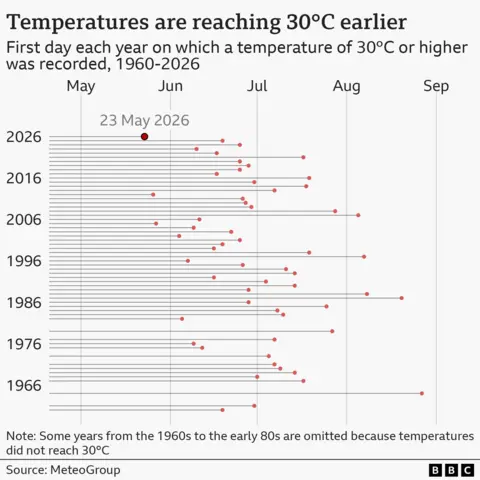
And this summer was not a one off. BBC analysis of temperature data shows a clear shift. In the 1960s, the first 30C day was occurring on average on 13 July. In the 2020s that figure has been 19 June.
So, is it going to be increasingly difficult for schools to operate in the summer months? And is moving the school summer holidays the solution to ensuring pupils are able to be taught for as much of the year as possible?
Longer summer season
This summer is likely to become the hottest on record, according to the Met Office. Multiple temperature records have been broken with five widespread heatwaves and four consecutive months where the temperature has exceeded 35C. This has never happened before.
June saw one of the UK's most intense heatwaves, with up to seven consecutive days where temperatures were well above the official heatwave thresholds of 25-28C - just as the exam period was in full swing. Temperature records were broken too: 38C was recorded in Lingwood, Norfolk on 26 June, the hottest June day ever measured in the UK.
The Met Office issued a red extreme heat warning at the end of June, while the UK Health Security Agency has issued multiple amber warnings over the last few months. The heat then continued into July, with heatwave conditions felt widely for most of the month.
 Reuters
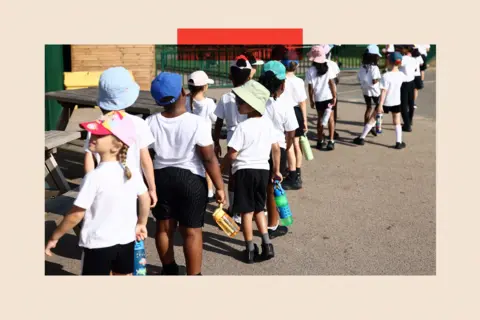
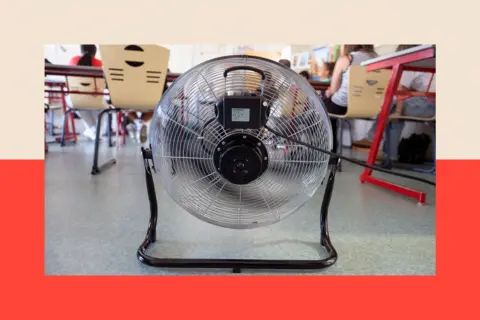
Schools struggled to cope, with some closed declaring "heat days" as temperatures in classrooms became too high for children to concentrate. These kinds of disruptions, or heat days, could become more likely as human-induced climate change brings hotter summers and more frequent heatwaves.
Summer heat is arriving earlier. Will Lang, chief meteorologist at the Met Office, says the "de facto 'hot season' in the UK is lengthening, with increasing prevalence of hot weather - including heatwaves – in May and September in addition to the standard meteorological summer of June, July and August".
It's one sign of a warming climate reshaping the pattern and timing of UK summers.
Poorer performance in hotter schools
According to a study conducted by the Met Office and University College London, students could lose an estimated 8.2 days of learning a year on average due to extreme heat, if average global average temperatures rise to more than 2C above pre-industiral levels - as many scientists believe will happen on current trajectories.
In the meantime, teachers are left to deal with the consequences.
Steve Chalke, founder of Oasis Academy, which runs more than 50 schools across England, says the heatwaves were a "real inhibitor" to teaching. One of the most difficult challenges came when the Met Office issued the red extreme heat warning at the end of June, suggesting potential "danger to life".
He says headteachers were forced into difficult decisions. "What do you do as a headteacher? How can they run a school safely if the national weather service is warning to travel only if essential and make every effort to stay cool. What if a student or member of staff collapses due to the heat and you're accountable for why you opened the school and didn't take your duty of care seriously?"
 Getty Images
And with Met Office predictions of more extreme weather, higher summer temperatures, and more frequent, prolonged heatwaves, these types of questions are likely to only become more prevalent.
Rebecca Martin is concerned about her son taking GCSE exams in a few years' time in potentially increasingly hot weather. She thinks there needs to be "some serious considerations to the school year to reflect the changing climate or better investment in schools to give them air conditioning".
And there is growing evidence to support her worries. The recent Well-Adapted UK report from the Climate Change Committee suggested that taking an exam on a 32C day leads to around a 10% lower likelihood of passing, compared to sitting the same exam at 22C.
Baroness Brown told the BBC that "as heatwaves become more frequent and intense, it is unacceptable that children are expected to sit high-stakes exams in halls that were not designed for these conditions".
Many of us are familiar with a "snow day" in the winter, when snow can make it very difficult for staff and students to get into school. While there is no legal minimum temperature, the National Education Union says classrooms should be kept above 18C. Heat days are a newer concept - and there are no specified maximum temperatures for a classroom.
A 2024 study published in the journal Climate Risk Management suggested that any temperature above 24C can compromise learning. It also found a decline in student performance ranging from 2% to 12% for each degree increase in classroom temperature.
Setting a temperature benchmark of 26C as the upper "comfortable limit" in a classroom, the authors of the study went on to suggest that the average school currently reaches this limit 59 days of the year in England. That would increase to 71 days with 2C of warming.
In "at-risk" schools where there is no suitable ventilation or where newer buildings have lower ceilings, there would be 75 days where the "comfortable 26C classroom temperature would be breached".
In hotter European countries such as France and Spain, local authorities have extreme heat guidelines that trigger timetable changes or school closures when conditions become too hot. It's a model some argue the UK may need to consider as the UK summer continues to change.
The impact of shifting holidays
While extreme heat or heatwaves can still occur in May and June - or indeed in late August or early September, by which time it's proposed pupils would have returned to class - breaking up for summer at the end of June could reduce the amount of disruption schools face from the hottest conditions heading into the peak of summer.
And while this August has also been hot and dry, some parents argue that an earlier break would be better aligned with the UK's typically warmer and drier mid-summer weather. Rebecca Martin says she'd like to be able to "make the most of the more guaranteed summer-like weather in July" planning to spend more time outdoors in a UK staycation rather than going abroad to parts of Europe where the "heat is getting even more extreme and unpleasant".
Europe is the fastest-warming continent, with temperatures rising at around twice the global average. Like the UK, European heatwaves are becoming hotter, more frequent and longer.
Staycations in the UK could become even more popular. According to 2024 research by Mintel, more than half of UK holidaymakers say they are likely to choose to holiday at home rather than abroad for climate-related reasons. Meanwhile, some 28% say higher UK temperatures are encouraging them to take domestic holidays.
What remains to be seen is how any changes to the school summer holiday could affect the price tag. Aligning the holiday period more closely with Scotland and other countries means there could be more demand in late June and July, potentially pushing the traditional price peak earlier in the year.
Other changing holiday habits - such as avoiding the peak of the summer heat and extreme temperatures in southern Europe - will also play a role.
In a recent national survey by InsureandGo, more than seven in 10 UK holidaymakers thought some European countries like Spain, Greece or Turkey would be too hot to visit in the summer months by the end of the decade.
As travel journalist Simon Calder has said: "A significant shift in holiday habits could push up the cost of a domestic holiday.
"If more people decide to stay in the UK, and others come to Britain because it is more climatically appealing, the rise in demand would trigger price increases. But there are always locations where you can get reasonable deals."
Long-term plans are required
In England, term dates are determined by school employers - for maintained state schools, that's their local authority. Other schools, including academies, free schools, foundation schools and voluntary-aided schools, can set their own term dates.
However, any changes to the school holiday or academic year would likely require national‑level discussion and leadership, rather than decisions made by individual schools.
Steve Chalke of Oasis Academy suggested there needs to be a national plan with clear guidance for schools facing increasingly hot conditions in our warming climate.
"We're all accustomed to 'snow days' but we now need to properly think and prepare for 'heat days' too," he says. And "without doubt we need to rethink the school year".
For some parents, though, the answer isn't about changing the school holidays but making the school buildings more climate-resilient for the future.
Gemma Beake, a parent of two boys at a school in Bristol, suggests that if schools can be made cooler and have investment with air conditioning, they will be "safer places than a lot of homes and flats where we have the same problem of overheating".
British summers will always be variable, and no two years will be exactly alike. But the direction of travel is becoming clearer. Hot weather is arriving earlier, lasting longer and increasingly testing our school buildings that were designed and built in a past climate.
While headteachers can implement changes to uniform - as many did this year - so that PE kit could be worn instead of traditional uniform, for many it's the buildings that need adapting to the changing climate of today and especially the future.
But either upgrading infrastructure to climate resiliant schools or modifying the academic year would need institutional change with the possibility of a lot of investment. And both would take many years to implement.
For parents, teachers and school leaders however, changes are needed as soon as possible. As Steve Chalke puts it: "We need the government to come up with a short-term plan for the next few years."
This may simply mean better guidance during "heat days" and on when it is appropriate to shut schools, as with "snow days". Or just being more flexible - allowing schools to open earlier and finish earlier in the day to avoid a peak in temperatures.

BBC InDepth is the home on the website and app for the best analysis, with fresh perspectives that challenge assumptions and deep reporting on the biggest issues of the day. Emma Barnett and John Simpson bring their pick of the most thought-provoking deep reads and analysis, every Saturday.Sign up for the newsletter here
