How 'a doodle of a massive greenhouse' saved the Great Exhibition

 Getty Images
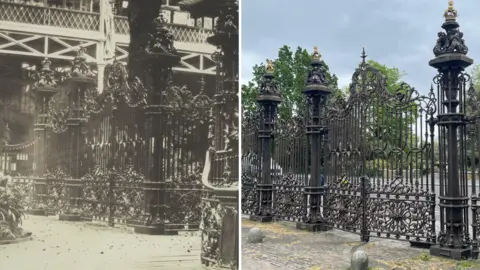
On a street corner in South Kensington, an elaborate set of cast iron gates decorated with stag heads, cherubs and foliage open on to London's Hyde Park.
"Around here would have been full of people, people on the street selling food and all sorts of things - and everyone would see the Crystal Palace in the distance," explains historian Jennifer Wallis.
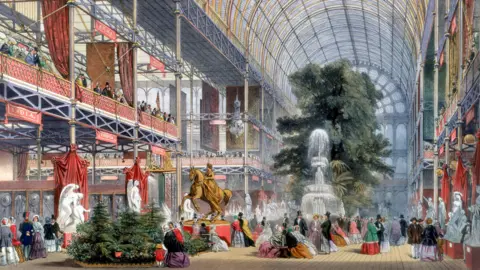
On 1 May 1851, 20,000 people packed into the largest glass building in the world to hear Queen Victoria declare the Great Exhibition open.
More than six million people - the equivalent of a third of Britain's population at the time - visited the six-month long spectacle showing off Britain's industrial prowess.
"Almost as soon as it closes there's this air of nostalgia for it. It was a great moment, it was never going to be surpassed," says Wallis.
And yet its existence was far from straightforward - with some of the issues it faced having certain echoes of today.
 Getty Images/BBC
With Prince Albert as its patron, plans were announced for a "Great Exhibition of the Works of Industry of All Nations" to be held in Hyde Park in May 1851.
From the outset there were critics, none more so than those already living in the South Kensington area.
"There were lots of disgruntled, 'not in my backyard' kind of people who were really unhappy that they were going to have it," says Wallis, a lecturer in the history of science and medicine at Imperial College London.
"They thought their property values were going to go down, that it was going to turn into a slum, that it was just going to be overrun with horrible tourists."
 Guildhall Library & Art Gallery via Getty Images
A petition sent to Parliament failed but even designing a suitable venue to host the exhibition had its own issues.
In 1850 a competition was launched to design a venue that was both suitable for such a grand event, but also temporary and could be built in time.
Some 250 entries were submitted but all were rejected as inadequate. The exhibition's building committee, including preeminent engineers of the day like Robert Stephenson and Isambard Kingdom Brunel, even had a go - but were turned down.
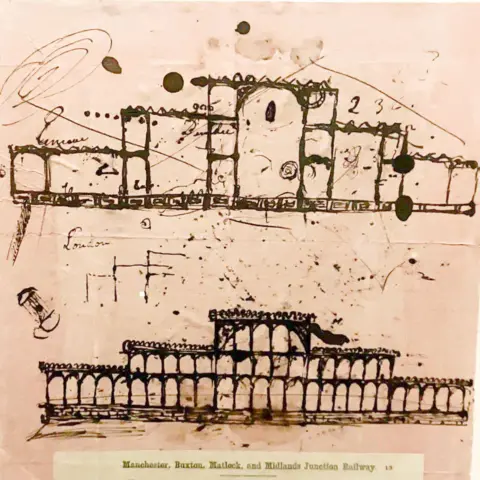
The entire project was in crisis but a chance meeting between Chatsworth head gardener Joseph Paxton and Stephenson saw Paxton present a doodle of a massive greenhouse he had drawn while attending a meeting about railways.
And with that a scribble on a piece of paper became the basis for one of the most famous constructions of Victorian London.
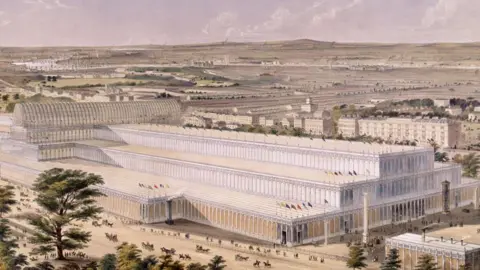
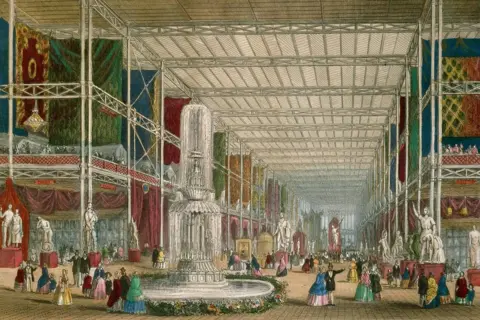
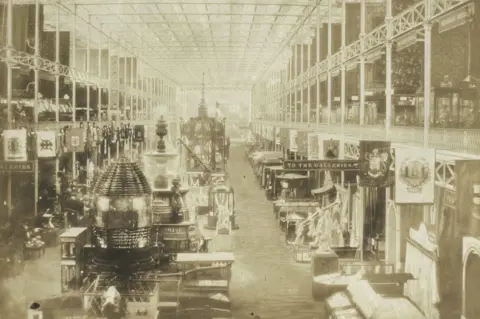
The glass house, dubbed the Crystal Palace by satirical magazine Punch, was revolutionary, being more than 560m (1,837ft) long, with 330 columns holding up thousands of glass panels - and perhaps most amazingly of all, built well in time and within budget.
"I find it pretty incredible that they do pull it off," comments Wallis.
Despite the critics - including one MP who branded it as "humbug" and wished for it to be destroyed by a hail storm or lightning strike - excitement grew.
Subscription clubs were set up across the country the year before meaning people could save to buy a ticket, with excursions organised using Britain's growing railway network.
 Getty Images
Upon arrival, visitors entered a huge glass palace which was tall enough to incorporate some of the park's trees and had a magnificent 8m (27ft) high fountain made of pink glass at its centre.
Faced with such grandeur, a common British trait soon came to the fore - mild disappointment.
"There's lots of like really familiar complaints like, 'the cab drivers charge us too much to go to the Great Exhibition, they're all profiteering'," Wallis explains.
And then there was the catering.
"It's so reminiscent of like British Rail sandwiches, like all the food's terrible and it's overpriced".
 Corbis via Getty Images
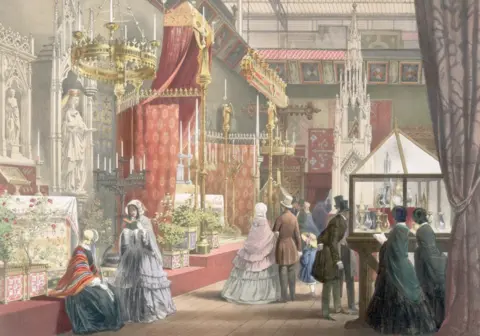
Being a massive greenhouse in the height of summer, temperatures would at times soar to around 36C (97F), the daily heat being reported in the newspapers.
Even what many people considered the main attraction, the Koh-i-Noor diamond which is now in the Crown Jewels, proved to be a bit of a let down.
"Apparently it wasn't as shiny and sparkly as they expected," she adds.
 Hulton Archive via Getty Images
For some it was all too much. During a family visit, a teenage William Morris, who would become the centre of the Arts and Crafts movement, refused to enter and instead sat on a bench sulkily outside having condemned it as "wonderfully ugly".
Even so crowds kept coming. At its height 50,000 were turning up each day to look around the largest display of manufactured objects ever assembled from Britain and across the world.
With some 100,000 objects from 14,000 exhibitors on show, the Times estimated it would take three months of visits to see everything.
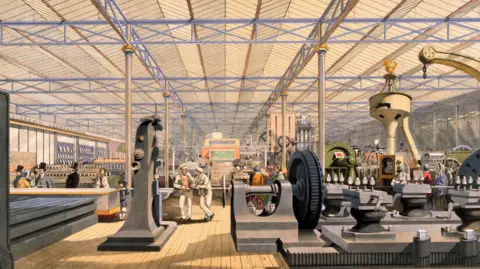
A section of the ground floor was called Machinery in Motion, where visitors could watch all kinds of large industrial works in action, powered from a boiler-house.
"It was like one of the great wonders of the world at the time," says Ben Russell curator of mechanical engineering at the Science Museum, where a number of exhibits from the exhibition can be found.
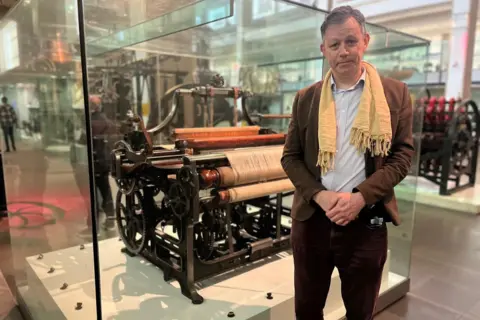
Among those featured was a mechanical loom made for producing cotton built by a Blackburn textile engineering firm, which the museum now owns.
"Alongside it they had what was one of the old handlooms, which was made of wood. And it was saying, 'look what we've replaced. We've got this amazing, shiny, high-precision manufactured thing'."
Yet there was also a bittersweet message in this display, akin to the same fears many now have about the impact artificial intelligence could have have on the job market now.
"The mechanical loom was designed to be power driven by a steam engine but actually put tens of thousands of people out of work.
"Having this alongside what it replaced, they're saying, 'look how far we've come', but they've slightly glossed over a lot of the controversy about it," Russell says.
 Getty Images
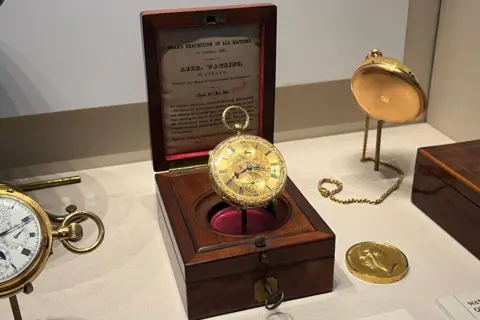
Other objects from the exhibition can be found nearby and further afield. The V&A museum, for example, has souvenir tickets, a statue of a dog standing on a snake and Paxton's doodle among other objects.
The Crystal Palace was rebuilt in what is now south-east London, but the exhibition left its own legacy in South Kensington's museums and cultural destinations with the £186,000 (the equivalent of £20m today) profit raised from the exhibition being used to found many of the museums and institutions there.
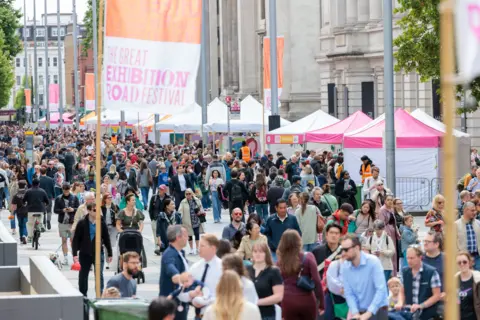
Next month the likes of the Science Museum, Imperial, the V&A and the Royal Albert Hall will come together for the Great Exhibition Road Festival on 6 and 7 June.
Aptly, this year will partly focus on the 175th anniversary, with tours of the original site, demonstrations about food of the time and the building of a new Crystal Palace in sand among numerous events going on along Great Exhibition Road.
"I guess you could say there's some legacy between the two events in terms of it's kind of cutting edge science and arts," explains James Romero, Imperial's public engagement manager.
"You can only really do a festival like the Great Exhibition Road Festival in South Kensington because there's such a cluster of sort of museums and research organisations and cultural stations around here.
"So we are sort of the heirs in that way."
 Great Exhibition Road Festival
Listen to the best of BBC Radio London on Sounds and follow BBC London on Facebook, X and Instagram. Send your story ideas to hello.bbclondon@bbc.co.uk
