Woman realised she had ADHD during early menopause

 BBC
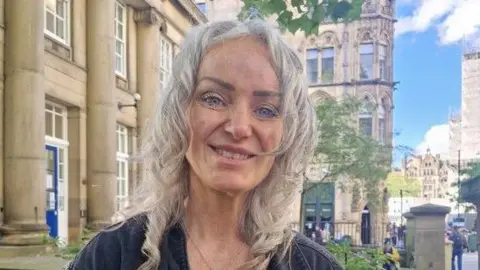
BBCA woman who was diagnosed with ADHD at the age of 43 said she only realised she had the condition after going through early menopause due to her breast cancer treatment.
Gill Charlton, now 46, believes her ADHD symptoms were heightened while she was undergoing treatment for the disease along with dealing with her own mental health struggles.
"I'd had a really successful career and suddenly the wheels started falling off," said Gill, from Chorley in Lancashire, who served in the British Army for more than two decades.
She made the comments as Dr Helen Wall, a GP from Bolton, has called for more awareness and training to help women who are diagnosed with ADHD when they begin menopause.
She said menopause could be challenging for many women, but for those with ADHD, the experience can often feel like life was completely unravelling.
Menopause happens when a woman's period changes and eventually stops due to lower hormone levels.
ADHD is a condition where the brain works differently to most people including difficulties with things like concentrating and sitting still, according to the NHS.
Gill, who now works as a celebrant, said: "I was late diagnosed with ADHD and my diagnosis came after a cancer diagnosis.
"I had breast cancer that was oestrogen positive.
"So the medication that I had to take after that put me into a clinical menopause quite early, and that's when my ADHD symptoms came to the fore."
Gill now runs a support group in Manchester called ADHDAF+.
The charity runs 13 groups across the country with four in the north-west of England.
"I cannot explain the power of community," she said.
"We've had somebody that came to group who had run her own really successful business and then one day she just couldn't understand what had happened.
"She couldn't function anymore. Her business ceased to trade.
"She went in and out of psychiatric help and then one day she was diagnosed with ADHD.
"She then realised that she was in perimenopause. She just needed those support systems."

ADHDAF+ was created by Laura Mears-Reynolds in 2022 after she was diagnosed with ADHD.
"Getting those answers and starting treatment for ADHD absolutely saved my life," she said.
"There's no doubt about it."
She said starting perimenopause - the transitional phase leading up to menopause - could be incredibly tough for many women.
"When that oestrogen starts to drop, our ADHD is exacerbated so our symptoms get worse," she said.
"So the mask or the coping strategies that we didn't even know that we had built become impossible to uphold, meaning that that's why so many people in their late 30s, early 40s are discovering they have ADHD."
'Long wait times'
Some symptoms of both ADHD and menopause are similar, so it can not always be easy to tell the difference, leaving women unsure.
Dr Wall, who recently published a book on ADHD and menopause, said there was not enough help and support out there.
"It's really challenging for anyone – male or female – who think they may have ADHD or any neurodivergence," she said.
"The systems are very clogged, there's long wait times to be assessed, long wait times to be seen and managed.
"Even if you don't want a diagnosis and don't want medication, it's difficult to get that support, which is why I think groups like ADHDAF+ are so great."
In December last year, the government launched an independent review to examine how the health system currently delivers mental health, ADHD and autism services.
NHS Lancashire and South Cumbria Integrated Care Board (ICB), said it "recognised the challenges highlighted and the impact that long waits can have on people seeking help".
A spokesperson said the issue was "largely underpinned by huge increases in demand since the pandemic", and a full transformation of adult ADHD pathways was taking place.
They said people with ADHD had told the ICB they needed "more than a diagnosis alone" and it was developing "broader support", including neuro-informed mental health services, peer support, and practical skills-based education to help with ADHD-related difficulties.
"Our ambition is an end-to-end pathway that offers early support, timely access to specialist care where needed, and a personalised package of support for everyone who comes forward for help," they added.
If you have been affected by this report, help and support is available at BBC Action Line.
Listen to the best of BBC Radio Manchester on Sounds and follow BBC Manchester on Facebook, X, and Instagram. You can also send story ideas via Whatsapp to 0808 100 2230.
