'Our son's jaw was left in pieces after dog attack'

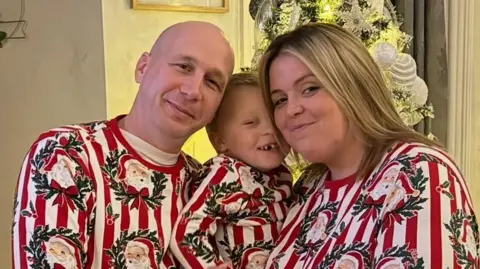 Family handout
"The surgeon described Alfred's jaw as being like a box of cornflakes - when they opened it up, it was just in pieces."
Danielle is describing the injuries her son suffered when the four-year-old was attacked by a pocket bully dog while the family was out trick or treating at Halloween nearly two years ago.
She has been speaking about her son's recovery and is now campaigning for more responsible dog ownership, as new figures suggest a rise in dog attacks recorded by police in England and Wales.
Defra said it would consider whether the current dog control rules were sufficient to ensure communities were protected.
'He started screaming'
The family were knocking on doors in Bexhill, East Sussex, in October 2024, when a dog ran out and bit Alfred's face.
"It was completely unprovoked, he wasn't wearing anything scary," said Danielle. "It happened very quickly."
Her husband Robert said his son was initially lifeless in his arms, before Alfred started screaming.
"When I looked at him, he had a hole in his face and blood gushing from under his neck," he added.
The couple have praised hospital staff in Hastings who initially treated him and the specialist plastic surgeons at the Queen Victoria Hospital in East Grinstead for rebuilding their son's jaw.
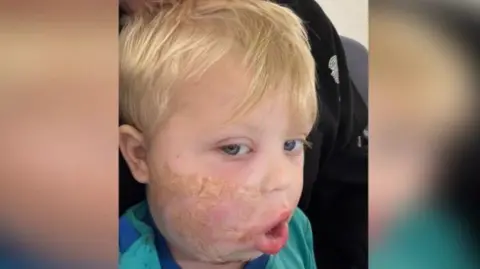 Danielle
Last year, police across England and Wales recorded 32,746 offences of an out-of-control dog causing injury to a person or guide dog.
That is up 5% from 31,276 in 2024. The number of offences recorded has risen each year, but the rate at which it is doing so is down - 2023's figure of 30,276 was up 21% on the year before.
These figures are based on police data obtained by the BBC via a Freedom of Information request from 42 of the relevant 43 forces. Cheshire Constabulary did not provide figures for each year requested.
A measure introduced to help reduce the number of dog attacks was adding the XL bully to the list of banned breeds, following a series of fatal attacks.
However, Danielle and Robert said their son was injured by a type that was not banned - a pocket bully - and they are calling for parents to be more aware of the dangers that all dogs could present.
Danielle said she feared people could be complacent around other breeds that are not banned.
"Banning a dangerous dog just makes people feel they are safe from other dogs and that's not the case," she said.
"All dogs can be dangerous if they're not brought up correctly, if not raised the right way, if in pain they can lash out, they can bite."
The RSPCA said it was hard to pinpoint one single factor behind a rise in recorded dog attacks.
The National Police Chiefs' Council previously told the BBC some of the increase could be attributed to dogs purchased during lockdown, who missed out on key socialisation and have since become too difficult to handle in maturity.
In 2024, a Royal Veterinary College study suggested dogs bought during the pandemic had high rates of problem behaviours.
"Potentially the increase in behavioural problems is linked to the pandemic puppy surge," said Surrey-based dog trainer Antonia Mitchell.
She also believes increased dog ownership during the pandemic is a factor.
A Commons Hearing in 2023 heard the UK's dog population rose to an estimated 11 million, with many people becoming first-time owners.
"A lot of these owners were first-time owners and at that time we were all closed down [during lockdown] and there wasn't that access to training, so you were very much on your own," Mitchell added.
Why were XL bullies banned?
The XL bully ban came into force in England and Wales in February 2024 to help reduce the number of people injured by dogs.
It is illegal to own or possess one unless you have a valid Certificate of Exemption and follow strict rules.
The ban followed a spate of fatal dog attacks, with XL bully types disproportionately involved, according to the last government.
Some have argued bully-type dogs present a bigger risk than other dogs.
But the RSPCA claims breed-specific legislation does not work because the breed itself is not a reliable predictor of aggression in dogs.
A recent BBC Panorama investigation revealed how the number of dangerous dogs needing to be put in kennels has risen more than a third since the ban.
The police tactical lead for dangerous dogs in England and Wales said attacks were likely to get worse before they get better, as dogs bought before the ban reached maturity.
The family of 19-year-old Morgan Dorsett, who was killed by an XL bully after the ban came in, have called for tougher legislation.
They want it to focus more on the owners as well as the dogs, with checks like those for firearms certificates.
Pippa Apps, director and founder of Best Behaviour School for Dogs in Kent, works with dogs displaying aggression towards people.
"I think it's a case of ensuring dogs are bred properly through reputable breeders and then in the homes of people who are bringing them up and the nurture, the environment and the training is all correct for them," she said.
"If a dog is displaying these sorts of behaviours, we are going to get it treated and countered very early on in their life".

Apps, who is an animal behaviourist, said the UK needed more regulation on dog ownership to reduce attacks, potentially bringing back a dog licence.
"It's not just buying a licence, it's education and maybe mandatory classes, or some sort of lessons on how to identify different types of dog behaviour," she added.
The Government has reconvened a taskforce to explore measures to promote responsible dog ownership.
Defra said the taskforce had considered the role of education and training, for both dogs and their owners, in reducing the risk of dog attacks and ministers would consider the recommendations.
Dog licences were abolished in England, Scotland and Wales in 1987, but the RSPCA has been consistently calling for a return of licensing.
The charity said it would help to provide information to monitor dangerous dogs and would enable targeted enforcement.
Dr Samantha Gaines, head of companion animals at the RSPCA, also wants more focus on responsible breeding.
"Whether or not a dog goes on to bite someone is very much around how they have been bred and their lifetime experiences," she said.
A Defra spokesperson said: "Dog attacks can have severe consequences, which is why it is a criminal offence under the Dangerous Dogs Act to allow any dog to be dangerously out of control.
"We will continue to encourage responsible dog ownership across all breeds of dog and to consider whether the current dog control rules are sufficient to ensure communities are protected."
Follow BBC Surrey on Facebook, X, and on Instagram and listen to BBC Radio Surrey on Sounds. Send your story ideas to southeasttoday@bbc.co.uk or WhatsApp us on 08081 002250.
