What is Birmingham's political future?

 BBC
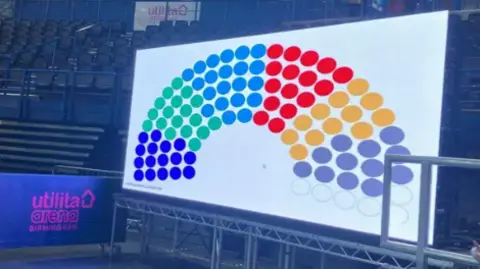
BBCThe political map of Birmingham now resembles a rainbow.
The largest unitary council in the UK has gone to no overall control, its political future hard to predict.
As of 23:00 BST on Friday there were two seats left to count in the Glebe Farm and Tile Cross ward. Having run out of time, the returning officer announced the team would be back at the Utilita Arena on Monday to finish the job.
Counting cannot resume before Monday because of other bookings - psychedelic rock act Tame Impala are playing on Saturday night.
Reform UK are the largest single group, with 22 of the 101 seats, far below the 51 necessary for an overall majority and just behind them are the Greens who took 19 surpassing the former ruling Labour group who once held 65 seats in the second city.
 Jacob King/PA Wire
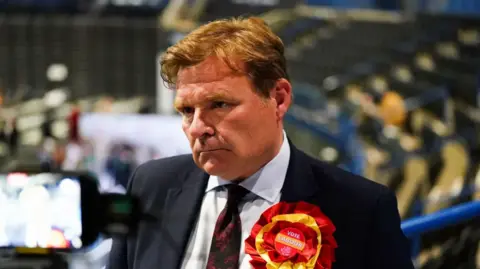
Labour appear to be casualties of not just the national mood, but also financial hardship and an all-out bin strike nearly into its 15th month.
The Conservatives held firm in their heartlands in leafy Sutton Coldfield, but lost seats to Reform elsewhere - including in the south, in the areas in and around the former Rover plant in Longbridge.
Despite investing in a fairly serious ground operation in the second city the Liberal Democrats held their ground but failed to make gains.
Meanwhile, independents campaigning in largely Muslim areas won a handful of seats in wards the Labour Party could once rely on.
What happens now is a head-scratcher.
No two parties working together have enough seats to take control. It will need to be three, or even four and the Venn diagram of what these groups agree on is limited.
Some of the groups have already spoken publicly about red lines when it comes to negotiations with other parties.
The Lib Dems locally have said they are happy to look at deals with others, but would not work with Reform UK.
The Green group leader Julian Pritchard told me on Friday the party had always shown a willingness to work with others, but "would not work with anyone whose values conflicted with what the party stood for". They would not be working with Reform.
While some may think a pact between Labour, the Lib Dems and the Greens could be the answer, some quick maths reminds you even then they do not hit the magic 51 figure required for an overall majority.
 PA
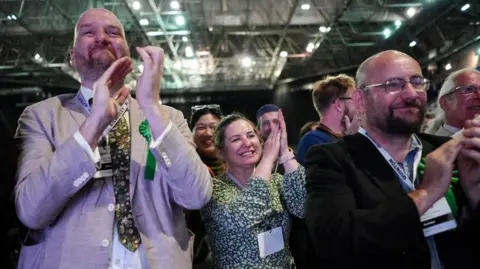
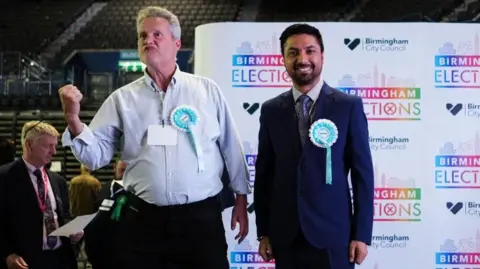
PAAs the largest single group Reform UK might argue they have the mandate to attempt to form alliances and lead the authority.
Uniting the right is a phrase we've heard from some within its ranks often, but that would very much depend on the Conservatives. I'm told senior Tory figures in the region, including former West Midlands Mayor Andy Street, who hails very much from the centre ground of British politics is dead set against any such a deal and is lobbying hard to prevent it.
In any event, such a deal would only deliver 38 seats, and support from the Independents, who formed a pact with George Galloway's Worker's Party, seems highly unlikely.
Many of these new independent councillors also campaigned on a staunchly anti-Labour position and would be unlikely to support any deal in which the party was involved.
 PA
PAWhat all this means is that negotiations are likely to be long and protracted. A lack of clarity could mean a greater role for the government commissioners appointed in the wake of the council's defacto bankruptcy in 2023. They are currently set to depart in 2028, after the authority managed to balance its budget earlier this year, but that could potentially be extended.
On Friday morning, the current Labour Mayor of the West Midlands Richard Parker said that uncertainty was the last thing the region needed, telling the BBC he needed "serious people" running Birmingham to help attract business and investment. There is a lot riding on what happens next in the second city.
Follow BBC Birmingham on BBC Sounds, Facebook, X and Instagram.
