Court hears Hampstead ponds trans access challenge

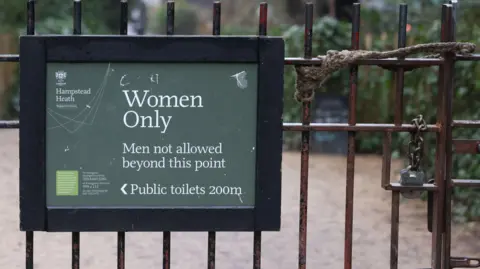 EPA
A High Court challenge to the transgender access policy at Hampstead Heath's single-sex swimming ponds has heard arguments that it compromises women's "privacy, dignity and sense of safety".
The charity Sex Matters is disputing City of London Corporation rules that allow access to the north London ponds based on gender identity rather than biological sex.
Representing the corporation, David Stilitz KC said changing the policy "would prevent [trans people] using the pond corresponding to their lived gender, which is recognised as an aspect of their rights".
The case will determine whether the policy is lawful following the Supreme Court ruling that a woman is defined by biological sex.
The corporation confirmed in June that Highgate Men's Pond would remain open to transgender men, whose biological sex is female, while transgender women, whose biological sex is male, would continue to have access to Kenwood Ladies' Pond. The mixed pond remains open to everyone.
Lawyers for the Sex Matters charity argued the policy placed women at a "particular group disadvantage compared to men".
The court heard that the City of London Corporation had recorded no substantiated incidents of inappropriate behaviour involving a transgender person since the policy was first introduced in 2017.
On behalf of Sex Matters, Tom Cross KC said the charity was not suggesting that "every, or most, or even many" transgender women posed "an actual threat" to women.
He said: "The point is that women are more likely to experience compromise to their privacy, dignity and/or sense of safety than are men in the presence of a person of the opposite sex in what they expect to be a same-sex space."
Cross added: "There is no requirement for a man who identifies as trans to have had any surgery when being permitted to undress and shower in front of women, or to be present in front of women who are undressing or showering.
"Neither the defendant, nor a female pond-user, will know if the male pond-user genuinely has a trans identity or just prefers to use the facilities of the opposite sex."
He also told the court that transgender people could still use the ponds according to their biological sex, or use the mixed pond.
'Lived gender'
Stilitz told the court that the current trans access policy was "justified" and a "proportionate means" of minimising what he said were disadvantages faced by transgender people, while fostering an environment that reflected "the ethos of the ponds".
He said a sex-based policy "would have deprived the ponds of their unique character" and "would also have been likely to give rise to claims of indirect discrimination by trans users, which the corporation would have struggled to justify".
Stilitz said the ladies' pond included private changing and shower facilities for those who did not wish to use shared spaces, with the corporation spending hundreds of thousands of pounds to improve them.
He told the court: "A biological sex-based option would force trans people to use other facilities where they do not feel as comfortable or safe. It would prevent them using the pond corresponding to their lived gender, which is recognised as an aspect of their rights."
Listen to the best of BBC Radio London on Sounds and follow BBC London on Facebook, X and Instagram. Send your story ideas to hello.bbclondon@bbc.co.uk
