Diver urges more protection for world's longest chalk reef

 Rob Spray
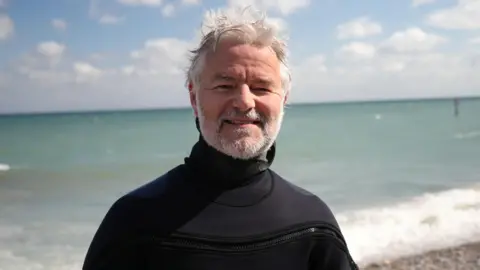
A diver who helped discover the sprawling size of the world's longest chalk reef has warned more needs to be done to protect it, 10 years after it was designated a Marine Conservation Zone (MCZ).
The Cromer Shoal Chalk Beds, dubbed Great Britain's Barrier Reef, date back more than 100 million years and stretch 20 miles (32km) along the Norfolk coast from Happisburgh to Weybourne.
But diver Rob Spray, who uncovered the reef's size with Dawn Watson, said the "conservation zone has brought nothing in the way of protection".
Natural England, which granted the MCZ status, said it "remains committed to safeguarding this remarkable habitat".
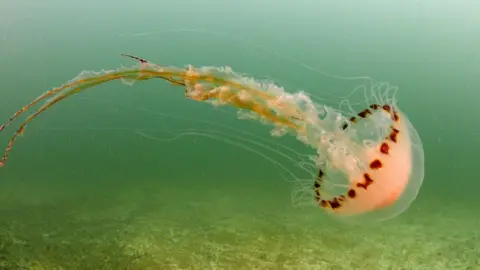
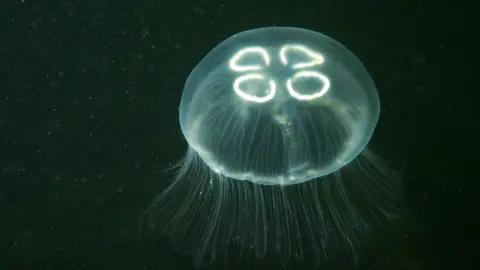
The North Sea off the East Anglian coast has been experiencing its own heatwave since February and as temperatures increase, unusual creatures are starting to move in.
 Shaun Whitmore/BBC
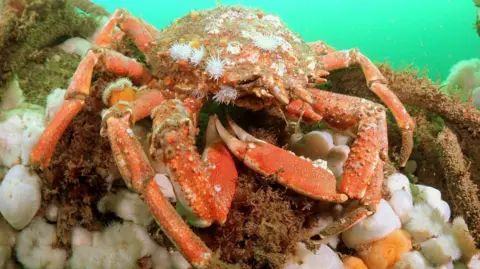
Spray, chairman of the Marine Conservation for Norfolk Action Group, said: "We've seen things like the spiny spider crab, which is a couple of foot wide, and something never seen on this coast before."
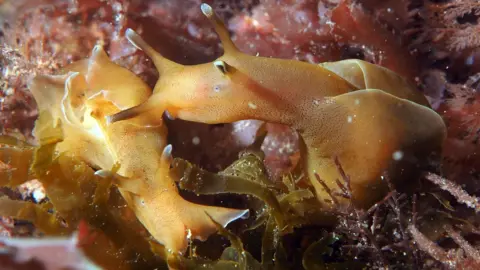
Other creatures found on the reef, which is about 8m (26ft) below the surface, include spiny spider crabs and sea hares – "a kind of very sexy sea slug", according to Spray.
"We hadn't seen them before and in the last few years we have had mountains of them," he said.
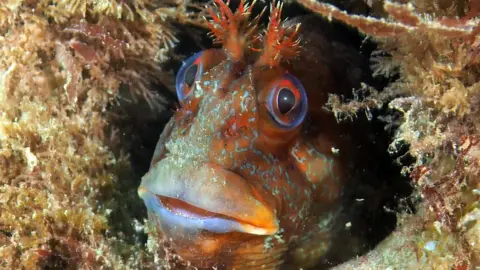
The "most cute", he said, were fish called tompot blennies, which were very rare on the reef but could now be seen "squabbling over territory on the bottom".
More stories on Norfolk's chalk reef:
 Rob Spray
 Rob Spray
The feature, recognised by Guinness World Records as the world's longest chalk reef, can be seen at low tide at West Runton and other spots between Trimingham and Cley next the Sea.
However, Spray is concerned how it will be protected for future generations.
"We have got a climate crisis going on as the extremes of weather get ever stronger," he said.
"And we have got the reduction in the reef, which means that the reef population is ever more sort of imprisoned by the shallows, whether that's very hot in the summer or very cold in the winter."
Spray fears a tipping point will be reached and native species will be driven out.
He believes the reef needs to be protected from the impacts of fishing and cable access.
 Shaun Whitmore/BBC
While it is a designated MCZ, the site is constantly monitored.
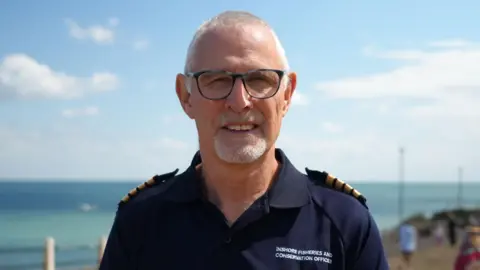
Julian Gregory, chief executive of the Eastern Inshore Fisheries and Conservation Authority, said there was now a "question mark" over whether fishing could continue there.
"The work we are doing is giving us a good understanding and we are pretty confident we've got a lot of breathing space and we are not close to the conservation efforts being hazards," he said.
"A MCZ is intended to be a multi-use site, so the objective is not to ban activity from the outset. What we have to do is assess and understand the impact of that activity to see if it is damaging... we know a lot more than 10 years ago."
He said it was important to ensure that efforts to manage the risks to the reef were not having a "disproportionate impact" on the fishing industry and the coastal communities it supports.
"The features of the site are important habitats. The rugged chalk in particular is quite rare in Europe – you can understand why it's designated," he said.
 Rob Spray
 Shaun Whitmore/BBC
Prof John Pinnegar, lead adviser for climate change at the Centre for Environment, Fisheries and Aquaculture Science, said water temperatures around East Anglia had been monitored for more than 120 years.
In that time, he said, the water had warmed by 2C (3.6F) with the sea experiencing heatwaves since 2014.
He said changes in temperature would have an impact on species living on the reef, both positively and negatively with some species departing and others arriving.
 Rob Spray
Pinnegar said species becoming more abundant in some waters included anchovy, sea bass, squid, octopus and seahorses.
"I'm concerned for some of those fishery species like cod which might not be able to hang on in the UK but equally quite excited by some of the warmer water things people are used to eating when they are on holiday in the Mediterranean," he said.
Hannah Thacker, deputy director for Norfolk and Suffolk at Natural England, said: "Ten years ago, we designated Cromer Shoal Chalk Beds as a Marine Conservation Zone, protecting one of England's most distinctive chalk reefs, home to species from lobsters and crabs to the tompot blenny, and supporting the small-scale fishery that's long shaped this coastline's character.
"A decade on, Natural England remains committed to safeguarding this remarkable habitat for the marine life and communities who depend on it."
Do you have a story suggestion for Norfolk? Contact us below.
Follow Norfolk news on BBC Sounds, Facebook, Instagram and X.
