Council to decide on plans for 300-acre solar farm

 Getty Images
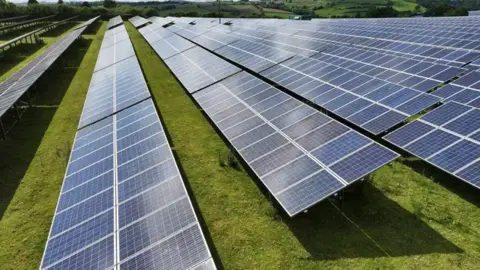
A council is set to decide on plans for a 300-acre solar farm dubbed "the lesser of two evils" by residents after a string of housing applications in the area.
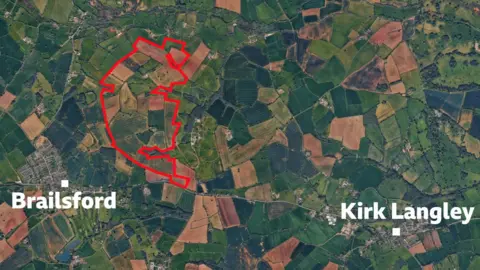
British Solar Renewables (BSR) has submitted plans to build the solar farm between Brailsford and Kirk Langley, west of Derby.
If approved, the Local Democracy Reporting Service (LDRS) said the plans would provide electricity directly to the National Grid for 16,060 homes per year, with BSR saying it would save 22,396 tonnes of carbon dioxide annually.
Derbyshire Dales District Council will make a decision on the plans in the coming months.
 LDRS
LDRSThe LDRS said the scale of the proposed scheme was reduced from an initial 373 acres (150 hectares).
BSR said this includes a reduction of 18 acres (seven hectares) in "sensitive areas".
A submitted map shows the reduction in size was taken from the western side of the development closest to Brailsford, including fields which would have directly adjoined a development of 70 homes off Throstle Nest Way, which was approved by an inspector in February.
The plan would turn dozens of fields between Brailsford and Mercaston, towards Wild Park Derbyshire, Mercaston Hall and The Pub in the Woods, into a solar farm.
Access to the site would be from the A52, which developers said could accommodate delivery of construction equipment.
BSR said it has also planned more landscaping in a bid to block the significant scheme from view.
'Significant improvements'
A number of housing developments have been approved in the Brailsford area, including 70 off Throstle Nest Way and 75 off Main Road.
Kirk Langley has also seen around 200 homes approved, according to the LDRS.
Arthur Durham, who has lived in the village since 2001, said the solar farm was being viewed as the "lesser of two evils" when compared to housing development applications submitted for Brailsford.
Alex McAll, who has lived in Brailsford since 2018, said: "They are going to destroy the countryside with solar panels and it will kill the land."
Duncan Gray, project manager at BSR, said: "BSR recognises that residents will have questions about the proposals and we have made significant improvements to reduce impacts, including removing the western parcel from the scheme entirely.
"This has reduced visual impact and increased separation from nearby development and other nearby properties.
"Unlike permanent housing development, this would be a temporary and reversible form of infrastructure.
"After the 40-year lifecycle, the land would be returned to its original use. Sheep grazing is being actively explored, to maintain the continued agricultural use of the site."
Listen to BBC Radio Derby on Sounds and follow BBC Derby on Facebook, on X, or on Instagram. Send your story ideas to eastmidsnews@bbc.co.uk or via WhatsApp on 0808 100 2210.
