'You get help after your first heart attack - why not after a miscarriage?'

 Ruby Rounding
"You should not be praying for a third miscarriage so you can get help. You wouldn't wait until you'd had three heart attacks - why should women wait until they've had three losses?"
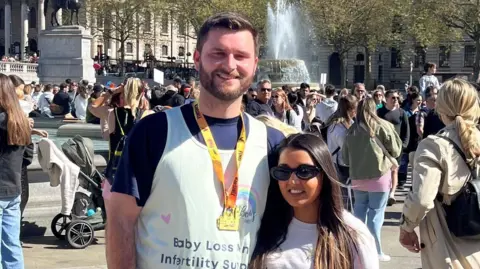
In 2023, Ruby Rounding and her husband James were newlyweds and wanted to start a family.
But Ruby is among the 1% of women to suffer recurrent miscarriages - when an expectant mother miscarries three or more times.
Currently, women normally experience three miscarriages before qualifying for specialist NHS help in England.
Ruby, 30 and from East Yorkshire, says earlier intervention could have helped her, and others in her position.
Last month, as part of its Women's Health Strategy, the government said it was considering "wider adoption" of a graded care model for miscarriages.
Piloted by Birmingham Women's and Children's Hospital and charity Tommy's, the model offers increasing levels of medical help, starting after the first miscarriage.
Ruby's second loss was a missed miscarriage, which is when a pregnancy ends but the body does not recognise the loss.
 Ruby Rounding
This resulted in a hysteroscopy and laparoscopy, but Ruby had months to wait before the surgery, which was "mentally a lot to take", she explains.
"You feel like you're fighting for yourself in these situations. When you've had losses you're in a very vulnerable state.
"It doesn't matter what gestation it is, it's still so traumatic."
After her second loss, she connected with Chasing Rainbows, a Hull-based baby loss and infertility charity.
Ruby praised the charity, and its founder Samantha Catanach, for offering advice and a support network which have helped her better advocate for herself.
Although she suffered a third loss, which qualifies her for NHS support, she says a roll-out of the graded model of care would "help so many women" much earlier.
"When you have your first loss, that's when you're probably the most vulnerable and the most naive," she says.
"To have access [to services] after the first time will be so helpful and beneficial.
"But I think it'll also be educational for them as well to know where to move forward and what to do, who to contact, what's available."
'Physically and mentally brutal'
As part of the pilot scheme trialled in Birmingham, women who had suffered one miscarriage accessed a one-to-one consultation with a specialist nurse.
They could then discuss lifestyle changes, including taking the hormone progesterone, which can help prevent miscarriage.
After a second miscarriage, women are tested for anaemia and abnormal thyroid function, and offered early scans to check the pregnancy is advancing normally.
Following a third miscarriage, the programme of care reflects the NHS' current offer - a referral to a recurrent miscarriage clinic, additional blood tests and a pelvic ultrasound.
Anna, 40, from North Yorkshire, has suffered two miscarriages.
She describes the losses as "physically and mentally brutal" and says advice given after the fact could have been more comprehensive.
"I think if you are in a position where you are trying for a baby, it's so all-consuming, everything becomes around that," she says.
"You need support right from the start really, from when they see that it's not a viable pregnancy.
"Instead of just being sent home with a leaflet, you need really dedicated support, not only for your physical health, but mental health as well."
Like Ruby, Anna found support through charitable organisations.
She contacted Reflect, a York-based pregnancy choice and loss service.
"If I hadn't had [access] to that, I think I would have really struggled," she says.
The graded model of care could offer pregnant women "an understanding what's going on from a medical point of view", as well as reassurance, she adds.
"The worst thing is that after any grief, everything goes back to normal. I'm back at work, I've got deadlines, I'm still a mum.
"But at the same time, you feel so lonely because you're going through this and you just have to get on with it.
"By adopting this [model], it would mean everything to have that support right from the start."
Jenny, not her real name, has a three-month-old baby, after having two previous miscarriages.
"I felt really upset," says the 38-year-old, also from North Yorkshire, recalling leaving the hospital after the second loss.
"Devastated, wondering whether I would be able to have a baby in the future, and then you are kind of left to do your own research online."
She feared she would have another miscarriage but says she almost "wanted to get that over with so that someone could actually help me".
While it is "a positive step" for the government to consider wider adoption of the model of care, she would like to see less of a "vague" commitment, she adds.
'Compassionate NHS care'
Baroness Merron, Parliamentary Under-Secretary of State at the Department of Health and Social Care, said the results from the pilot scheme would be "carefully considered" as part of ongoing work ensuring "women get the high-quality, compassionate NHS care they deserve".
"Pregnancy and baby loss can have a devastating impact on women and families, who too often feel they have been left without the care and support they need," she said.
The Women's Health Strategy aims to "drive better outcomes so women across the country are better heard and better served by the health system," she added.
If you have been affected by the issues raised in this story, information and support can be found via the BBC's Action Line website.
Listen to highlights from North Yorkshire on BBC Sounds, catch up with the latest episode of Look North.
