Traps set to see if Asian hornet survived NI winter

 BBC
BBCNorthern Ireland holds the dubious accolade of the most northerly discovery of the Asian hornet so far.
After the nest was found in County Down last year, work is underway to stop the invasive species taking hold.
But rather than shooing or killing the insects, the Northern Ireland Environment Agency (NIEA) is hoping people will instead report possible sightings using the Asian Hornet Watch app.
Thirty-four traps have been set up in a three-mile (5km) radius of where the nest was found, and 20,000 local households have received information leaflets about how to spot an Asian hornet.
The NIEA's Invasive Species Team lead, Rose Muir, said monitoring would continue, regardless of what is found in the traps in the next three months.
A threat that is spreading

The Asian hornet poses a severe threat to the pollinators our food system relies on.
It's thought to have come to Europe by accident, in a shipment of pottery from China to France in 2004.
The first nest in the UK was found in 2016, and the first on the island of Ireland in County Cork last summer.
The one in Dundonald came soon after.
Climate change is helping the species to establish further north than before, as the planet gets warmer.
Muir said finding this hornet in Northern Ireland "changed everything".
"We had written the rapid response contingency plan, hoping that we'd never need it.
"We knew things were advancing in GB - they had a lot of nests last year and it was getting further and further north, so there was a fair chance it was going to arrive and the risk assessments that had been done weren't really sort of alarming enough to think that it might have arrived here."
But arrive it did, in October.
Her team carried out a track and trace exercise that located the nest, which was destroyed by experts.
It was analysed to assess if any queen hornets - called gynes - had developed in it.
Queens are individual insects that establish new nests the following year.
But experts were unable to say if any queens had been produced that could have successfully overwintered.
"So we're actually waiting now to see if that has happened or not," said Muir.
"We don't think so, because it wasn't a very healthy nest and it was in decline, and even in a healthy nest, they reckon only 10% survive anyway.
"So we're hoping that the odds are for us not seeing any emerging queens."
The team at NIEA say there is "no reason" to think there are other Asian hornets around at the moment, so monitoring is focused on finding any queens and removing them.
How to spot an Asian hornet
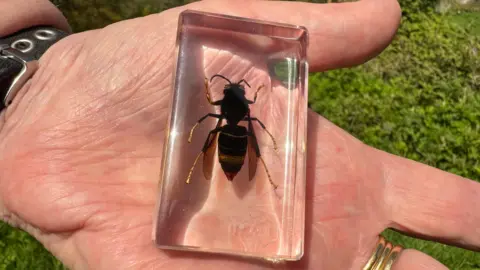
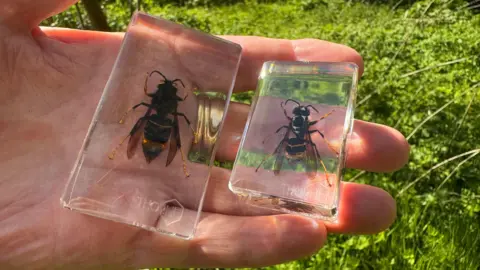
The Asian hornet is larger than our native wasp and has less yellow on it.
It is also known as the yellow-legged hornet due to its golden-coloured legs, which are very noticeable in the sun.
Queens are larger than workers and tend to travel no more than three miles from the original nest to set up new ones.
Twenty thousand leaflets have been delivered to homes in the area where traps have been set up, with pictures of what to watch out for and how to report possible sightings.
Identification guides are available as part of the Asian Hornet Watch app and online.
Why are they a threat?
Muir explained that the Asian hornet is unusual.
"Unlike a lot of other insects, the Asian hornet actually likes to eat protein, so it will eat other creatures - as in our pollinators.
"If they run out of insects, they're known to go on and damage fruit crops and things like that.
"So they're a big, big threat to all our pollinators, not just the bees - but they are particularly partial to bees.
"And that obviously has huge ramifications."
Around a third of global food production depends on bees, making them vital for food security.
A trapping first for Northern Ireland
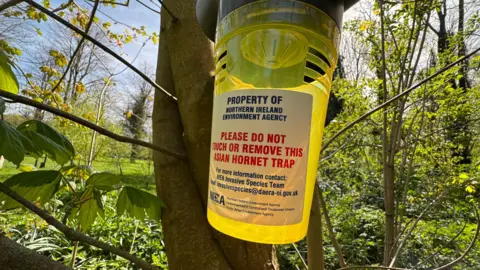
The traps are designed to ensure insects other than Asian hornets are able to get out of them.
They have been set up around Dundonald, including on the Stormont estate.
This is the first time this type of trap has been used in the UK or Ireland.
A sweet substance attracts the Asian hornets, hungry after winter hibernation.
All 34 traps will be checked twice a week.
The app the inspectors use is streamed live to the invasive species team, so if any Asian hornet queens are found, they can attend quickly to remove them.
And if members of the public submit photos via the Asian Hornet Watch app, those too are sent to the team and usually a rapid response provided.
Muir added that the most important thing is to not to kill any insect, but to trap it, submit a photo and wait for a reply.
"Don't worry if it's not one - we still want to see it if you're suspicious.
"We still want people to put the records in."
But she does not want people to set up their own traps.
"Because if people put out traps that aren't selective, they're going to end up killing more insects than the Asian hornets would, which is just counter-intuitive, and we don't want to encourage that.
"So please - just let us do the monitoring."
