'Uneven' demand for integrated schools across NI

 Getty Images
There is no Northern Ireland-wide demand from parents for more integrated schools, according to the Department of Education (DE).
Instead demand for school places is "uneven" and has been highest in areas like Mid and East Antrim, Ards and North Down, and Belfast.
But in council areas like Derry and Strabane, Causeway Coast and Glens, and Fermanagh and Omagh there are too many integrated school places.
However, the head of the Integrated Education Fund (IEF) Paul Caskey said there was "clear unmet demand" for integrated education.
"Whilst not all integrated schools are oversubscribed, many are, and in some areas parents and young people do not have a realistic choice of any integrated school within their local community," he said.
What is integrated education?
The first integrated school in Northern Ireland, Lagan College, was set up in 1981 with the aim of educating Protestant and Catholic pupils together.
It opened with 28 pupils in a former scout centre and has since grown to around 1,500 pupils.
Integrated schools aim to mix pupils from Protestant, Catholic and other backgrounds.
There are now over 28,000 pupils in integrated schools, and the number has increased over the past decade.
However, only about 8% of children in Northern Ireland currently go to formally integrated schools.
 PA Media
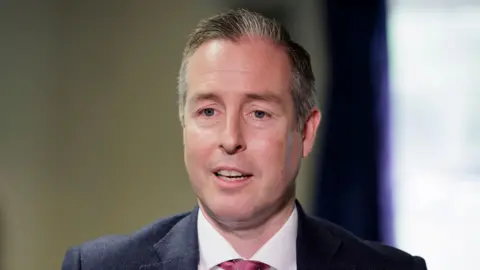
In 2025, a decision by the Education Minister Paul Givan to reject moves by two big schools in Bangor to transform to become integrated was controversial.
In rejecting the bids, Givan said that there was not enough evidence that there would be enough Catholic pupils at each school for it to provide integrated education.
Some non-integrated schools, though, also have a mix of pupils from different religious backgrounds and those who are not religious.
The department has a legal obligation to give more support to integrated education, since Stormont voted in favour of a new law in March 2022.
As part of its obligations, the department has to assess the demand from parents.
What is the demand for integrated education?
 Getty Images
The department's analysis suggested that there was no shortage of places in integrated primary schools, and oversubscription was "not a significant issue".
However, there was higher demand for post-primary places in some parts of Northern Ireland.
The department said there was "consistent oversubscription in certain council areas" including Mid and East Antrim, Ards and North Down, Lisburn and Castlereagh, and Belfast.
A survey carried out last year of 10,000 parents also suggested those areas had higher support for integrated education, with much lower support elsewhere.
Other studies into integrated education
The Northern Ireland Life and Times (NILT) survey annually monitors public opinion among around 1,200 adults in Northern Ireland.
Over half of those who responded (55%) to the most recent survey in 2024 said they would prefer to send their child to an integrated school.
Parents can also vote for their child's school to transform into an integrated school in a process known as transformation.
About 70 out of approximately 1,000 primary and post-primary schools across Northern Ireland are now integrated.
Of these, more than 30 have transformed from controlled or Catholic-maintained schools, with the majority from the controlled sector.
In 2021, Seaview Primary in Glenarm became the first Catholic school in Northern Ireland to formally change its status to integrated.
Integrated demand 'present but uneven'
Referencing his department's recent analysis, Givan said "this evidence shows that demand for integrated education is present but uneven".
"Pressures are concentrated in a relatively small number of schools," he added.
"This reinforces the need to plan proportionately, using reliable evidence and aligning with wider demographic and sustainability challenges in education in Northern Ireland."
But Caskey said that "the gap between current provision and public demand is clear" and the evidence shows there is "clear unmet demand" for integrated education.
David Brooks of the DUP, who sits on Stormont's education committee, agreed that the data does show people are interested in integrated schools but added it is not the main thing people use to decide where to send their children.
"They want a quality education, they want a good school and some of those good schools are integrated schools - but it's not the driving factor," he told BBC Radio Ulster 's Good Morning Ulster.
"When you look at the five-mile radius around primary schools and the 15-mile for post-primary schools, there is actually a limited number of places where there isn't access."
Alliance MLA Nick Mathison, the chairman of the committee, said that even if there is an integrated option within the radius, it does not always mean they are viable options.
He described the framing of the data by the department as "spin".
"55% are looking for an integrated place of which only 8.4% of those places are available as integrated - I think that data speaks for itself," he said.
