Phone box at centre of Great Britain listed

 HE
A telephone box that stands at the geographic centre of Great Britain has been given Grade II-listed status.
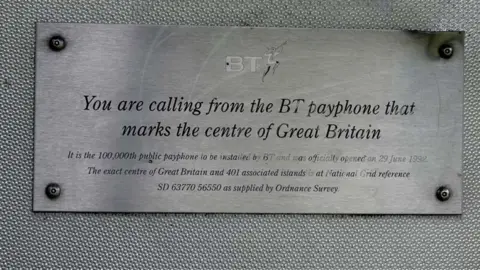
The KX100 kiosk at Dunsop Bridge, in Ribble Valley in Lancashire, was the 100,000th telephone kiosk to be installed in the country.
It was officially opened in June 1992 by explorer Sir Ranulph Fiennes, who was joined by children from nearby Thornleyholme RC Primary School as he made the first call from the kiosk.
Historic England's (HE) Jayne Rimmer said as part of "the last generation of the public telephone box", it was a "nationally significant kiosk".
The Twentieth Century Society (TCS), which champions outstanding examples of modern design, had applied for it to be listed.
Campaigns director Oli Marshall said he was "absolutely delighted" by their success.
"There's no small irony that it was the arrival of the KX100 that first spurred the Society into action back in 1985 - once the slayer of traditional red telephone boxes, that we fought vigorously to repel, now itself being given heritage protection," he said.
"While widely unloved and underappreciated in comparison to the classic red telephone boxes, the ugly duckling KX100 model has developed a cult following in recent years."
He added that with the Tour de France "passing through Dunsop Bridge next July, we hope the kiosk will form the centrepiece of the village's celebrations, as well as being the centre of Great Britain".
Ribble Valley Borough Council leader Simon Hore said the phone box had "a special place in local people's hearts".
 Graham Hogg/Geograph
First introduced in 1985, the KX100 design has large glass panels and was designed to be easier to clean and more accessible than the previous red model.
In the HE listing, it is described as having both architectural and historic interest.
The organisation stated it was both a "good and largely intact example... which illustrates all the standard features and branding of this newly introduced type of telephone kiosk" and an "exemplar of the last generation of the 'public telephone box', which makes an important contribution to our understanding of the historic development of the telecommunications industry in England".
TCS said the kiosk was of particular importance as it featured "a bespoke, site-specific design" featuring "key places in Britain radiating from the BT 'Piper' marque and Dunsop Bridge".
 TCS
The Lancashire village was named as the nearest settlement to the geographical centre of Great Britain following work by national mapping agency Ordnance Survey (OS).
Its calculations put the centre at Whitendale Hanging Stones, about 4.3 miles (7km) north-west of Dunsop Bridge.
The title has been disputed, with other places also making a claim, including Haltwhistle in Northumberland.
OS later stated there could be "no absolute centre for a three-dimensional land mass sitting on the surface of a sphere and surrounded by the ebb and flow of sea water" and "different projections, scales and methods of calculation will all produce different results".
Dunsop Bridge was the result of defining Britain as "the mainland and the 401 associated islands", a spokesperson said in 2014.
They added that "looking only at the mainland of Great Britain", the location was a little further south, lying about 2.5 miles (4km) north-west of Whalley.
Listen to the best of BBC Radio Lancashire on Sounds and follow BBC Lancashire on Facebook, X and Instagram.
