Campaigners say river bacteria levels too high

 BBC
Campaigners have called for action to be taken after discovering bacteria levels in a York river were "well and truly above satisfactory".
For the past five months, members of the Ouse It or Lose It group have gathered weekly water samples from the River Ouse to test for bacteria and pollutants.
The group, which tests for four kinds of bacteria including E. coli, said polluted rivers could not be accepted as "inevitable" and called for greater transparency from those responsible for local rivers.
A spokesperson for Yorkshire Water said it understood public concern over river pollution, including in the Ouse, and was "committed to improving it".
Ouse It or Lose It, which works to both protect the River Ouse and gather evidence to call for action, has taken samples from the Blue Bridge area, where the Ouse and Foss rivers meet, since May.
Across 21 sampling rounds it recorded an average E. coli reading of 1,379 cfu (colony-forming units)/100ml, exceeding the 900 cfu/100ml threshold used for the "sufficient" inland bathing-water standard.
Blue Bridge is not a designated inland bathing-water site but the campaigners said the comparison illustrated the river's water quality against recognised bathing-water standards.
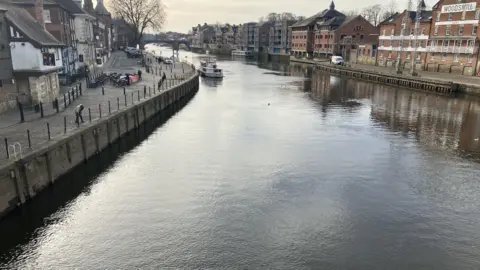
Chris Stewart, a citizen scientist with Ouse It or Lose It, told the BBC the group's findings showed "levels of bacteria in the river are well and truly above satisfactory".
"Our results raise serious questions and Yorkshire Water, the Environment Agency, York City Council, North Yorkshire Council and individuals and companies responsible for pollution must help answer them," he said.
"We need transparent, independent testing and action on pollution, not excuses."
Luke Charters, Labour MP for York Outer, said the finger must be pointed at Yorkshire Water "when it comes to the unacceptable levels of pollution that are entering our precious rivers".
Charters, who would like to see water companies under public ownership, blamed polluted rivers on "failure going back decades".
"I think the prime minister is absolutely right to ask a really searching question - is the ownership model of the water system correct? I would say no, it's not."
Prime Minister Andy Burnham last month said the "strengthened" Water Bill would remove the current limits on government ownership of shares in the major water and sewerage companies in England.
The government said this meant it could act when water companies "let down customers and the environment".
'Hold to account'
Robin Norton, a local rower from the York branch of Surfers Against Sewage, said he hoped the legislation would be "the cleanest Water Bill we can get".
"In other words, it holds the water companies to account to make them do what they should have been doing all along and not putting raw sewage into our rivers."
A Yorkshire Water spokesperson said it would achieve improvements by "both upgrading our infrastructure, changing our approach to pollution from our network, and working with partners and the community to tackle other sources of pollution".
"We're under way with a £1.5bn programme to reduce storm overflow discharges across the region," they said.
"In York, we have projects under way at Landing Lane and Poppleton Road that will significantly reduce discharges into the River Ouse, and several more projects in the planning stages.
"It is also important to note that there are many things that can impact the health of watercourses, including agricultural run-off and private misconnections.
"We're continuing to work with our partners and the community to do our bit in addressing these. This includes supporting citizen science activity, which can be a helpful tool in identifying sources of pollution."
Stewart said the River Ouse had been enjoyed for "hundreds, thousands of years", and it was only in recent years that people "back away from it in fear".
"I would love to see this river getting back to a pristine, natural environment," he said.
Listen to highlights from North Yorkshire on BBC Sounds, catch up with the latest episode of Look North.
