Calls for new law to cut catapult crime

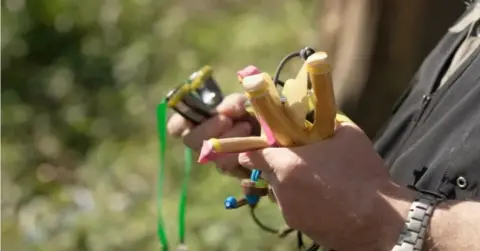 BEN MOORE/ BBC
Police, politicians and animal welfare charities are meeting Home Office officials later to discuss the impact of catapult crime after attacks on wildlife, people and property.
One police force says it is recording an average of 14 crimes a day involving the weapons, with teenagers posting videos online of wildlife being shot.
Ahead of the meeting, some campaigners have called for new laws on possessing the weapon in public and restrictions on sales to children.
The Home Office said the meeting was to discuss the current status of catapults in legislation with stakeholders and discuss views.
A BBC documentary last year heard from a man who was too afraid to leave home after being shot by a catapult.
Sittingbourne and Sheppey MP Kevin McKenna, who is attending the meeting, says there has been recent vandalism to churches and shops in towns within his constituency.
"Lots of people living in the villages and farmers are also coming across maimed, injured and dead animals," he said.
There is also growing concern about wildlife being shot at between Polegate and Horam in East Sussex, according to wildlife rescuers.
Volunteers at Shepperton Swan Sanctuary in Surrey say they have also spent the last two years responding to attacks on birds.
In the UK catapults are not illegal to own or carry in public, but if they are being used to harm people, animals, property, or for antisocial behaviour, their use could be illegal under existing laws.
Some politicians say they want the Home Office to classify catapults as offensive weapons.
"It will allow the police to actually deal with this problem properly," McKenna said.
Surrey Deputy Police and Crime Commissioner Ellie Vesey-Thompson said: "Anyone caught with one must have a legitimate purpose for doing so, and it should be their responsibility to prove that purpose if they're stopped by the police."
She says she wants the onus on the person carrying the catapult to show they have a good reason for carrying it - similar to the approach taken with knives.
"Anglers with a legitimate reason to be carrying a catapult would be able to evidence this with the presence of bait or other fishing equipment," she said.
Dartford MP Jim Dixon says he is also concerned about social media trends involving young people using catapults and wants tougher rules around sales.
"These offences are often fuelled by social media, with sellers – many linked to organised crime – using platforms to trade and offenders sharing videos of wildlife being killed or maimed," he said.
In April, Dickson and fellow Labour MPs met with officials from TikTok to discuss their concerns.
The platform said it was committed to bolstering its moderation and to do more to remove accounts selling catapults, while working more closely with police, Dixon said.
TikTok said it did not allow any form of animal exploitation on its platform and that between October and December 2025 it had removed 99.4% of violating content before it was reported.
Some campaigners are also calling for slingshots to be made harder for children to buy.
"We need bespoke catapult legislation covering sales, carriage and use, including a minimum purchase age of 18," said Jim Clark, wildlife crime campaign manager at Naturewatch Foundation.
A government spokesperson said: "Catapults should not be used for illegal purposes, whether against people, wildlife or property.
"We continue to keep all relevant legislation under review in the interest of public safety."
Follow BBC Kent on Facebook, on X, and on Instagram and listen to BBC Radio Kent on Sounds. Send your story ideas to southeasttoday@bbc.co.uk or WhatsApp us on 08081 002250.
