Summer solstice at Stonehenge sees parking sold out

 English Heritage
Parking has now sold out for the thousands of people expected to gather at Stonehenge to celebrate this year's summer solstice, with public transport recommended.
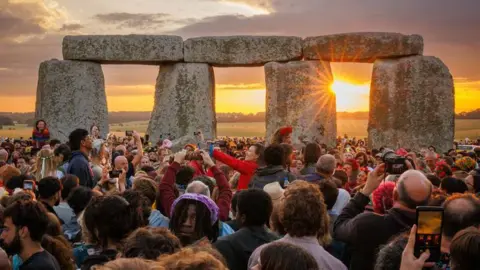
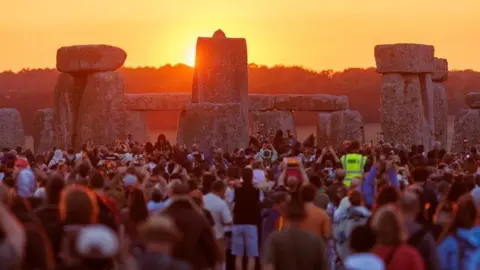
Visitors have flocked to the monument in Salisbury, Wiltshire, for thousands of years to witness the sunrise on the longest day of the year behind the 'heel stone', the ancient entrance to the monument.
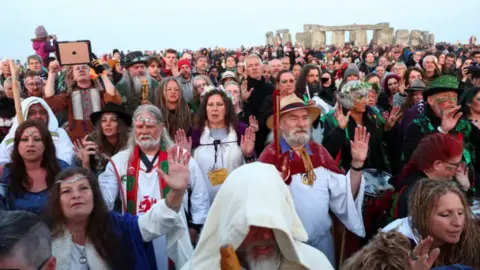
In 2025 more than 25,00 people gathered at the stone circle and English Heritage expects similar numbers again this year. However, visitors arriving by car without parking are unlikely to gain access.
This year, the sun will rise on 21 June at 04:52 BST, with the astronomical solstice itself occurring at 09:24.
What is the summer solstice?
The summer solstice occurs when the earth's northern hemisphere is most tilted towards the sun, making it appear at its highest point in the sky.
Without this tilt, there would be no seasons due to an equal amount of daylight all year.
Why Stonehenge?
The monument, built in about 2,500 BC, was designed to align with the midsummer sunrise and midwinter sunset.
On summer solstice, the sun rises behind the 'heel stone' and its first rays are channeled into the heart of Stonehenge.
According to English Heritage, it is likely worshippers conducted rituals and ceremonies relating to the changing seasons, the sun, and the sky at the site.
For Neolithic people, sunlight provided warmth for them and their animals and helped crops to grow.
 PA Media
How do I get there?
Salisbury train station is 12 miles (19km) away, while Salisbury Reds will operate special bus services to Stonehenge from Salisbury city centre, Salisbury Rail Station, Wilton Park & Ride and Amesbury.
Free access to the site will begin at 19:00 on 20 June and end at 08:30 on 21 June.
Where can I park?
Parking is now sold out as it had to be pre-booked in advance if you are travelling by car. Those who have booked should expect long queues.
There is a 1.2 mile (1.9km) walk from parking areas to the monument.
The last admission to the car park will be at 04:15 on 21 June.
Motorists are advised to follow temporary road signs, with road closures and traffic diversions in place.
Wiltshire Police have said vehicles abandoned or parked on the A303 or nearby roads "are likely to be towed away".
Further travel advice is expected as crowds begin arriving on Saturday evening.
 English Heritage
What should I wear?
Visitors are urged to wear sensible footwear and bring warm, waterproof clothing, with large umbrellas and large bags not allowed.
A small torch and blanket is also recommended, but sleeping bags, duvets and tents are not permitted.
Anything else I need to know?
English Heritage asks all visitors to respect the stones and the people around them, many of whom regard Stonehenge as a sacred place.
Amplified music, alcohol, drones and pets - excluding assistance dogs - are not allowed.
Stonehenge's operations director, Steve Bax, said: "We want to remind people of how vulnerable the stones are.
"Please treat them with respect for the future generations who want to enjoy midsummer celebrations in this remarkable historic place."
Follow BBC Wiltshire on Facebook, X and Instagram. Send your story ideas to us on email or via WhatsApp on 0800 313 4630.
