Bird flu housing order to be lifted across island of Ireland

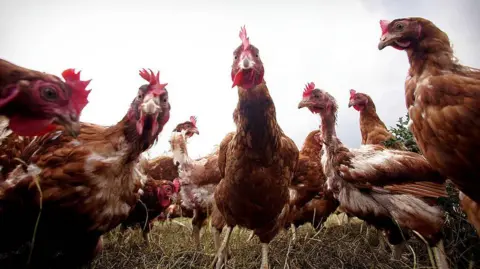 Getty Images
A mandatory housing order for poultry and captive birds across Northern Ireland will be lifted next week, however a ban on bird gatherings will remain in place.
The housing order came into force on 6 November 2025 and will be lifted on Tuesday 5 May. Stormont officials have said it "has been a vital tool in protecting flocks across the country".
In conjunction with the decision to lift the housing order in Northern Ireland, the Republic of Ireland will lift their mandatory housing requirement at the same time.
The last confirmed case in poultry or captive birds in Northern Ireland was in March 2026.
'An incursion of disease'
Announcing the move, Agriculture Minister Andrew Muir said: "This will be welcome news for poultry keepers across Northern Ireland who have put great effort into keeping their flocks safe.
"I want to thank the engagement and cooperation from those poultry farmers who have suffered an incursion of disease over the past year."
He added that his message remains the same to all bird keepers: "They must continue to do their bit to maintain strict biosecurity measures on premises so that we do not lose the progress that we have made."

Northern Ireland's Chief Veterinary Officer Brian Dooher said the risk of bird flu has been "kept under close review".
"These reviews have considered all the available evidence and have included ongoing and recent engagement with stakeholders, and colleagues in the Republic of Ireland, to determine the most appropriate time to reduce the current protective measures in place," he said.
All flock keepers, including backyard and hobby keepers, are encouraged to use the next few days to prepare their ranges so that birds can be let outside again, the Department of Agriculture, Environment and Rural Affairs said.
The Republic of Ireland's Minister for Agriculture, Food and the Marine, Martin Heydon said: "The risk of avian influenza to our poultry is no longer as high as it had been in recent months and as a result it is an appropriate time to lift the housing order and prohibition on the assembly of live birds."
He acknowledged the "hard work and cooperation from the Irish poultry industry and bird owners in recent months".
What is bird flu?
Bird flu is a disease caused by a virus that infects birds and sometimes other animals, such as foxes, seals and otters.
It spreads through contaminated feed and water, or through birds' droppings and saliva.
The major strain - circulating among wild birds worldwide - is a type of the virus known as H5N1. It emerged in China in the late 1990s.
Bird migration has led to outbreaks in domestic and wild birds.
The virus has in very rare cases infected humans but experts say the current risk to humans is low.
A ban on the gatherings of poultry - such as for shows, sales or exhibitions - will remain in place as part of the Avian Influenza Prevention Zone (AIPZ), which places a legal requirement on all bird keepers in Northern Ireland to follow strict biosecurity measures.
