'Not enough is known about condition that led to my leg amputations'

 BBC
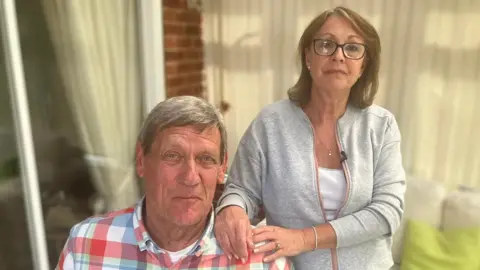
BBCNic Olsen was the picture of health.
The 80-year-old was a keen walker and cyclist, but began experiencing leg pain over several years, which had become "unbearable" by January 2021.
Nic and his wife Fiona searched for answers, visiting various health professionals until he was diagnosed with a common condition called peripheral arterial disease (PAD) in October 2024.
But by then, the disease - caused by the narrowing or blockage of arteries in the legs - had progressed to the point that both legs eventually had to be amputated.
Nic, who is supporting a campaign for greater awareness of the condition, said: "I had the same symptoms all the time, but nobody took any notice."
Nic, from Tugby in Leicestershire, explained he had suffered from ulcers and cuts on his foot that would not heal.
He also experienced thickening toenails and the loss of hair on his feet, which are all symptoms of PAD.
Fiona, 68, said the pain was described by Nic as being like "somebody stabbing me in my toes".
Nic said: "First of all I found I was dragging my foot, then it progressively became more and more painful.
"It was very unpleasant and I didn't really know why."
 Supplied
The Olsens said they visited health professionals including GPs, podiatrists, and orthopaedic specialists, more than 20 times.
Eventually, a Doppler scan - a non-invasive ultrasound test commonly used in pregnancy - revealed there was no detectable blood flow in his feet.
Fiona said a podiatrist suggested the test after a wound on Nic's foot had not healed.
Nic said his feet were not examined prior to this and that the theory from professionals was that his spine was causing the pain, linked to a "very old back problem".
"They said, 'you are too healthy, you have got nothing else wrong with you, it must be your spine'. And it wasn't," Nic said.
"I don't know that many of the professionals knew about peripheral arterial disease.
"It was never mentioned, my feet were never examined - except by podiatry - and this is how it got missed."
 Supplied
In March 2025, Nic underwent an angioplasty on his right leg to try and treat the condition.
Surgeons attempted to insert a catheter through his groin as part of the procedure, but it was blocked at his knee.
A leg artery bypass procedure also failed and caused "agony" for Nic as the blood pooled in his feet and the wounds would not heal, Fiona said.
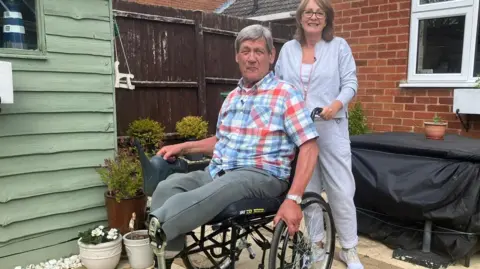
As a result, his right leg was amputated below the knee in April 2025.
A second angioplasty on his left leg and a similar bypass procedure followed shortly after, but again both failed, leading to the amputation of his other leg through the knee in July that year.
Nic said he had "a lot of black, dark days" after this.
He added: "You don't sleep very well in hospital and I used to think, 'what on earth am I going to do?'"
Fiona said the amputations had been "life-changing".
"I was just... I think worse than Nic, because he became pain-free," she said.
"Overnight I became a carer and we had so many plans.
"We still [had] a young daughter, we loved travelling, we loved bike riding, [we were] fit and healthy people who had looked after ourselves."
'Rapid action'
Researchers at the University of Leicester are raising awareness of PAD with the campaign called Are Your Legs Killing You?
Athanasios Saratzis, a research professor of vascular surgery at the university and a vascular and endovascular surgeon based at Glenfield Hospital, said amputations were often preventable.
"PAD affects about one in five people above the age of 55," Saratzis said.
"Most people who have got PAD don't get symptoms until late down the line.
"So unfortunately, diagnosing PAD is not as common as we would like it to be."
The Olsens want to warn others of the symptoms and hope more people can be diagnosed earlier.
A Department of Health and Social Care spokesperson said: "Our thoughts are with Nic, and everyone impacted by peripheral arterial disease. All NHS professionals should consider every possible diagnosis to ensure serious conditions don't go untreated.
"We have taken rapid action to strengthen patient safety, including rolling out Jess's Rule so patients can get a fresh clinical review if they present three times with the same symptoms or concerns."
Listen to BBC Radio Leicester on Sounds and follow BBC Leicester on Facebook, on X, or on Instagram. Send your story ideas to eastmidsnews@bbc.co.uk or via WhatsApp on 0808 100 2210.
