Plymouth a 'role model' for WW2 bomb disposal

 Royal Navy
A city where a number of unexploded World War Two bombs have been uncovered in recent years has been branded a "role model" for others places that might have to deal with suspect devices, an expert has said.
Historian Dr Harry Bennett, from the University of Plymouth, said the city council, the military, local businesses and residents should all be congratulated on how they dealt with the bombs, given the "potential for loss of life and massive destruction of property".
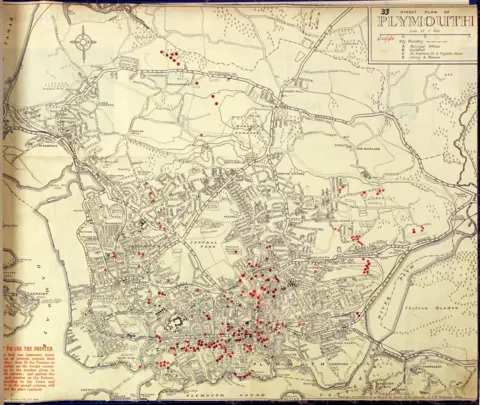
Two unexploded WW2 bombs have been found in Plymouth in 2026, leading to the safe evacuation of thousands of people from their homes, the cordoning of large areas and the closure of many businesses. In 2024, thousands of people also had to be evacuated before a bomb was removed from the Keyham area to be detonated at sea.
Bennett said the way the incidents were dealt with was a "wonderful example of the way in which the city worked together with the military authorities, but also the general public as well".
 S.I UXO
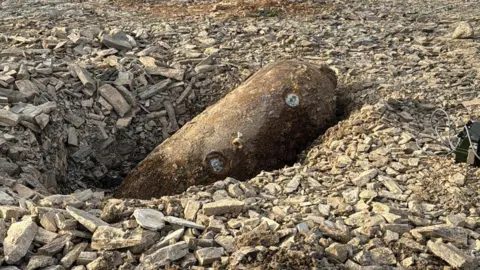
The first discovery of 2026 was on 14 January when a 50kg (110lb) German World War Two bomb was discovered on a building site in Plymouth's Millbay area.
The discovery prompted an 800 person evacuation before military bomb disposal specialists successfully secured the device, which was later removed for detonation.
The most recent incident led to more than 1,200 homes being evacuated from the Southway area of Plymouth on 29 April when a 250kg (551lbs) device was found on another building site.
Plymouth City Council confirmed the device was a German SC250 air-dropped bomb which was made safe with a controlled detonation on 1 May.
While finding two unexploded devices in Plymouth within four months is unusual compared to previous years, Bennett said there was no specific reason and it was likely just down to increased building work.
He said: "A lot of these bombs, the ones that didn't explode, went into the ground with some force and went in to some depth and they're really only being turned up when you're dealing with building work in various localities.
"So, it may well be a sign that builders in Plymouth are doing rather well in terms of redevelopment and in the process they're just turning up the odd unexploded bomb.
"I don't think it's any more than that, it's simply about the amount of land that's actually being reworked.
"I think it's a really interesting reminder actually of the safe spaces in which we live... these were battlegrounds."
In 2024, a 500kg (1,102lb) German World War Two bomb forced the evacuation of thousands of people in the city, with the device being transported through suburbs, before it was detonated at sea.
The unexploded device was found in a garden in Keyham, and sparked four days of disruption, with the Ministry of Defence describing the evacuation operation as one of the largest since the end of World War Two.
'Very scary moment'
Bennett said there was not much more the authorities could be expected to do to reduce the impact on the public.
He said: "I think a better way of looking at it is to actually congratulate the authorities, in terms of the armed forces, the unexploded ordinance officers and the city authorities, in the way that they have dealt with it.
"Given the potential for loss of life, massive destruction of property, the way that they've dealt with it, not just on one occasion, but actually two occasions within recent months I think is a role model of effective responses to an issue like this."
He said the discoveries were not just an issue for authorities but also a test for how well the people of a city dealt with "quite a scary challenge".
He said: "Major disruption to their lives, a lot of common sense on display, a lot of calm on display.
"I think certainly in the case of Plymouth, it's testament to not just the military authorities but the civil authorities and also the people of Plymouth.
"The way in which they've handled themselves in what could be, a very, very scary moment indeed in certain localities affected by the bomb."
Plymouth City Council said the number of devices found in recent years had led them to develop a "multi-agency protocol" it uses whenever one is discovered.
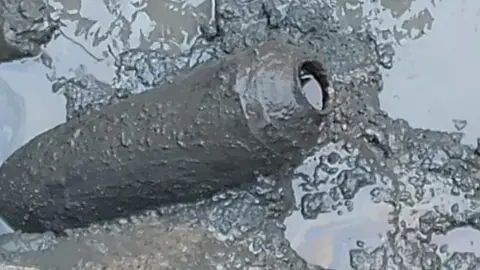
It was also able to offer advice when a 400m cordon was set up at Exmouth Marina after a "suspected unexploded ordnance" was dredged from the water, with properties also evacuated.
It said: "We keep refining it as each incident highlights unique identified learning.
"Our communications teams have held workshops with other councils in relation to communicating at pace an evacuation and all it entails.
"The team, for instance, advised Exmouth Town Council during their recent emergency."
 The Box Plymouth
Senior explosives officer Col Nick Handy oversaw the discovery and detonation of the 250kg German Second World War bomb in Plymouth in May.
He said similar devices would continue to be discovered in Devon as the south coast was "littered with bombs" near the end of the war.
He said: "Pilots used to drop bombs as they reached Britain because actually all they wanted to do was get home to Germany.
"Have we found them all? Absolutely not. Will we find more? Absolutely.
"But to reassure you the military trained well and hard against this.
"We train for this because we don't take this lightly."
Follow BBC Devon on X, Facebook and Instagram. Send your story ideas to spotlight@bbc.co.uk.
