Disabled woman feels 'penalised' for wanting to work

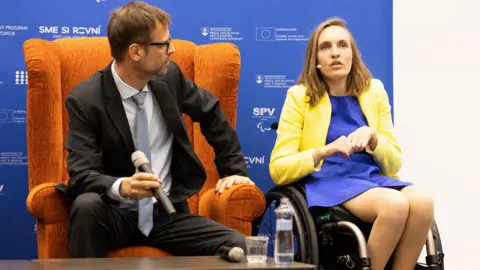 Lucy Robinson
A woman with a spinal injury said she has been denied "crucial" NHS-funded care for her overseas work as the head of a disability association.
Lucy Robinson, president of the European Spinal Cord Injury Federation (ESCIF), said she has received care for years from personal assistants, both at home and when travelling outside the UK for work.
But the 38-year-old, from west Oxfordshire, said Thames Valley Integrated Health Board (ICB) wrote to her on 14 April, telling her care delivered overseas could not be authorised under its current policy.
The care board said a complex case panel ensured "decisions remain consistent, transparent, and are informed by national guidance and legal advice".
Spinal cord injuries cause temporary or permanent changes in the spinal cord function, with symptoms varying from numbness and paralysis to incontinence.
The NHS describes it as "a big trauma", which could also cause a number of emotional issues.
"Regardless of where I am, for the last 20 years, I have 24-hour care delivered by personal assistants and they are trained to support me," Robinson said.
"Whenever I've travelled, it's the same care that I receive in the UK on a day-to-day basis, it's just that those personal assistants travel with me.
"They are crucial for me to be able to survive. Some of the things that people with spinal cord injury deal with are life-threatening, like autonomic dysreflexia, or quite invasive in terms of some of the healthcare tasks that are delivered."
 Lucy Robinson
ESCIF advocates for the rights of people with disabilities and Robinson has been involved with delivering, setting up and assessing peer support globally.
Robinson said her NHS personal health budget was removed in July 2025, which meant a risk assessment for travelling needed to be submitted by the ICB's chosen care company.
Due to attend the European Spinal Psychologists Association conference in Murnau, Germany, as a keynote speaker on 23 and 24 April, she said she notified the ICB about the planned trip in December.
After months of delays, compounded by "a whole ream of questions" such as who would be providing medication, she said she was told the arrangements would not be approved just days before the trip.
"I've been travelling and working internationally for over 15 years, and this hasn't been a problem before," she said.
"I'm not asking for any additional funding, it would cost exactly the same as if I stayed at home and wasn't working," she said.
"The expenses are fully covered by the conference organisers, it's just that I need the same support that I get at home in order to travel anywhere."
Robinson said the decision letter said "their provision ceased at the border and that they weren't able to provide the care".
She attended the conference, helped by her 69-year-old mother and a worker provided by the conference organisers, neither of whom have formal training, she said.
"My freedoms are restricted and I am caught in a system that penalises me for wanting to work," said Robinson, adding that she intends to follow up with a complaint.
"I have a disability but I want to have a meaningful contribution to our society.
"I feel that the ICB should understand and support me in that and not put up such a barrier, which is incredibly disabling."
Thames Valley ICB said it did not comment on individual cases.
It said in a statement: "Decision-making in relation to NHS continuing healthcare is guided by the ICBs equity and choice policy, which reflects the residency-based nature of the NHS.
"Oversight is provided through the ICB's complex case panel on a case-by-case basis, ensuring that decisions remain consistent, transparent, and are informed by national guidance and legal advice."
