The college scam that promised students fleeing war a new life in Finland

 Getty Images
When *Ma Naw Phaw was given the chance to go to a vocational school in Finland, she took it immediately.
"It didn't matter what I studied," the 19-year-old says. "I just knew I needed a degree to find a good job and earn a decent salary to support my family."
She had been living as a refugee in Mae Sot, a Thai border town, after fleeing the devastating war in Myanmar.
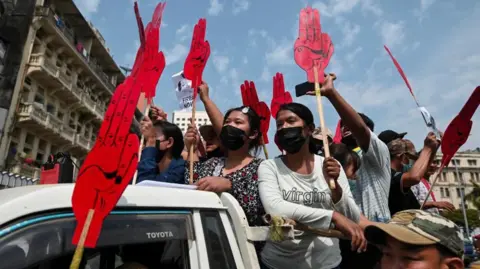
Ma Naw Phaw had just started secondary school when Myanmar's military overthrew the democratically elected government in February 2021.
It crippled education as thousands of teachers left their roles, and students like Ma Naw Phaw refused to enrol in junta-controlled schools.
In Mae Sot, she joined a high school set up for refugees, and that's where she heard about an agency offering students the opportunity to study in Finland.
She decided to enroll in Finnish classes as she prepared for a new life on the other side of the world.
But that dream shattered in April, along with the future she had thought was in her grasp.
She had paid about 10,000 euros ($11,500; £8,600)to an agency called Brighter Future Way (BFW), which was operating in Mae Sot.
The money was supposed to pay for Finnish language classes in Mae Sot, the application for the vocational school, where she was going to study nursing, and a residence permit to live in Finland.
It was a huge sum for her family and it took them nearly a year to raise it, she says, but they were glad to do it for an opportunity that promised to turn the tide.
But then Finland rejected Ma Naw Phaw's request for a residence permit, which BFW had told her she could easily secure.
She wanted a refund but she could not reach the agency. Weeks later, she learnt that the founder, Min Min Soe Shwe, had been arrested in Finland.
BFW co-founder Phitak Pakay, who is based in Thailand, told the BBC the company has "lost contact" with Min Min Soe Shwe and that it will soon cease operations as "there are no students left in the dormitory".
Finland's Border Guard has also announced a "large-scale investigation" into an education agency which had offered to help some 350 Burmese students enrol in vocational schools across Finland, between 2022 and 2025.
"It is suspected that at least some of these students have been charged exorbitant amounts of money under the guise of arranging study places, residence permits and language exams," it said in a statement, noting that some of the victims have been left in debt.
"This situation could lead to many of the students ending up in a vulnerable situation and predisposed to being further exploited financially or otherwise," Juho Sillanpää, who is leading the investigation, told the BBC.
He says that he has been involved in several investigations over the years where education agents have misled clients or the Finnish authorities, but previous cases have "mostly been smaller in scale".
This case could amount to "aggravated extortion", he added, but declined to reveal the identities of the organisation or the individuals under investigation.
 Supplied by student
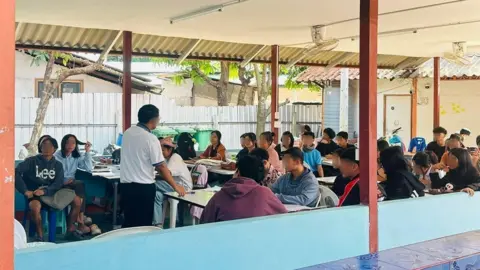
Piecing together interviews with six affected students, a Finnish vocational school, and a BFW co-founder, the BBC understands that BFW is the agency in question.
The BBC has reached out to Min Min Soe Shwe's lawyer and family, but they have declined to be interviewed.
According to its website, BFW "specialises in language training and student recruitment services for individuals from Myanmar who are preparing to live, study, or work abroad".
Among the vocational courses listed on its site are nursing, property maintenance and catering.
The company, which has registered offices in Myanmar, Thailand and Finland, says its mission is to "support our students every step of the way, ensuring they are well-prepared and cared for during their transition period".
Agencies like BFW have sprung up in recent years because students outside the EU can enrol in Finnish vocational and higher education institutions through these third-party "commissioners", a list that also includes local governments.
These agencies can "commission" specific programmes, tailoring them to suit the demands of students they are recruiting.
It is unclear how many students have signed up for programmes with BFW, and how many of them actually made it to Finland.
*Ko Myo is among those who did. The 26-year-old, who says his family knows Min Min Soe Shwe, told the BBC he is working in a nursing home after completing the vocational course.
He says the agency allowed him to defer some payments until after he started working, but that option was not given to any of the other students who spoke to the BBC.
EduSavo Oy, a vocational college in the Finnish town of Iisalmi, was due to receive its first batch of students through a programme commissioned by BFW in the autumn.
By May, however, it still had not received any tuition payments from BFW and decided to call off the partnership, EduSavo Oy's CEO Mira Repo told the BBC.
"We received information regarding the ongoing police investigation and information indicating that BFW was currently unable to complete the payment. My understanding is that Min Min Soe Shwe was detained by Finnish authorities."
Finland's education ministry said it is not involved in the investigation but that it is "naturally concerned about the suspected violations".
"So‑called intermediary agents are widely used in the recruitment of international students worldwide, including in Finland," communications director, Thomas Sund, told the BBC.
He stressed, however, that new laws will come into force in August, which will allow all international students to apply directly to vocational training schools in Finland, rather than through intermediaries.
 Reuters
"I felt inspired when I saw some of my seniors move to Finland for university after graduating," Ma Naw Phaw says.
Countries like the US and UK have tightened visa restrictions on Burmese nationals after the coup, driven by concerns that student visas were being used to secure refugee status.
So agencies such as BFW began promoting Finland as an alternative. Once the country offers a residence permit to those pursuing higher education, their families are eligible to apply for it as well.
All of this made Finland an attractive prospect for young Burmese desperate to flee the war and poverty in Myanmar — living and learning in "the world's happiest country", with the possibility of bringing their families over in the future.
In online ads, several agencies also touted "easy visa approval and free education", "world-class secondary education", and the ability to "work while studying to cover your expenses".
Ma Naw Phaw even met BFW's founder Min Min Soe Shwe who assured her that what might seem like a pipe dream was, in fact, within reach. Her mother sold two plots of farmland to cover the fees.
"I was excited because I'd be going there with my friends," she says.
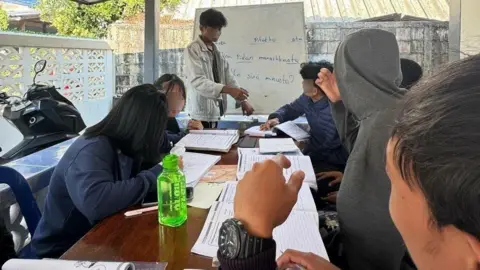
But when she turned up for language classes at the BFW "school" in Mae Sot, Ma Naw Phaw found, to her shock, that there were no teachers. "I kept wondering why we had to pay so much money to teach one another."
She wanted to withdraw from the programme after a few months but she was told to stay on as she would not get her money back.
 Supplied by student
The six students who spoke to the BBC, including Ma Naw Phaw, each paid about 10,000 euros to BFW — 8,000 euros to learn Finnish and 2,000 euros for visa application fees. Despite receiving admission offers from Finnish institutions, five of them were denied residence permits because of "insufficient financial proof" and "delayed documentation", the students say.
"All the visa application work, preparing documents... We had to do everything ourselves. What did they take our money for?" Ma Naw Phaw asks.
*Ko Myint, 21, says his parents emptied their life savings to fund his BFW programme in 2024, and even borrowed more money from relatives. They hoped that he would be able to make enough to pay them back once he landed a good job in Finland.
Ko Myint was working with his parents at a food factory in Thailand, where they were paid about 10,000 baht ($305) a month. As Burmese migrants, they struggle to find jobs that pay better.
"I wanted to move forward in life by getting a better job... [Min Min Soe Shwe] told me that if I studied hard, he could help me. That's how my Finland dream began," he says.
Ko Myint says Min Min Soe Shwe initially agreed to accept a lump sum of about 8,000 euros. But he later demanded another 3,500 baht a month as payment for accommodation.
Unable to shell out the additional fees, Ko Myint dropped out of the programme despite having been offered a place to study nursing in Helsinki. "They told me that not a single baht of my money was left, but I never even got a visa. I don't understand how all the money could be gone."
When Ko Myint spoke out about his experiences with BFW on Facebook last year, he says he got harassed by Min Min Soe Shwe's supporters online.
"Even members of his family confronted me. Being one person against many, I felt mentally exhausted," he says. "I'm now working both day and night shifts at the factory to pay off my debt."
Ma Naw Phaw has moved to another city in Thailand as she felt "too ashamed" to return to her hometown in Myanmar. She says her mother struggled with how she had lost so much money, and it "strained my relationship with her".
"Only after news of Min Min Soe Shwe's arrest emerged did she finally understand we've been scammed."
*Names of students have been changed on request
