How do families with SEND children cope with summer holidays?

 Shariqua Ahmed/BBC
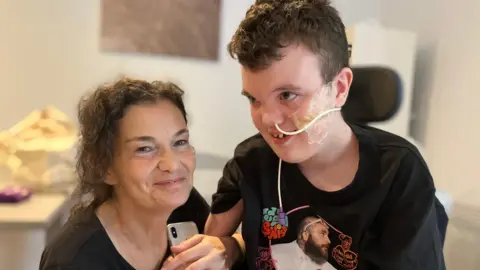
"Imagine being handcuffed to the person you love most... he needs that one-to-one care constantly – he can't do anything for himself."
That's how Sam, from Thorney, near Peterborough, describes caring for her son Alex, 14, who has complex needs caused by a rare genetic condition.
Unable to walk or eat independently, Alex also has drug-resistant epilepsy. Sam sleeps beside his bed to monitor seizures and breathing problems through the night.
While she says she loves her son unconditionally, the relentless demands of caregiving are "draining and not sustainable".
Her experience reflects the challenges facing families of children with special educational needs and disabilities (SEND), especially during the school holidays.
Parents say a shortage of suitable holiday activities and support leaves them providing intensive care 24 hours a day, often with little opportunity to rest, work or spend time on themselves.
In Peterborough, a total of 7,659 children and young people receive SEND support. This includes 2,287 with an Education, Health and Care Plan (EHCP).
Across Cambridgeshire, 18,617 children and young people receive SEND support. This includes 5,491 with an EHCP.
According to research by SEND charity Sense, nationally only 6% of disabled children receive holiday support, showing a vast gap in provision.
The charity also found 57% of 1,000 parent carers reported difficulties finding accessible holiday clubs and 27% said activities had refused to accommodate their disabled child.
'I am knackered'
 Shariqua Ahmed/BBC
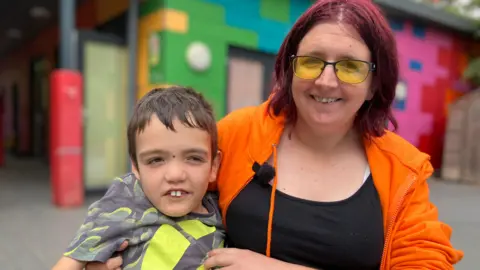
Eight-year-old Logan, from Chatteris, Cambridgeshire, has Larsen syndrome, a genetic condition affecting his muscles and joints. He has limited mobility and is also undergoing assessment for autism.
He requires daily physiotherapy, speech exercises and respiratory treatments, making his care a full-time commitment for his mother Laura, a single parent and a district nurse.
Laura says few holiday clubs are able to meet Logan's needs.
"I've been trying to contact a couple of them but I've had no success at all or they think he's too complex [needs] and don't want to take the responsibility of caring for him," she says.
During school holidays, Laura shares childcare with Logan's father, but says the demands of caring for him leave little time for herself.
"He's got serious separation anxiety so he won't be out of my sight, which is something we're working on. At any point when I'm at home I cannot do anything. I can't go from room to room. It's really tricky.
"And by the time he's eventually gone to sleep, I'm just knackered and end up falling asleep myself."
'It's heartbreaking to have to say no'
 Shariqua Ahmed/BBC
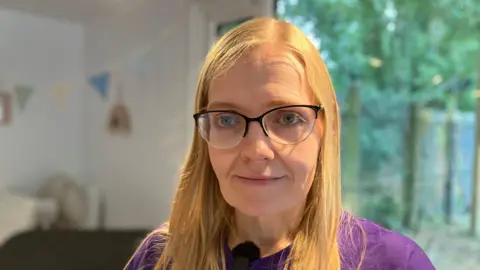
Little Miracles, a charity supporting SEND families across Cambridgeshire and Lincolnshire, is trying to help.
It runs outdoor trips and themed activities from 22 centres.
Founder Michelle King says demand is "extremely high", with about 4,000 families attending sessions since the start of August.
She says some activities are oversubscribed, with at least five children competing for every place.
More from Peterborough:
King, herself the mother of a 19-year-old with SEND, says children with complex disabilities often require specialist support that mainstream holiday clubs are unable to provide – and that a lack of support is having "huge impact" on parents' mental and physical health.
"It doesn't matter how many spaces we have, there is never enough," she says.
"It's heartbreaking to have to say no to someone and it keeps me awake at night thinking about families that can't get the support they deserve."
She adds that rising care costs are making the situation worse for families.
Sam, who attended an activity on Thursday, describes the sessions as a "lifeline".
"At Little Miracles, Alex wasn't looked at as if he was a child with needs, he was simply looked at like a child," she says.
"Usually people are a bit worried about him because he is in a constant seizure, or he doesn't quite look exactly like other children, he's not doing the same things as other children, but they [Little Miracles] saw past that. They just saw a child who wanted a fulfilled childhood."
Laura says the charity is now her "family". She and Logan travel 45 minutes each week to attend activities in Peterborough, which he "absolutely loves".
"There's nowhere else we can go," she adds.
"I feel comfortable and safe here. We don't feel judged and we can be ourselves, and it doesn't matter whether we're having a good day or a bad day – we all support each other."
 Shariqua Ahmed/BBC
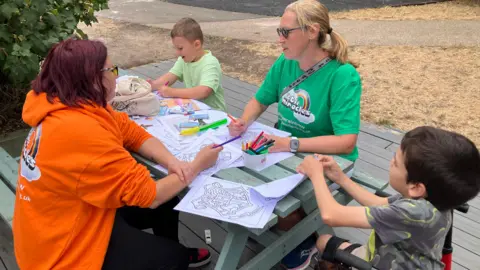
The Department for Education (DfE) funds the Holiday Activities and Food (HAF) programme, which provides free holiday sessions and a meal for eligible children and young people in Peterborough and Cambridgeshire during holidays.
Some children attending Little Miracles activities are supported through the scheme, although King says the charity also relies heavily on fundraising and donations.
But Sam says these clubs are not always accessible for children with complex needs who need one-to-one support, and that the activities may not be suited to neurodiversity.
"So whilst holiday clubs are very much welcomed, they need to be more accessible," she adds.
A DfE spokesperson says: "We're determined to rebuild opportunity for every child, regardless of background or need, to make sure childcare is available and affordable, particularly for disadvantaged children or those with additional needs."
Do you have a story suggestion for Peterborough? Contact us below.
Follow Peterborough news on BBC Sounds, Facebook, Instagram and X.
