Volunteers form human chain to restore white horse

 Martin Purslow
A white horse has been restored thanks to the efforts of 130 volunteers who scaled a hillside in soaring temperatures.
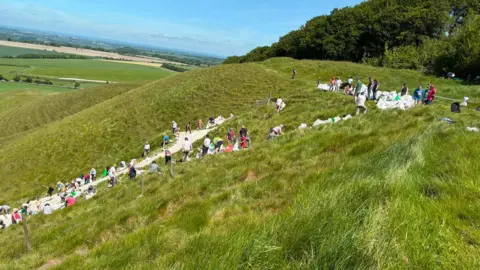
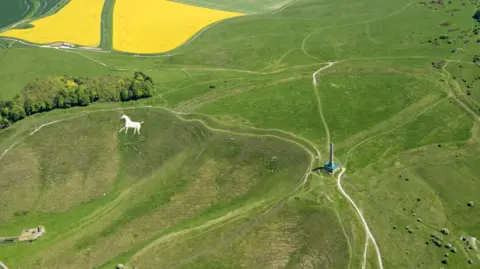
Volunteers reached the Cherhill White Horse, on the Cherhill Downs in Wiltshire, at 10:00 BST and weeded the area before they formed a human chain to pass down bags of chalk.
Edward, from the Cherhill Scout Group, helped with both aspects of the restoration project. The 12-year-old said he was "exhausted" but it was "worth it" to see the end result of a "new and shiny" horse.
He added: "It makes everything look a tad bit nicer so people can just generally be happier."
Dave Grafton, chair of Cherhill Parish Council, thanked people who gave up their time in the hot weather.
Explaining the rechalking process, he added: "We got mechanical equipment to bring the chalk on pallets to the top of the horse and then it is manhandled down - almost in a crocodile fashion - from one person to another."
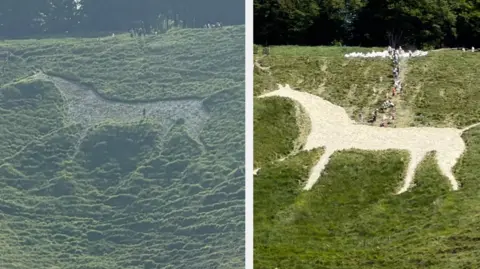
Martin Purslow, a volunteer from Cherhill Parish Council, said that due to a wet winter and damp spring, the horse looked "dreadful" before the clean-up.
He added: "It was full of weeds. You couldn't really see the head, legs or tail so it looked like a blob."
 Getty Images
Some volunteers visited the Black Horse Pub at the foot of the hillside to view the new and improved horse after a day of tidying it up.
"It was really nice to look up at it looking so much better," Purslow added. "It was a lot of effort and a lot of teamwork.
"I've been doing this for eight years and today there were more people than I've ever seen. There were people from all over Wiltshire and as far as Reading, it was a really good turnout."
 Greg Stoner
It is thought 13 white horses once existed in Wiltshire, with only eight visible today.
Their origins remain a mystery, but one theory suggests they commemorate Alfred the Great's triumph at the Battle of Ethandun - which took place in Wiltshire - in 878.
Other historians have suggested the chalk structures may have demonstrated loyalty to the House of Hanover, of which the historic emblem is a white horse.
Follow BBC Wiltshire on Facebook, X and Instagram. Send your story ideas to us on email or via WhatsApp on 0800 313 4630.
