Pompoms to Alexander McQueen: 10 years of Valley girls in fashion spotlight

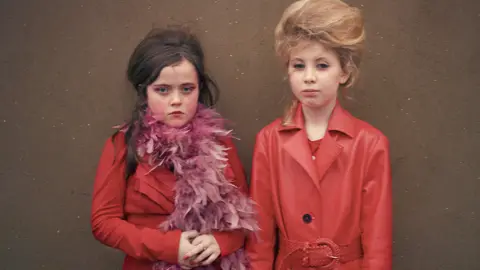 Charlotte James and Clémentine Schneidermann
Standing on top of a cold mountain in thin clothes with just one hot water bottle between two to keep warm while on a photo shoot, a young Nia Day discovered the less glamorous side of the fashion industry.
"This is an eye opener" were the Merthyr girl's words to describe it. But the cold is the least of it when she explains the people at the shoot were from legendary fashion house Alexander McQueen.
How did one of the leading couture brands end up on a photoshoot with local children on a south Wales mountain?
It is all thanks to a project started a decade ago by two artists who wanted to show young people in the Valleys that the world of fashion, photography and the arts was one they could be part of too.
Now, a 10th anniversary retrospective of the project, Ffasiwn, is opening at National Museum Cardiff, celebrating the achievements of Charlotte James and Clémentine Schneidermann and their young participants.
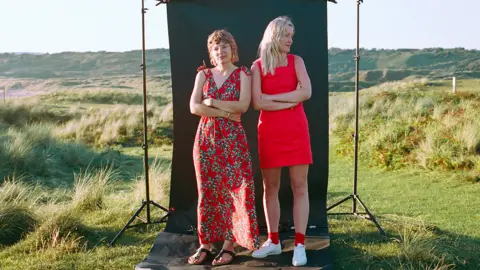 Charlotte James and Clémentine Schneidermann
Clémentine, a French documentary photographer, explains the genesis of the project came when she moved to Abertillery, Blaenau Gwent, after being commissioned to do an art project in 2015.
She met a youth worker who put her in touch with a youth group and, crucially, a fashion editor in London, where Charlotte was working, connected the two of them.
Charlotte, from Merthyr Tydfil, had also been working on a photography project at the time.
She arrived on the first day with her mum and best friend and, from there, "we built a small community of friends and collaborators", Clémentine explains.
"I couldn't believe she was living in Abertillery," quips Charlotte.
Via the youth group, they worked with a group of girls in Blaina to stage a fashion photoshoot.
It was supposed to be a one-off.
But Clémentine said: "A three-month residency grew to a 10-year project.
"The first shoot was very important for us because it's the first time we saw the potential of starting a process and working with young people.
"We thought it would be a good idea to continue working with young people."
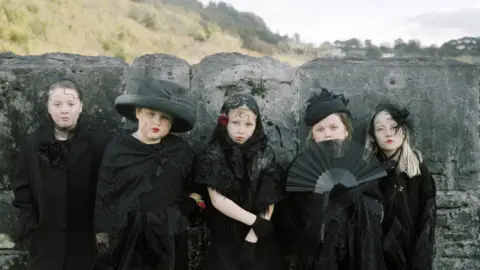 Charlotte James and Clémentine Schneidermann
As well as the Blaenau Gwent base, they contacted a youth project in Merthyr and began working with the Gellideg Foundation to deliver workshops to young people to show them how to design clothes, sew and cut.
Each workshop - based around a colour - was followed by a photoshoot.
Clémentine explains: "The first one was all in black. We photographed around Halloween time. Then we did red for Valentine's, we did green around spring."
It was during the first shoot that the name for what would become the ongoing project emerged.
The girls were dressed in their black finery and a passing group of lads made comments about "going to a funeral" to which one response was along the lines of: "I'll be going to yours."
But another retorted: "It's called fashion. Look it up."
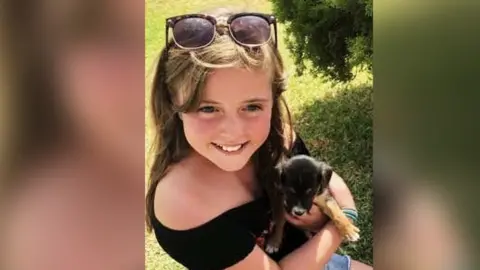 Nia Day
For Nia, then aged eight, a project like this was right up her street.
"When you're in school and they ask you what your dream job was, mine was to own a fashion shop where I make my own clothes."
The only problem was she missed the photoshoot because of a holiday.
It didn't stop her.
She texted Charlotte and begged to join: "I was eight and I was like 'right, this can get me my future'."
The first one she took part in was the green shoot.
Charlotte explains that, after the initial black shoot, designer Emma Brewin had seen some of the photos and got in touch asking if she could photograph the girls in green to tie in with her pistachio collection.
But the artists didn't want the girls just to be passive subjects - the deal was they would take part if the designer came and ran a workshop with them so they could learn skills at the same time.
Nia, now 19, remembers: "The green fur had been worn on big celebrities and music videos and Charlotte was like 'I thought it would be amazing for you to be in what celebrities have worn', to show us that we were literally all the same as everyone else."
 Charlotte James and Clémentine Schneidermann
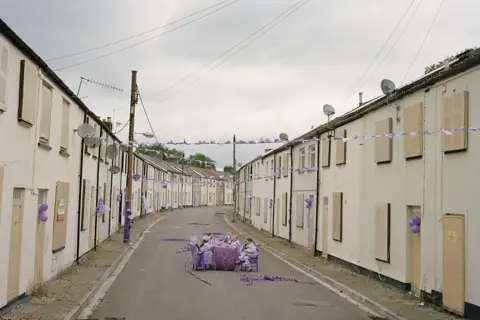
They began by making pompoms, but as they got older they learned how to use sewing machines and made their own clothes and hats for the shoots.
"We got involved with everything, photography, the lot," says Nia.
"If we wanted to try it, they were like 'do it. Try it.' It was so amazing to not be like 'oh you can't touch that camera, you can't touch that'."
The artists might come up with an initial idea but the girls (and occasionally a few boys) would guide the themes, colours and decorations.
Sometimes they would turn the camera on other people.
"We'd do photoshoots out in public where we'd stop random people who we thought looked cool, or random people who were wearing purple, and we'd go up to them," Nia said.
"We had so much confidence [from the artists] we'd ask 'can we have photos? Can we have a photo with you'?"
The scale of the artists' work expanded as the years went on and the children turned into young women.
Clémentine said: "We had a big exhibition in Bristol at the Martin Parr foundation. We did a collaboration with Alexander McQueen in 2020, with [then-creative director] Sarah Burton."
Nia said some shoots had a quick turnaround time, gathering materials from charity shops one day, making outfits the next and shooting the day after.
Others, like the collaboration with McQueen, ran for weeks.
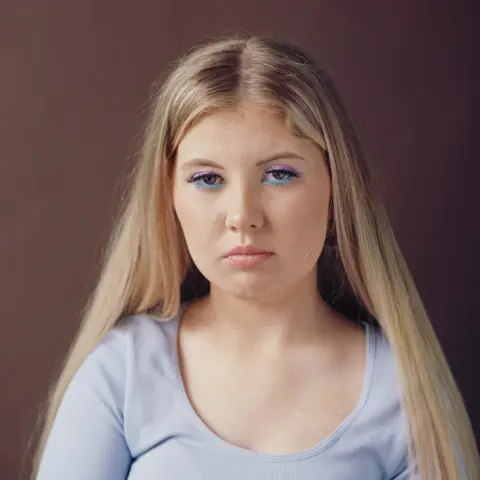
The girls were given dresses but then could adapt and add to them as they wished and did sewing and embroidery workshops with professionals.
Remembering the mountaintop location, Nia said: "It was so cold on the shoot. They were like 'this is the side you lot don't see'. Charlotte and Clémentine do it in the summer, but this was winter.
"They were like 'here's a hot water bottle, one between two. We were like, this is an eye-opener.
"But since that shoot it made me think if we can do a shoot with McQueen then we can go bigger and bigger, and it's just been driving me since. I just want to keep going."
 Charlotte James and Clémentine Schneidermann
Encouraged by Charlotte to think about studying fashion in the longer term, she switched one of her GCSE choices to art, where a teacher who saw her work on a complete papier mache dress told her: "You've got a talent for this so do it."
Nia put off the decision for a couple of years, initially studying childcare but realised her heart was elsewhere.
Receiving the invitation to the exhibition's opening was the kickstart she needed.
She applied for a fashion course the same day and will start a two-year college course in the autumn, then hopes to go to university.
Clémentine said of the participants: "I think it really gave them the opportunity to see the fashion industry from a very original angle.
"Unfortunately, fashion and photography are very difficult industries to get into. Now it's very expensive to study fashion and the fact that we provided free workshops open to everyone opened them up to it.
"They had the opportunity to work with Alexander McQueen and Martin Parr. It was pretty special the opportunity to work with these people and I hope it stays with them all their lives."
For Charlotte, one of the notable things with the opening of the exhibition is how it changes those more typically shown within the museum's walls.
"How many working class women were otherwise featured in places like this?
"And look how many are on the walls now."
- Ffashiwn runs at National Museum Cardiff from 23 May 2026 until April 2027
