Israel and Lebanon sign framework agreement after US-brokered talks

 Getty Images
Israel and Lebanon have signed a framework agreement in Washington after several days of negotiations brokered by the US.
US Secretary of State Marco Rubio said the agreement will begin to put in place a framework for lasting peace and security.
It comes as limited fighting has continued between Israeli forces and the Iranian-backed Hezbollah in southern Lebanon, despite an existing ceasefire.
Hezbollah is not party to Friday's agreement, and it is unclear whether it will agree to withdraw its fighters from the South Litani area in southern Lebanon.
Washington has feared that ongoing tension between Israel and Hezbollah could undermine its peace deal with Iran, which includes a commitment to end fighting on "all fronts", including Lebanon.
In the 14-point framework agreement, Israel and Lebanon both "affirm" the right of each state to "live in peace", and express "mutual desire to live in security as neighboring sovereign states".
It makes specific note to a "cessation of all hostile or adverse actions in international political or legal fora" between Israel and Lebanon, with both nations pledging to work towards the release of detainees, as well as the return of any remains.
However, both governments acknowledge that "nothing in this Framework prevents them from exercising their inherent right to defend themselves".
The agreement says that the Lebanese Armed Forces (LAF) will restore effective sovereign authority over all Lebanese territory, "pending the verified disarmament of non-state armed groups and dismantlement of associated infrastructure".
In order to achieve this, Lebanon makes a specific request for the support of international and "particularly Arab partners, under the leadership of the US".
A US-supported military coordination group will also be established to help implement the framework.
From a diplomatic perspective, the signing of some kind of an agreement is a step forward, but the situation on the ground in Lebanon has shown little sign of shifting, despite several ceasefires.
Israel and Hezbollah have traded cross-border fire, with both accusing each other of violating the agreement, but the intensity has dropped off in recent days.
Lebanon's President Joseph Aoun said the framework was a first step to restoring sovereignty.
But shortly after the signing, Israeli Prime Minister Benjamin Netanyahu reiterated that Israeli forces would remain in southern Lebanon until Hezbollah disarms. The Israeli army is currently occupying around 5% of the country's territory.
He said Israel was "allowing the Lebanese army to begin organising to take over some territory" in two pilot zones - one south of the Litani River and another north of it.
Israeli strikes on targets in southern Lebanon have threatened to derail efforts to settle the conflict in the Middle East.
US President Donald Trump on one occasion held a terse phone call with Netanyahu, in which he reportedly uttered an expletive. He also publicly criticized Netanyahu and Israel's conduct in the conflict.
While Trump has insisted that Israel has a right to defend itself from Hezbollah rocket strikes on its territories, he has also claimed he can "control Israel from attacking Lebanon".
"They have a lot of respect for me," Trump told Axios in an interview last week. "They do as I say."
In the final point of the framework agreement signed on Friday, both Israel and Lebanon acknowledge role of the US in supporting their efforts to bring "comprehensive peace" between the two nations, and express "deep appreciation for the vision and leadership of President Donald J. Trump".
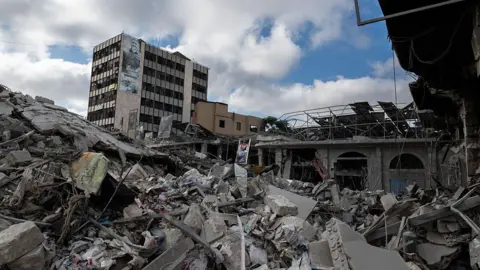
Israeli attacks in Lebanon have killed at least 4,192 people since the current round of hostilities began, according to the Lebanese health ministry. More than 11,600 have been injured, and more than 1.2 million people have also been displaced, Lebanese authorities say.
Israeli authorities say 36 Israeli soldiers and four civilians have been killed on both sides of the border during the conflict.
Lebanon was drawn into the war between the US and Israel against Iran on 2 March, when Hezbollah launched rockets into Israel in retaliation for an Israeli strike that killed Iran's supreme leader. Israel responded with an air campaign across Lebanon and a ground invasion in the south.
A US-brokered ceasefire between Israel and Lebanon on 16 April failed to stop the fighting.
Israel and Lebanon agreed in June to renew their fragile ceasefire, and the US said it would help guide the creation of "pilot zones in which the Lebanese Armed Forces will take exclusive control of the territory to the exclusion of all non-state actors".
Earlier on Friday, Trump accused Iran of a "foolish violation" of the truce after a cargo ship passing through the Strait of Hormuz was attacked. Iran has not issued any official response.
In response, US Central Command said later on Friday it had struck missile and drone storage facilities and coastal radar positions.
There has been no comment yet from Iran.
Additional reporting by Ghoncheh Habibiazad and Tabby Wilson
