Capybara sighting confirmed as Samba hunt continues

 Marwell Zoo
A missing capybara has been spotted five months after it escaped from a zoo.
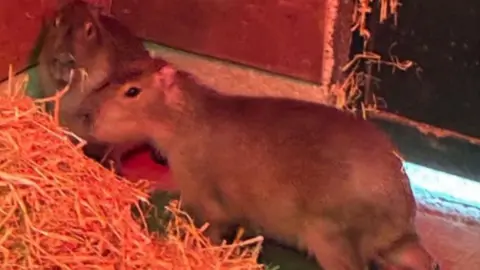
Marwell Zoo, near Winchester in Hampshire, said it is still searching for one-year-old Samba, who attracted global interest after she went on the run in March.
The zoo confirmed that the animal was spotted by a member of the public on 11 August who managed to take a photograph of Samba.
Marwell called it a "promising lead" in the ongoing search but said it was not able to share any further updates.
Samba escaped from the zoo on 17 March, less than a day after arriving. She broke out of a temporary enclosure she shared with her sister, Tango, who was quickly recaptured.
Tango remained at the zoo alone until July, when keepers introduced a male capybara named Ripple.
Samba, however, has stayed on the run and is considered the more adventurous of the pair.
In the four months since her escape, the young capybara has been reported at several locations, including near a pub and sunning herself on a riverbank.
Search teams were deployed to the Brambridge area on 6 July after a fisherman reported a credible sighting.
Despite extensive efforts using thermal-imaging drones and a specialist sniffer dog, Samba has so far avoided being caught.
What are capybaras?
 Marwell Wildlife
Originally from South America, capybaras are the world's largest rodents, with stocky bodies, short legs and partially webbed feet.
They spend much of their time in and around rivers, lakes and marshes, feeding on plants and using water as a refuge from danger. When alarmed, they can slip beneath the surface and hold their breath for up to five minutes.
The zoo has appealed for anyone who spots Samba to take a picture and share it, along with the exact location, to help with efforts to track her down.
