UK-first surgery reaches brain via eye socket

 PA Media
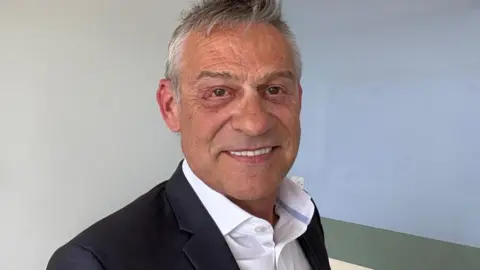
A grandfather avoided major brain surgery after experts performed an operation, believed to be a UK-first, which reached his brain through his eye socket.
Andrew Wood, 61, said he was "shocked" to learn he had a potentially life-threatening bulge in a blood vessel, which was discovered during scans for a separate medical issue.
Such cases are usually treated by removing part of the skull and moving sections of the brain to access the problem.
Consultant neurosurgeon Asim Sheikh said operating through the eye socket allowed direct access. "This meant we could get to the aneurysm without even having to touch the brain," he said.
The procedure, performed by specialists at Leeds Teaching Hospitals NHS Trust, built on earlier work by the same team, who removed a brain tumour via the eye socket in 2024.
 PA Media
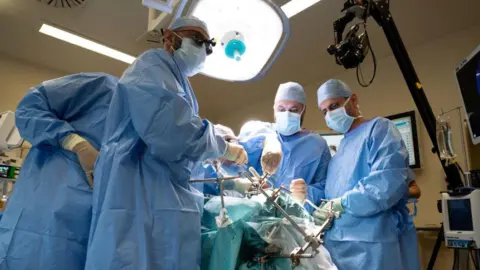
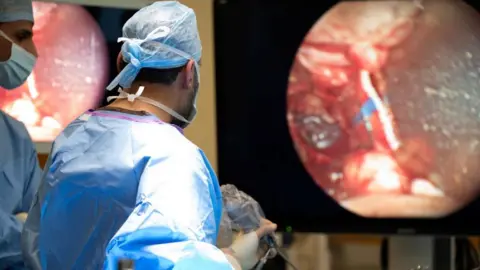
Surgeons made a small incision at the side of Wood's eye and an opening in the outer wall of the socket, which allowed them to place a metal clip across the aneurysm to prevent it from rupturing.
Wood, from Wakefield, spent just one night in hospital, compared with around a week for conventional surgery, and returned to his job as a builder within weeks.
"I didn't have any symptoms whatsoever," he said. "The way it was explained to me was you can do something causing minimum damage and get the same result. I thought it was great."
 PA Media
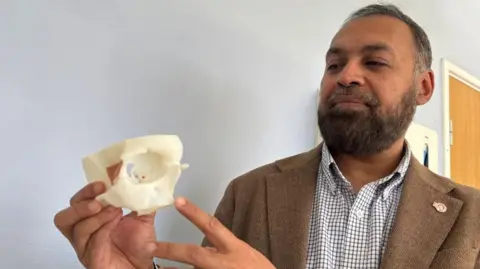
To prepare, engineers created a 3D-printed model of Mr Wood's skull and aneurysm, allowing surgeons to rehearse the procedure in advance. Custom-made retractors were also produced to protect the eye during surgery.
Sheikh described the approach as "a significant step forward" in minimally invasive brain surgery, reducing the need for large incisions and lowering the risks associated with moving or operating on the brain.
Consultant maxillofacial surgeon Jiten Parmar said the case demonstrated the benefits of collaboration across specialisms. "Most importantly, we achieved a brilliant result for the patient, who went home the next day." he said.
 PA Media
Mr Wood, said: "It has been perfect since, no pain, no double vision, and I'm back at work."
"Thanks to the skill of the surgical team, I've been given a second chance," he added.
"I'm proud to have been part of such an important procedure and I'm amazed at how quickly I recovered and returned home."
Listen to highlights from West Yorkshire on BBC Sounds, catch up with the latest episode of Look North.
